Short answer
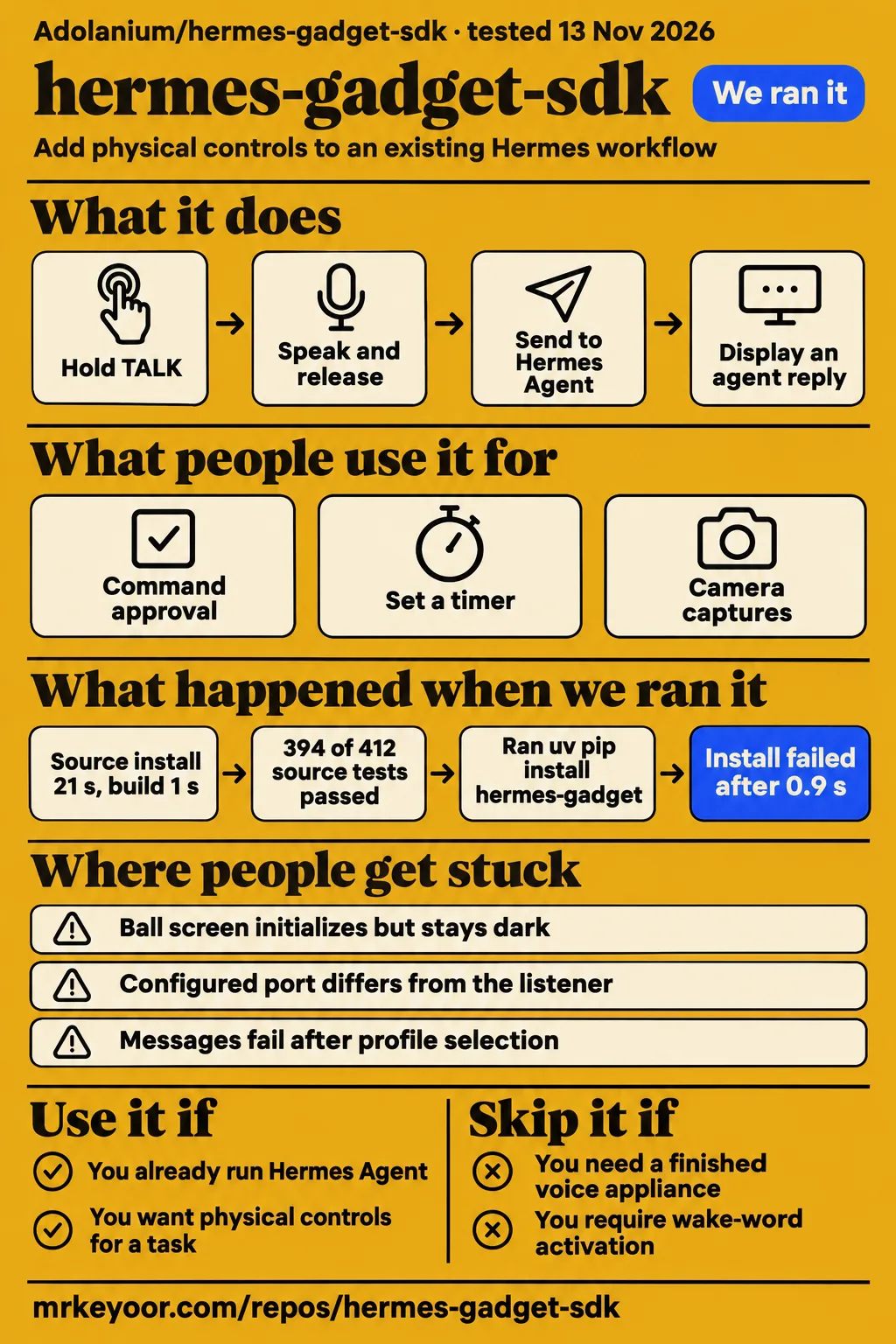
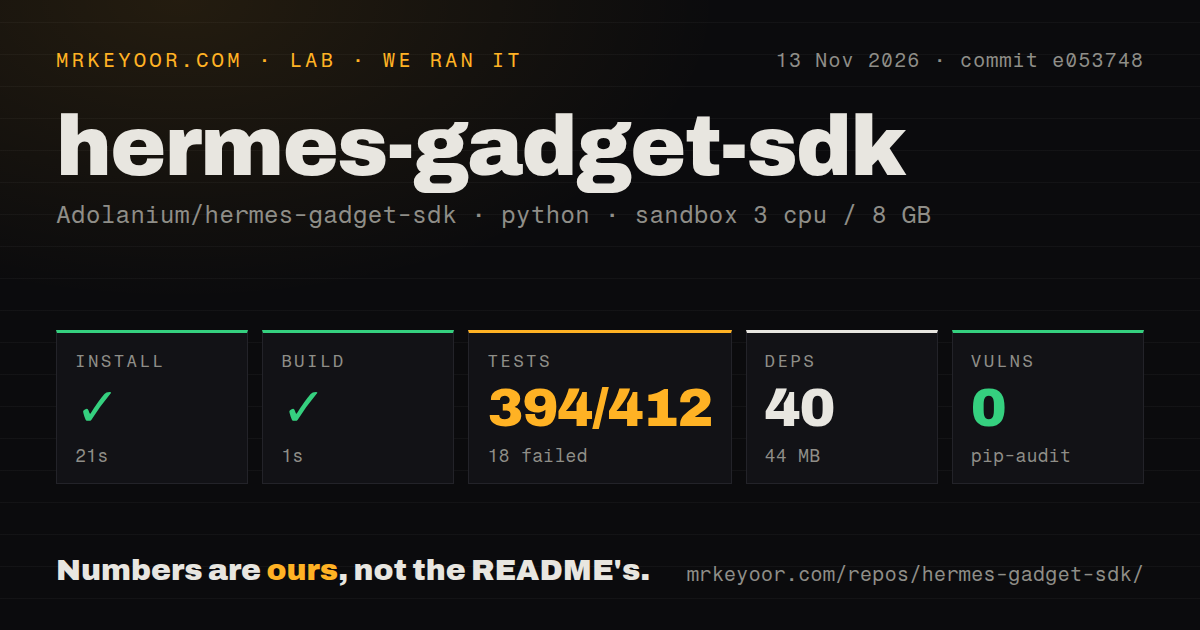
Our sandbox installed Hermes Gadget SDK in 21 seconds and built it in 1 second, but its test command failed with 18 failures. Use it if you already run Hermes Agent and have a recurring task that would benefit from a physical button, screen or sensor. Skip it if you need a finished voice appliance or require a passing simulator suite before adopting an SDK. The recorded failure tail repeatedly names a missing native simulator library.
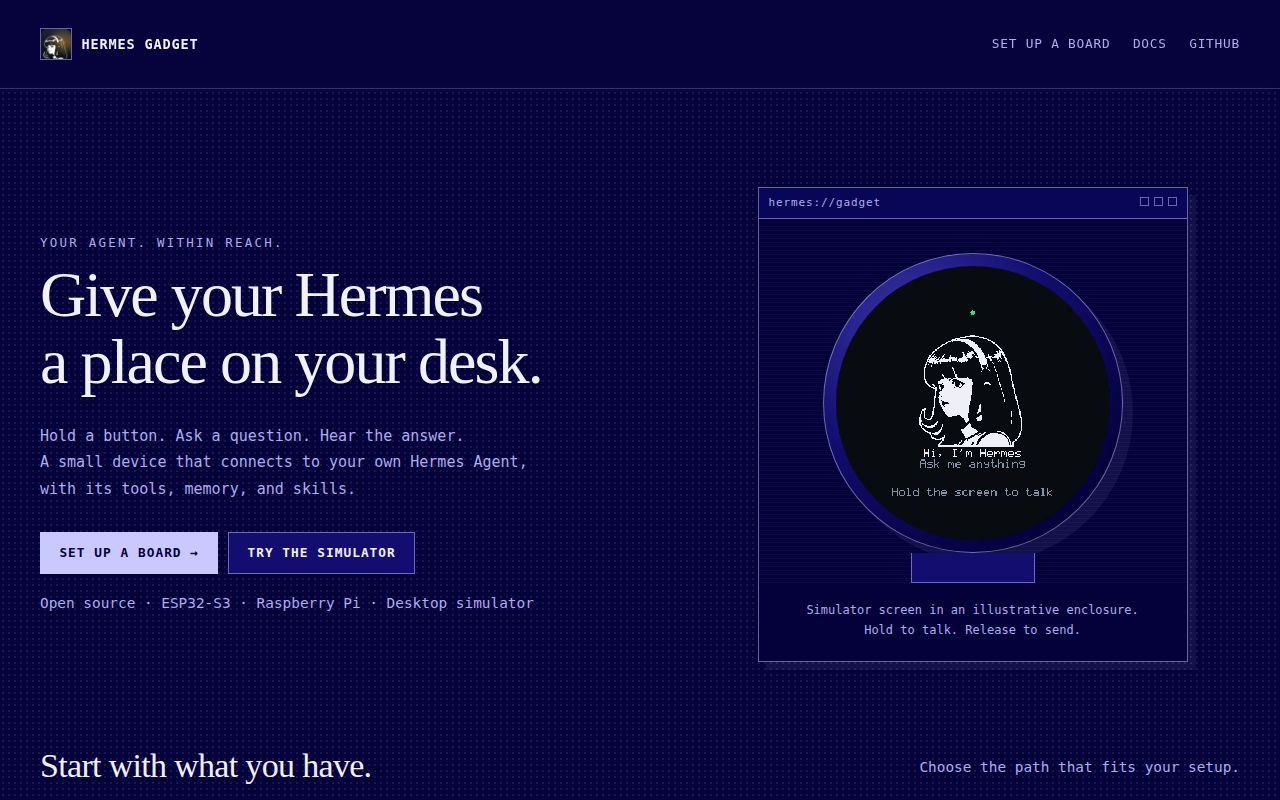
Hermes Gadget is an independent community project, separate from Nous Research. The Hermes Gadget README describes ESP32-S3 firmware, Raspberry Pi 4/5 support and a desktop simulator sharing the device core. Real conversations need Hermes Agent and the Gadget plugin. Voice also needs speech recognition and text-to-speech configured in Hermes. The documented interaction is to hold TALK, speak and release it to send; the README says wake-word activation is not included.
What people use hermes-gadget-sdk for
Contributors report approval prompts, timers and camera captures on named boards, giving builders specific interactions to compare before choosing hardware. These accounts answer a more useful question than whether an ESP32 can display an agent reply: what would you actually use its controls for? The reports below identify the builder, the device and the reported outcome, rather than treating every available board profile as an equivalent experience.
| Builder | Use case | Reported outcome |
|---|---|---|
| Adolan | Ported Hermes to a Miyoo Mini Plus | No built-in microphone and painfully slow typing. Miyoo Mini Plus report |
| Moghal Saif | Tried Hermes Gadget and Muse Gadgets on a StickS3 | Preferred Hermes's builder freedom while describing Muse as more polished. StickS3 comparison |
| Slaventuss | Ported the SDK to an ESP32-S3 ball | Reported working cards, yes/no prompts, OTA rollback and Cyrillic rendering. Ball port report |
| momoshamiko | Used a Waveshare AMOLED-1.75 with covered buttons | Manually checked a resting clock, face-down sleep and an agent-set timer. Round-panel report |
| james-see | Exercised CoreS3 camera.capture | Reported an upright, correctly coloured 640×480 PNG. CoreS3 camera report |
The covered buttons in momoshamiko's case explain the interface work: touch and sensors carried the interaction. The contributor checked the resting clock, face-down sleep and a timer set by Hermes with its alarm. The supplied synthesis records the clock, timers, face-down sleep and edge ring landing, while the pull-down panel was held back. That distinction matters when comparing a contributor's demonstrated interface with the features subsequently accepted into the project.
Adolan's handheld experiment supplies a different buying lesson. The port worked, but its author described slow typing and a missing microphone. Choose the input around the intended task: a spoken question, a readable command approval and a timer demand different controls. A board photograph shows its shape and display; the contributor's account tells you how the interaction felt. Start with the task you expect to repeat, then compare the available hardware against it.
What happened when we ran it
Our November 13, 2026 run at commit e053748 completed installation and a build command, then failed its test command after 25 seconds. We measured these checkout results in a sandbox configured with 3 CPUs, 8 GB RAM and image ghcr.io/astral-sh/uv:python3.12-bookworm. The checkout contained 555 files, approximately 106,943 source lines and occupied 6.8 MB. The repository scan found four CI workflows, a tests directory and no Dockerfile.
| Question | Answer | Verdict | Why |
|---|---|---|---|
| Did checkout installation complete? | Yes, in 21 seconds; 40 dependencies and 44 MB on disk. | Passed | The recorded installation step returned success. |
| Did the build command complete? | Yes, in 1 second. | Passed | The recorded build step returned success. |
| Did the test command pass? | No; exit 1 after 25 seconds, with 394 passed, 18 failed and 301 skipped. | Failed | The failure tail repeatedly reports a missing simulator library. |
| What did pip-audit report? | 0 known vulnerabilities; 39 packages scanned and one skipped. | Scan completed | The result describes the scanned dependency set. |
| Did the separate registry installation complete? | No; uv pip install hermes-gadget exited 1 after 0.9 seconds. | Failed | The recorded error says hermes-gadget was absent from the package registry. |
The failure tail names battery_mv inputs true, 3750.5, -1 and 65536; battery_percent inputs false, -1 and 101; and battery_pct set to 50. It also names screen-sleep cases for holding a card until wake, sleeping face down and resting on a clock. Each listed case stopped with SimLibraryError and a missing-simulator-library message. The README checkout instructions include hermes-gadget build-sim --test before starting the demo server.
The separate registry probe cloned in 1 second, then failed installation after 0.9 seconds in an environment reporting Python 3.12.12. Its summary identifies commit e05374828e37 and a container configured with 2 CPUs, 4 GB RAM, no published ports and no secrets. That summary also says installation succeeded from PyPI, contradicting the failed installation step and explicit registry error. Teardown returned ok. Clone record, installation record, failure finding, run summary and teardown record preserve those separate observations.
Where people get stuck: plugin scope, ports and profiles
The connection guide requires Hermes Agent 0.21.6 or newer and directs installation to the plugin subdirectory. Hermes scans the supplied installation scope; the repository root includes a privileged Raspberry Pi installer and receives a refusal even with --force. The documented path installs the plugin, runs gateway setup and restarts the gateway. The guide also distinguishes installation from main from a release-pinned command used to match firmware. Connection and installation guide
| Symptom | Documented action or reported change | Source |
|---|---|---|
| Ball screen initializes but stays dark | Backlight inversion support lets an active-low board opt in. | Ball integration issue #63 |
| Cron rejects gadget as a delivery target | The synthesis records cron registration support merging in #66. | Cron delivery report |
| Configured port differs from the listener | Restart the whole gateway and update the device address. | Port-change instructions |
| Secondary-profile messages fail after selection | The dated report describes coordinated local core and plugin changes. | Profile admission issue |
The profile report names Hermes v0.22.5 and Gadget v0.3.0. Selecting a secondary profile succeeded, but the next ordinary message raised profile_mismatch; the default profile worked. The report describes admission failing closed and calls the result a functional integration failure. Its local patch reportedly restored an actual StopWatch conversation after switching. A selector accepting a profile and the agent accepting a subsequent message are therefore two separate outcomes. Dated profile report
Long replies exposed different audio failures
Issue #73 records five long replies playing cleanly on a Waveshare 1.85C V2 after fixes #75 and #80. The supplied synthesis attributes the original white-noise problem to partial audio-sample drops and display stalls, and describes the fixes as preserving whole samples and removing display-related stalls. The final contributor check reported no playback-buffer or event-queue warnings. Those are the supported before-and-after outcomes for that thread. White-noise issue #73
Issue #126 describes a different path: an AMOLED-1.75C reaching its gateway through Tailscale Funnel. The initial report recorded 68 buffer drops at -88 dBm and no drops in two replies at -58 dBm, while choppiness continued. Later synthesis distinguishes underruns from overflow and reports that a longer lead reduced the worst gap from 136 to 56 ms and total gaps from 304 to 196 ms. Tunnel audio report
The v0.5.0 release documents a speaker-buffer announcement, caps.speaker.buffer_ms: about 4 seconds on codec boards with PSRAM and 1.5 seconds on I2S boards. It says a hub reading that value can send audio further ahead. Separately, CoreS3 issue #289 describes quiet replies even when the user volume setting exceeded 100; the synthesis records a before-and-after hearing check and a driver change merged in #290. Buffer-announcement release notes and CoreS3 loudness report concern different mechanisms.
Pairing and transport have separate settings
The marketplace says the gateway listens on WebSocket port 8765 at /gadget, on all interfaces by default, using plain ws:// unless TLS is configured. Its settings include host, tls_cert and tls_key, followed by a gateway restart. A new device normally requires pairing approval; GADGET_ALLOW_ALL_USERS skips pairing and is intended for development. These defaults give an operator concrete network and access settings to review before connecting a device. Marketplace network disclosure
A paired gadget can answer a dangerous-command prompt for its own chat as allow once or deny. A command too long to fit one screen line can only be denied on the device and requires host approval. Camera captures are retained indefinitely under ~/.hermes/gadgetpix/ until manually deleted. The marketplace also says the plugin has no telemetry, while speech recognition and synthesis use the services configured in Hermes, which may be cloud services. Marketplace storage and approval disclosure
Board reports and editorial ratings
Issue #98 distinguishes an available AIPI Lite firmware image from a physical report for the release revision. The synthesis records an image in v0.3.0 and a request to run the checklist against that release build; earlier audio results came from an older contributor branch. Bruno Orlandi separately reported 14 merged contributions, with most work tested on a Waveshare AMOLED-2.06 watch. Keep the board and revision beside each result when comparing hardware. AIPI Lite report request and Orlandi's contribution report
Documentation receives 4/5 and community receives 3/5 as editorial judgments. The rubric uses 1 for an obstructed documented path, 3 for useful support with material boundaries, 4 for concrete instructions addressing several observed problems, and 5 for broad corroboration within the category. Separate setup paths, explicit service requirements and plugin-scope and port-change instructions support the documentation score. Named builders and maintainer follow-through support the community score. These scores assess the supplied material, rather than counting users or successful deployments.
hermes-gadget-sdk vs Muse Gadgets and phone apps
Moghal Saif preferred Hermes's builder freedom after trying both SDKs on a StickS3, while describing Muse as more polished. His account provides a same-device comparison of his preferences. Jonathan Vitela's reply raises a different purchase question: whether a dedicated gadget will stay useful after setup. The comparison below keeps those opinions attached to their authors and separates them from Gadget's documented requirement for an existing Hermes Agent.
| Option | Reason to consider it | Evidence |
|---|---|---|
| Hermes Gadget | Add physical controls to an existing Hermes workflow | Gadget README and Saif's attributed builder preference |
| Muse Gadgets | Give greater weight to the polish Saif reported | Saif's comparison also describes ecosystem dependence and geographic restrictions |
| Native phone apps | Continue an agent workflow on a phone | Vitela described phone apps as more efficient in his opinion |
| Hermes Agent directly | Choose a recurring agent task before adding hardware | Gadget's README requires Hermes Agent for real conversations |
Saif valued control over the agent behind the device; Vitela questioned whether the hardware would become an unused setup project. Neither preference decides the purchase for every reader. Pick a task such as a timer, spoken question or command approval, then compare the proposed device interaction with how you already perform it. Saif's comparison and Vitela's reply supply the opinions; the Gadget README supplies the agent dependency.
What the other reviews get wrong
The supplied older catalog labels the plugin 0.2.0, while the newer marketplace labels it 0.5.0. These examples are official documentation and issue summaries rather than independent reviews. The version difference makes the older label stale relative to the newer page; it does not prove the older page was inaccurate when published. Match installation and removal instructions to the documented revision. Older plugin catalog and newer marketplace
The older catalog's storage description is incomplete for the newer plugin because removing plugin-data/gadget alone leaves the separately stored camera captures. Issue summaries also need later release context: issue #208 discusses text hiding talking faces, while v0.5.0 describes a talking face with the latest two caption lines on sufficiently large panels. The listed smaller panels retain text from the start. Face discussion and released display behaviour describe different stages of that work.
FAQ
A contributor manually checked an agent-set timer, resting clock and face-down sleep on a Waveshare AMOLED-1.75, giving a concrete answer to the everyday-usefulness question. The supplied questions also cover buying hardware in Ghana, audio pacing, profile policy, tunnel certificates and camera implementation. Their answers come from contributor reports and documentation, with unresolved testing boundaries collected in the final section.
Is a dedicated Hermes gadget useful beyond the initial setup project?
momoshamiko reported checking a timer, resting clock and face-down sleep on the AMOLED-1.75. Those interactions give a prospective buyer tasks to compare with a phone. Vitela's usefulness question asks whether the device will earn repeated use after setup. Choose the task first, then choose controls and hardware around it. Timer and interface report and reader's usefulness question
Where can I buy the hardware in Ghana?
The supplied Instagram material records a Ghana buying question. The README directs board owners to its supported-hardware and browser-installation paths, with Chrome or Edge, a USB data cable and 2.4 GHz Wi-Fi among the requirements. Use the exact board model when asking a supplier about shipping and returns; similarly named panels can represent different profiles. Ghana buying question and README setup requirements
Can reply audio be paced using the device's buffer instead of a fixed half-second lead?
The v0.5.0 release documents devices announcing their speaker-buffer duration through caps.speaker.buffer_ms. Issue #126 also records a longer-lead experiment that reduced gaps over its Tailscale Funnel path. These sources support describing buffer announcements and that attributed experiment, with the issue's overflow and underrun findings kept separate. Buffer-announcement release notes and longer-lead experiment
Should switching Hermes profiles be disabled until explicitly enabled?
The current marketplace describes profile switching as opt-in through the profiles setting in the default profile's platform configuration. It also describes pairing approval within each selected profile and returning a device to the default profile when its default-profile approval is revoked. This documented policy answers the proposal's default-access question. Profile-switching proposal and marketplace pairing policy
Is there a release containing the Cloudflare quick-tunnel certificate fix?
The supplied synthesis records PR #139 addressing certificate-chain handling after firmware v0.2.0 failed against Cloudflare quick tunnels. It also records the reporter using a Let's Encrypt endpoint through Caddy as a working route. The maintainer's stated basis for closing the issue was reasoning about the fix. Certificate issue and maintainer response
Should CoreS3 camera support use esp32-camera or a native SDK capture implementation?
The supplied camera report establishes a working gateway capture outcome: an upright, correctly coloured 640×480 PNG, followed by repeat captures reported at about a second. Its proposal asks about the camera implementation choice. The useful adoption evidence is the capture result together with the later camera and proximity-sensor failure described below. CoreS3 camera proposal and reported outcomes
What we have not tested yet
Our checkout run covered installation, a build command and the suite; it included no physical board, live voice conversation, OTA recovery or sustained daily use. It supplies no device-latency, battery-life or audio-quality benchmark. Its summary appends "of 412" to 394 passed, 18 failed and 301 skipped, so this review reports the categories without a pass percentage. The configured image label does not identify actual runtime versions, and the supplied failure tail does not explain the missing simulator artifact after the successful build command or demonstrate incorrect hardware behaviour.
Contributor checks have specific boundaries. AIPI Lite's current-release checklist remains requested. The ball backlight change lacks the requested brightness, timeout and wake checks. CoreS3 loudness was a hearing comparison on one unit, without measured levels or extended full-volume battery playback. The clean 1.85C V2 playback result covers that contributor's board; the longer-lead experiment used two replies per condition with a better link that day. The supplied release extract establishes buffer announcements, without the exact half-buffer pacing formula, bounds or fallback previously attributed to it. AIPI Lite, ball backlight, speaker check and tunnel experiment
The Cloudflare quick-tunnel case lacks a device retest on 0.4.1. The Hermes v0.22.5/Gadget v0.3.0 profile report describes local success pending upstream review and releases, rather than a tested current version matrix. CoreS3 camera evidence includes successful captures followed by the camera and proximity sensor disappearing from I2C after uptime, with camera.capture reporting "Detected camera not supported" / 0x106. The supplied extract ends during diagnosis without a completed repair or support for the camera PR and dependency-version assertions removed from the FAQ. TLS retest boundary, dated profile report and camera follow-up
The supplied material contains no usable video transcripts or lab screenshot records and does not resolve usefulness over months. It supplies no Ghana seller or delivery option. Rendered layout, assets, automatic related links, recommendation modules and template content are outside this text assessment. Setup ease and sustained maturity remain unassessed. Before choosing a board, seek a report for its exact revision and your intended interaction: a spoken turn, readable approval or repeat camera captures after uptime.