Sixty projects trade consistency for range
The main README lists 60 projects: 35 agents, 11 RAG applications, 4 OCR tools, 3 audio projects, 6 multimodal examples, and 1 fine-tuning project. Subjects range from a local research assistant to financial analysis, document extraction, email replies, and medical workflows. This is a catalogue of separate applications, each with its own dependencies and provider choices. There is no shared SDK or one command that turns the whole repository into a service.
That breadth is handy when you want to see how another developer wired a narrow idea. The README points to projects using OpenAI, Anthropic, Google, Mistral, Ollama, and other services. Some are local, while others need paid APIs, scraping tools, market feeds, email credentials, or messaging accounts. Read the selected folder as an independent code sample. A successful setup in one folder says little about the next.
The OCR example exposes 2 schemas through Streamlit
The measured image_to_structured_data folder accepts product or invoice images through a Streamlit page and returns one of 2 Pydantic collection schemas. Pillow resizes an uploaded image to at most 2,048 by 2,048 pixels, converts it to JPEG at quality 90, and base64-encodes it. Instructor wraps the Mistral client so the response must fit the selected Python model before the UI displays JSON.
Schema validation improves shape, but it does not prove that a price, vendor, date, or product name matches the image. The processor allows 1 retry and sends a short instruction asking for every item. There is no source citation, bounding box, confidence value, or human approval stage in this example. For invoices or other records that drive payments, compare extracted fields with the original image before storing or acting on them.
What happened when we ran it
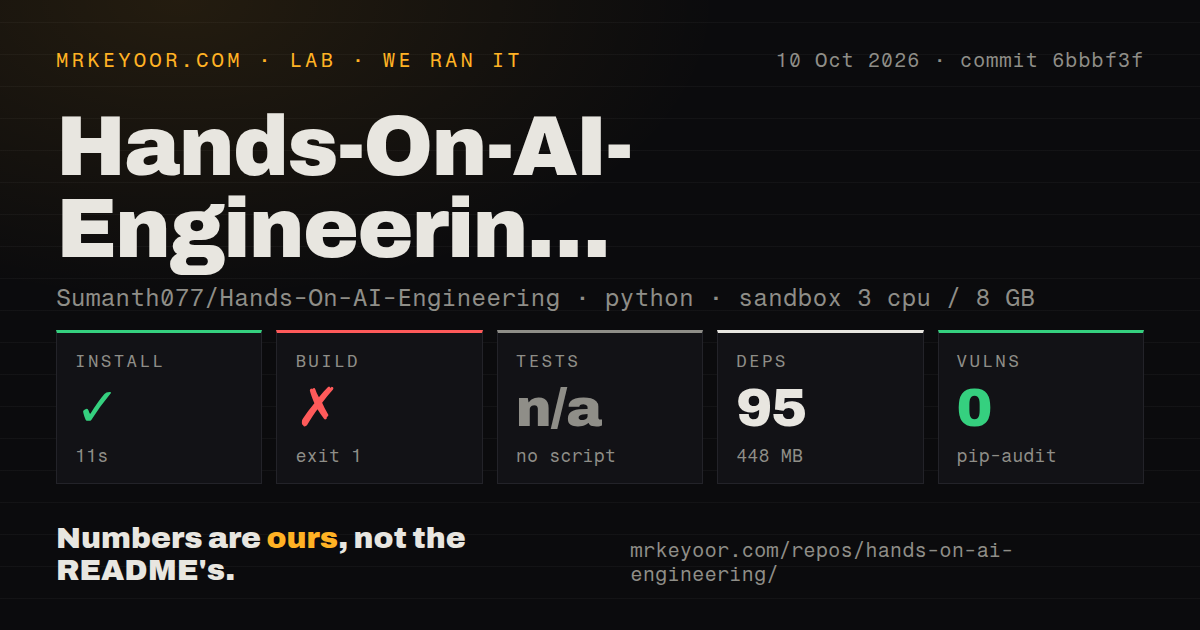
Our unprivileged Python 3.12 sandbox targeted commit dc88f37 with 3 CPUs, 8 GB of RAM, and no secrets. Installation succeeded in 43 seconds, adding 95 packages and occupying 445 MB. The build then failed with exit code 1 after 7 seconds. The measurement block does not include the build log tail, so it provides no reported error message or confirmed cause.
No test script or target was available, so tests were skipped. Pip-audit reported 0 known vulnerabilities in the installed environment. The repository checkout itself measured 285.4 MB, with 675 files and about 46,754 lines of source. Our scan found 0 CI workflow files, no Dockerfile, and no tests directory. Those are repository-wide signals; the install and build results apply specifically to OCR/image_to_structured_data.
Four OCR files still contain merge-conflict markers
The measured commit has unresolved Git markers in 4 files: .env.example, app.py, processor.py, and schemas.py. The same markers remain on the main branch fetched on September 4, 2026. In processor.py, the conflicting alternatives select different Mistral import paths. In app.py, they select between an API-key text field and an environment-only key. These are executable choices that should have been resolved before merge.
Lines beginning with <<<<<<< HEAD, =======, and >>>>>>> also sit directly in Python files, outside comments or strings. That source is not valid Python as checked in. We cannot say the markers caused our 7-second build failure because the supplied build record includes no log text. We can say the source needs repair before anyone should spend a Mistral request on testing its extraction behavior.
One Mistral key sends each uploaded image off the machine
The OCR README requires 1 Mistral API key in .env. The app passes that key to the Mistral client and sends the resized image as a base64 data URL to mistral-large-latest. This is simple for a demo, but an invoice or receipt leaves the local machine. A real deployment needs rules for consent, retention, access logging, provider terms, and how failed or retried requests are handled.
Dependency control is also loose. The requirements file sets lower bounds for mistralai and Pydantic while leaving Instructor, Streamlit, Pillow, python-dotenv, and the backport package unpinned. Our run resolved 95 packages and 445 MB on September 4. A later install may choose a different set. Freeze a known environment after fixing the source, then test the exact image formats and schemas you plan to accept.
Zero CI workflows do not support a production-ready label
The lab found 0 CI workflow files and no tests directory across the 675-file checkout. The contributor guide encourages a tests/ folder, local testing, and one project per pull request, but tests are not required by its folder template. The main README calls the projects production-ready. That label asks readers to trust each contributor's local checks even when no automated gate is visible in the repository.
Open issue 118 gives a concrete example outside the OCR folder. A customer-query router converts model fields with Python's bool(), so the non-empty string "false" becomes true and can wrongly flag legal or repeat contact. The report asks for strict validation and unit coverage. This is the kind of quiet application error that a valid JSON response will not reveal. Medical, financial, and support examples need domain tests before real users depend on them.
The August 25 push is active, but releases and licensing are absent
GitHub recorded 3,128 stars, 8 combined issues and pull requests, and a last push on August 25, 2026. The most recently updated open bug was issue 118 on July 31. There is no latest GitHub release. Activity continued through August 25. Users must select and pin commits themselves instead of following tagged versions and release notes.
The README says the repository uses the MIT License, yet GitHub reports no recognized license and the root LICENSE link returns 404. That mismatch is a practical blocker for organizations that need documented permission before reusing code. Hands-On AI Engineering is still useful as an idea shelf: its 60 entries can shorten the search for a relevant pattern. Copying an example into production requires a code audit, resolved source, pinned dependencies, tests, output validation, and legal clarification first.