Grok Build is an xAI coding client, not a local model
The 4,037-file public tree contains Grok Build's coding client, tools, and runtime, not local Grok model weights. The full-screen terminal agent can read and edit files, execute shell commands, search the web, preserve sessions, and run longer jobs in the background. Headless mode turns the same agent into a scriptable command, while the Agent Client Protocol connects it to editors and other clients. Model responses still come through an authenticated service.
We measured the commit a28ee2b checkout at about 1,903,014 source lines and 76.5 MB before installation. Much of that Rust lives across crates for the terminal UI, shell runtime, tool implementations, workspace access, configuration, MCP, markdown, and sandboxing. The repository also vendors a Mermaid-related stack. This is substantial client software, even though it is smaller on disk than many JavaScript agent projects before dependencies arrive.
Released binaries avoid the 775-second source build
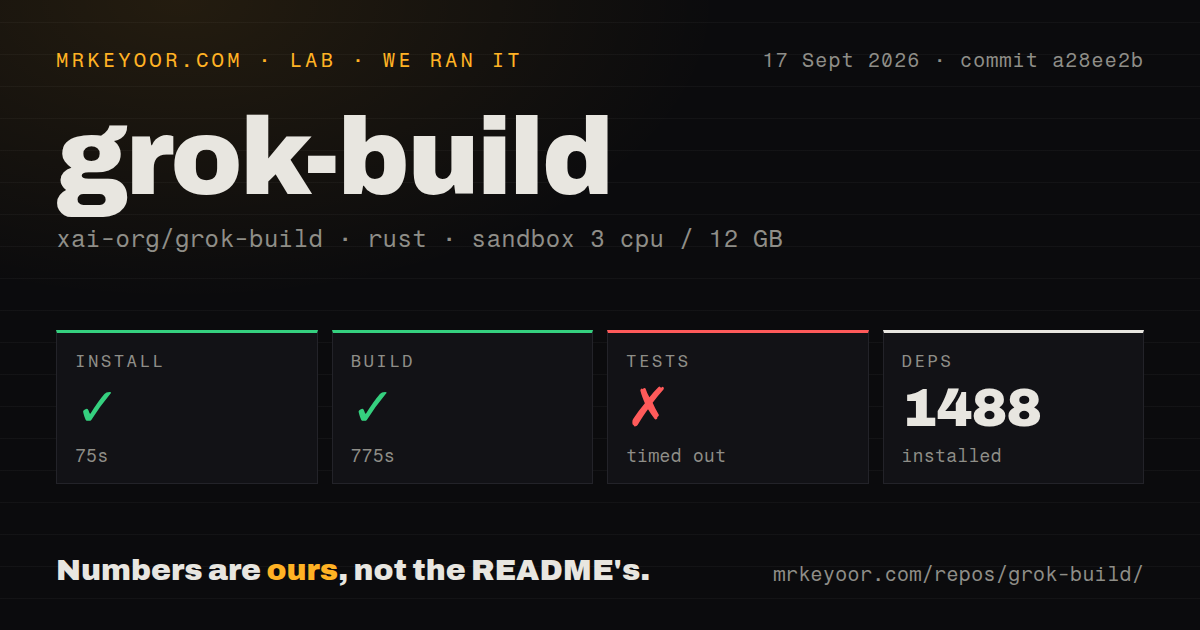
Our source build took 775 seconds, while the README offers prebuilt binaries for macOS, Linux, and Windows. Source builders need the pinned Rust toolchain plus DotSlash, which resolves hermetic tools such as the included protoc launcher. The official binary is named grok; a source release build produces xai-grok-pager. First launch opens a browser to authenticate, so compiling the client does not create an offline model or remove the need for an xAI account route.
Our sandbox installed 1,488 packages in 75 seconds, then completed the build in 775 seconds. That is nearly 13 minutes for the successful build alone on 3 CPUs and 12 GB of RAM. The README advises contributors to target a specific crate because full-workspace builds are slow. For an evaluator who wants to try the interface rather than change Rust code, the released binary is the practical starting point.
What happened when we ran it
In our run, the test command reached the 900-second limit without completing. Its final lines were still compilation messages for pbjson-build, prost-reflect, fuzzy-matcher, colored, mockito, several xAI code-generation crates, and jemalloc packages. The process timed out, so there is no test count and no evidence of an assertion failure. The narrow result is that this checkout's test path needed more than 15 minutes after the successful install and build.
The repository scan found 0 CI workflow files, no Dockerfile, and no root tests directory. Those signals do not prove that the project lacks tests: the README documents per-crate Cargo test commands, and our test run clearly found code to compile. They do mean the public mirror does not expose a GitHub Actions lane or a container recipe that reproduces the source check for you. Budget your own runner and cache before putting it in an internal gate.
Sandbox protection is optional and built-in failure can continue
The sandbox guide requires Linux kernel 5.13 or later for Landlock, yet sandbox mode is off by default. Its profiles can restrict writes, reads, and child-process network access. There are two catches worth putting in a deployment checklist. Child-network blocking is a no-op on macOS, and a built-in profile that cannot be applied may warn and continue without enforcement. A custom profile with a nonempty deny list is the documented fail-closed route.
Our measurement setup was a fresh unprivileged container with 3 CPUs, 12 GB of RAM, and no secrets, but we only installed, built, and invoked the test path. We did not authenticate the agent, edit a working repository through it, call the model, or test its runtime sandbox. Those missing checks matter because the agent can run commands and change files. Start with the ask permission mode, a workspace or custom sandbox, and explicit deny rules for credentials and destructive shell commands.
The public source cannot accept your patch
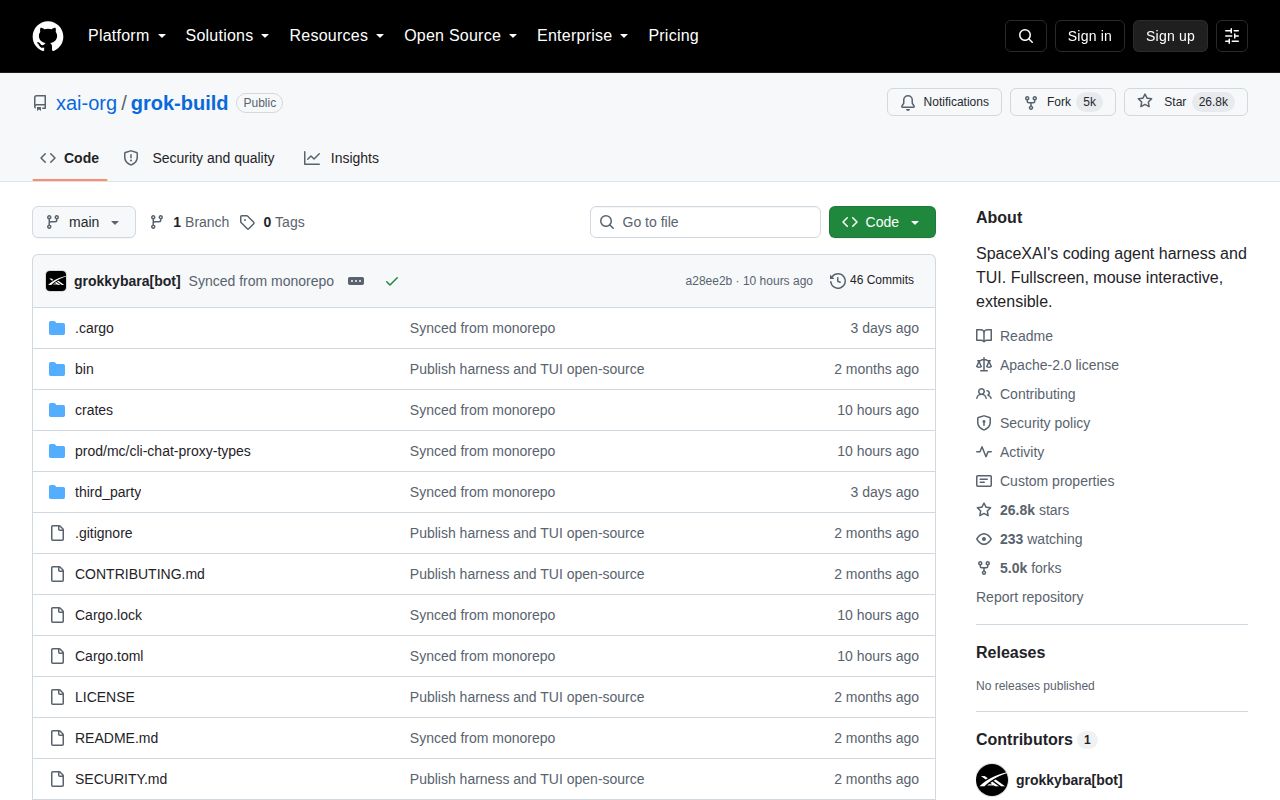
GitHub showed 26,827 stars on September 18, 2026, but the contribution guide says outside pull requests and unsolicited patches are not accepted. SpaceXAI syncs this tree periodically from its internal monorepo, and a root SOURCE_REV records the corresponding internal commit. The generated root Cargo.toml is read-only for contributors, with edits directed to individual crate manifests. Apache-2.0 permits use of the first-party source, but this is a transparency and local-build mirror rather than an open development venue.
The repository was pushed on September 17, 2026, one day before this review. Issues, discussions, and projects were disabled, with 0 open issues and 0 open pull requests. That shows current publication activity without a public queue to inspect for bug response. Our tested commit a28ee2b therefore has stronger local evidence for build behavior than the empty tracker has for maintenance quality. Support expectations must come from SpaceXAI's product channels, not GitHub participation.
The 900-second test cap makes packaged rivals easier to trial
Our 775-second source build makes OpenAI Codex the closest Rust alternative when your team wants an OpenAI-backed terminal agent. Claude Code fits organizations already using Claude's permission and hook conventions. Gemini CLI is the direct comparison for a Google model workflow. All three avoid tying the decision to Grok, but each still needs its own account, policy review, and repository-level evaluation. Switching agents does not remove the risk of automated shell and file access.
Grok Build makes sense when its model, TUI, headless output, MCP support, and editor protocol match the way your team already works. The public code is detailed enough to audit and the 775-second build passed in our sandbox. The unfinished 900-second test run, disabled tracker, and closed contribution policy put a firm limit on what that openness buys. Install the binary for product use; build this 1,903,014-line tree only when you need to inspect or change your own fork.