Termux puts a package-managed shell on Android
Our fresh clone contained 346 files for the Android interface and terminal emulator that put a Linux environment on an Android 7 or newer device. You can install command-line packages, open local shells, run scripts, and add capabilities through companion apps such as Termux:API, Termux:Boot, and Termux:Widget. Package recipes and repositories belong to termux/termux-packages, a boundary that matters when you report a problem or plan a fork.
The app repository measured roughly 48,626 lines of source and 3 MB at commit 084d709. That small checkout does not represent the Linux package catalog users see inside Termux. It does make the division of responsibility easy to grasp. This code owns the terminal experience, Android integration, shared libraries, and plugin plumbing, while another project owns packages such as shells, editors, and language runtimes.
One install source must supply Termux and every plugin
The current stable release is v0.118.3, and the README recommends F-Droid for most users. GitHub releases are also available, while the Google Play build comes from a separate experimental branch with missing functions and known bugs. These channels cannot be mixed casually. Termux and its plugins share an Android user ID, so their APK signatures must match. Switching source can require backing up your files, uninstalling every related app, and reinstalling the complete set.
Our 3 CPU, 10 GB sandbox examined source at commit 084d709 rather than trusting a prebuilt APK. GitHub release APKs carry a public test key, which lets other people sign compatible builds. The maintainers therefore warn users to download GitHub builds only from the official repository. F-Droid controls its own signing key and publication timing. For this app, download provenance determines whether plugins install and whether an apparent update deserves trust.
What happened when we ran it
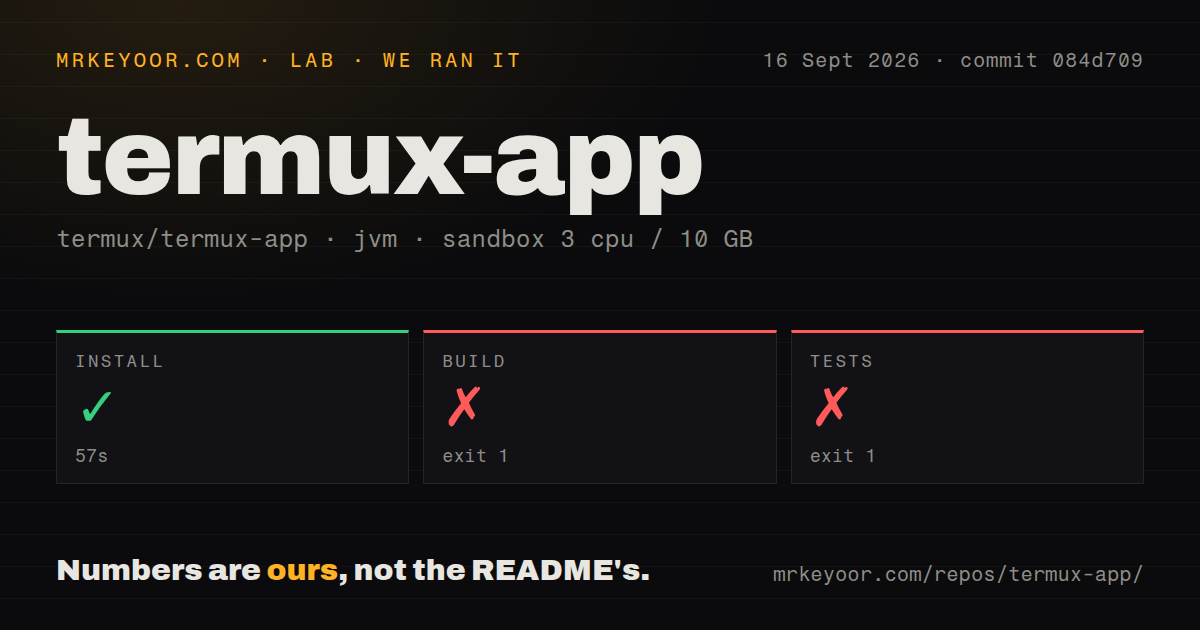
Our measurement setup was a fresh unprivileged Debian container with 3 CPUs and 10 GB of RAM. We cloned commit 084d709 and ran the install, build, and test steps there. The install succeeded in 57 seconds. The build then failed with exit code 1 after 7 seconds, and the test step failed with exit code 1 after another 7 seconds. Both commands stopped while Gradle configured the :app project because the Android SDK location was missing.
The 3 MB checkout contained 6 CI workflow files, no Dockerfile, and no tests directory in our scan. Gradle also warned that deprecated features in use would be incompatible with Gradle 10, but that warning was not the reported cause of either failure. No tests reached execution, so there is no pass count to report. A contributor should budget for an Android SDK before expecting the wrapper to behave like a self-contained JVM project.
Android can kill the jobs Termux was built to run
Android 12 and newer can terminate phantom processes once the system-wide count exceeds 32 processes, according to the project's README. The operating system can also stop processes that consume too much CPU. The visible result may be [Process completed (signal 9)] even when the user did not exit the shell. Issue 2366 documents the behavior on Android 12, and the project points readers to device and Android settings that may help. A phone still controls every local job.
Our unprivileged container had 3 CPUs and 10 GB of RAM, so it could check repository setup without reproducing Android process policy, touch input, storage permissions, or background execution. Those are product constraints rather than details a Debian build can settle. If your use case involves a persistent server, a long compile, or several child processes, test it on the exact Android version and vendor firmware that will run it.
A September 2026 push outweighs the May 2025 release date
GitHub recorded the last push on September 16, 2026, and an open toolbar-input bug received discussion that day. The repository had 60,942 stars and 608 combined issues and pull requests when fetched. Release v0.118.3 arrived on May 22, 2025 with fixes for an Android 16 QPR1 crash, a storage permission interaction, and serialized report data. The tag is older than the latest code activity, so the release date alone does not describe maintenance health.
The lab checkout's 48,626 source lines and 6 workflow files also show that this is an Android application with several integration surfaces, not a terminal widget wrapped around a shell. Recent issue 5309 concerns bracketed-paste handling in toolbar input, while older reports cover Android process limits. Neither proves the app is unreliable. They show why terminal behavior, keyboard paths, plugins, and Android releases all need separate checks before a team standardizes on it.
UserLAnd suits full distros, ConnectBot suits remote shells
GitHub recorded pushes to both UserLAnd and ConnectBot within 2 days of this September 17, 2026 review. UserLAnd is the closer alternative when the goal is a named Linux distribution or a guided application install on Android without root. ConnectBot takes a narrower route: it opens SSH sessions to machines that already hold the tools and data. Termux is stronger when you want the package-managed environment on the phone and accept Android's storage, signing, and process rules.
The 57-second install made Termux cheap to inspect, while the two 7-second failures gave a clean decision point. Install the Android SDK before judging the source build, keep every APK on one verified channel, and avoid treating a phone shell as an unattended server. If those rules fit your use, Termux earns the space on the device. If they do not, moving the workload to a remote host is the safer boundary.