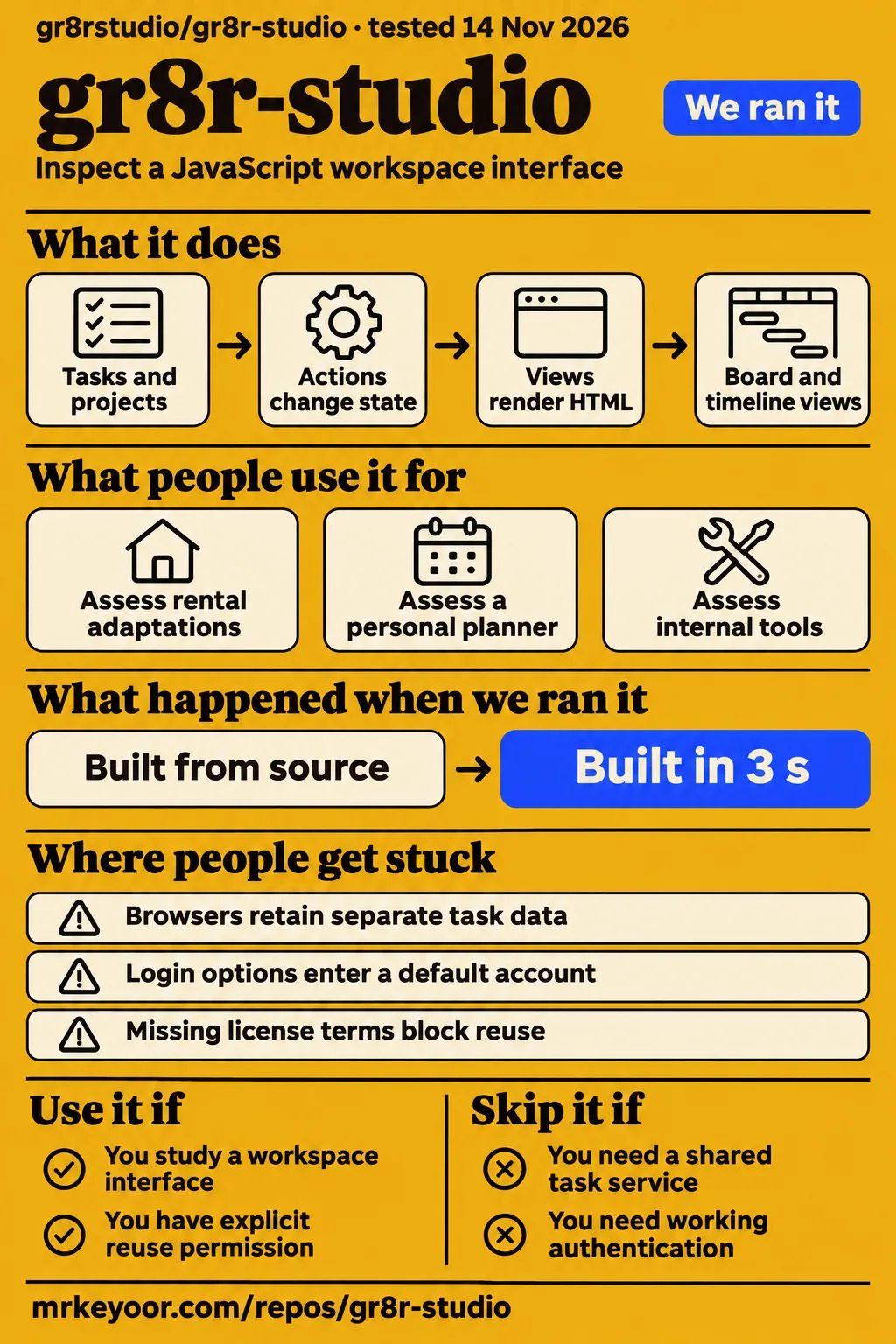
Our gr8r-studio source run installed in 6 seconds and built in 3 seconds at commit 904205c. Issue reporters describe a different part of the adoption decision: data stays in each browser, and login options enter a default account. Use this repository to study a workspace interface or assess a development starting point after resolving reuse permission. Teams looking to invite colleagues into a shared task service should choose a tool with documented shared storage and account handling.
What you can do with gr8r-studio
The README describes six project views: board, list, table, calendar, timeline and files. It also names a home dashboard, inbox, personal tasks, members, teams, activity and settings. These screens give a developer several parts of a workspace interface to inspect in one repository. The implementation uses plain JavaScript ES modules and CSS, bundled by Vite, without a UI framework or runtime dependency. Gr8r Studio README.
Setproduct's overview describes opening a board, dragging a card, reading a task drawer and switching the same project to a timeline. It explicitly says the live demo runs on seeded data. Those examples help a reader assess the interface's layout and interactions before installing the source. The overview's description concerns the demo experience; the storage discussion in issue #1 answers the separate question of how different browsers save their work. Setproduct interface overview.
What people use gr8r-studio for
Issue #3 records a user trying email, Google and Microsoft login; issues #2, #7 and #8 describe proposed adaptations. Keeping those categories separate makes the requests useful: they show which workflows attracted readers without turning an intended project into a completed deployment. The rental operator names business operations, the planner author names a custom backend, and the MCP requester names Claude-assisted planning.
| Person and source | What they did or requested | Outcome in the record |
|---|---|---|
| Reporter of issue #3 | Tried email, Google and Microsoft login | Reported entry into the default account |
| uncfreak1255-code in issue #2 | Requested a rental-operations interface for owners, maintenance, inbox and deals | Asked for licensing permission |
| Author of issue #7 | Proposed a personal planner with tasks, projects, calendar and their own backend | Asked for an explicit license |
| Author of issue #8 | Sought home-project planning and task management through Claude | Asked about an MCP server and said they might make one |
The vacation-rental request explains the interface's appeal in concrete terms: its author wants an internal operations window that combines owners, maintenance, messages and deals. The personal-planner request takes a different approach by explicitly proposing a single-user application with a custom backend. Both are useful design briefs for someone assessing the repository, and both authors ask for licensing terms before proceeding. Rental-operations request, personal-planner request, Claude planning request.
What happened when we ran it
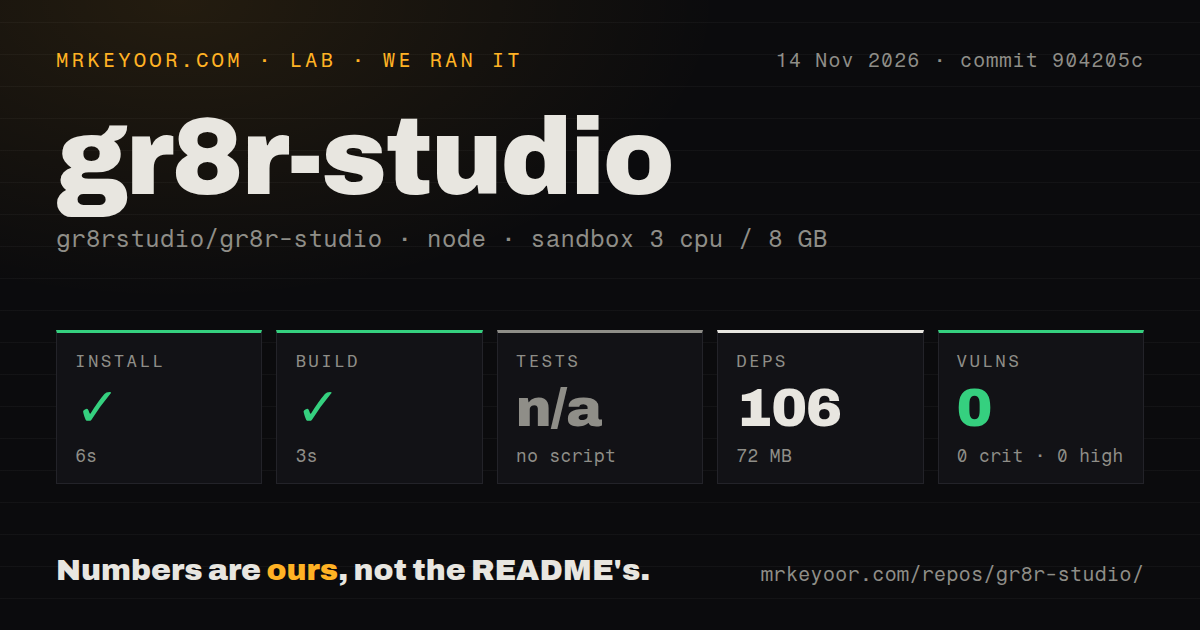
Our November 14, 2026 source run at commit 904205c installed successfully in 6 seconds and built successfully in 3 seconds. The build/test harness and the separate Compose-based hands-on attempt produced different outcomes. The harness completed its install and build steps; the container attempt failed its safety step because the required Compose file was absent. The table preserves each recorded source-run result rather than treating those paths as one successful deployment.
| Source-run observation | Recorded result |
|---|---|
| Sandbox configuration | 3 CPUs, 8 GB RAM, image label lab-node:22 |
| Checkout | 86 files, about 8,820 source lines, 1.2 MB |
| npm installation | Succeeded in 6 seconds |
| Dependencies | 106 recorded, 72 MB on disk |
| Build | Succeeded in 3 seconds |
| Tests | No tests script or target; skipped |
| npm audit | 0 known vulnerabilities: 0 critical, 0 high, 0 moderate, 0 low |
| Repository signals | 1 CI workflow file, no Dockerfile, no tests directory |
We measured 72 MB of installed dependencies for gr8r-studio on the recorded sandbox configuration. The 1.2 MB checkout and 86 files describe the source footprint, while the dependency figure describes the installed project. These numbers help a developer estimate the size of an initial inspection. The test outcome remains a skipped step, and the audit outcome remains npm audit's count of known dependency advisories.
The Docker safety log names the missing candidates: compose.yaml, compose.yml, docker-compose.yaml and docker-compose.yml. It marks safety as FAILED because its rule requires a Compose file. The accompanying run summary nevertheless says the application was deployed with its own Docker Compose on the lab server, with every port bound to 127.0.0.1. Teardown reports success. The failed safety record is the concrete outcome of the attempted container path.
Where people get stuck: storage, login and reuse
ShlomiPorush says in issue #1 that every browser retains separate data even when a container serves the same static files. The original requester wanted a durable, centralized dashboard for people on the same network. The reply identifies a backend as the work needed to meet that request. This gives a developer a concrete architecture question to answer before treating common access to one URL as a shared workspace. GitHub issue #1: Docker and storage.
| Reported obstacle | Proposed or requested response | Recorded status |
|---|---|---|
| Separate browser data, issue #1 | A backend with shared persistence | Open discussion |
| Default-account login, issue #3 | Working authentication and account handling | Open report |
| Reuse terms, issues #2, #7 and #11 | An explicit license or permission | Open requests |
| Container packaging, issue #12 | Official image, Compose example and documentation | Proposal |
| Claude connection, issue #8 | An MCP server for the intended task operations | Request |
Issue #3 reports that arbitrary email input and the Google and Microsoft choices lead to the default account. Issues #2, #7 and #11 raise another practical dependency: permission to adapt the source. A vacation-rental operator, a personal-planner author and an internal-tools requester each describe a reason to reuse the interface. Their requests make licensing part of the development decision, alongside storage and account handling. GitHub issue #3: authentication, GitHub issue #2: licensing, internal-tools request.
Docker packaging and shared storage solve different problems
Issue #12 proposes building the static output and serving it through nginx or Caddy, with a Compose example and deployment documentation. That proposal addresses how container users would package and serve the interface. Issue #1 addresses where tasks are saved and how browsers would share them. Reading the two requests together gives a clearer implementation sequence: packaging serves the files, while a backend supplies the shared persistence the original requester wants. Official Docker image proposal, shared-storage explanation.
The README gives developers an architecture map
The README separates state, rendering and actions into named directories and explains how they connect. It places utilities, constants, the store and theme in core/, while pages and views render HTML from state. Actions change state and trigger rendering. For a developer studying the interface, this is a more useful entry point than starting with every screen: follow the store, a view and its action handler to understand one interaction. README architecture and conventions.
The documented local workflow requires Node.js 18 or newer, with .nvmrc pinning 22. It lists npm install, npm run dev, npm run build and npm run preview, plus lint and formatting commands. The README also says its CI runs lint, a format check and a production build on pushes and pull requests. These are documented commands and workflow responsibilities; our recorded harness outcomes are the install, build, skipped tests and audit results listed above.
Attention and requested work are different signals
Trendshift records 1,586 added stars, 411 added forks and zero merged PRs for October 7 through November 14, 2026. GitHub metadata checked on November 15 lists the repository's last push as October 7, 2026. The issue threads give that activity a practical context: readers request licensing terms, Docker packaging and a Claude connection. Each signal answers a different question about attention, repository activity or desired work. Trendshift activity window, GitHub repository metadata.
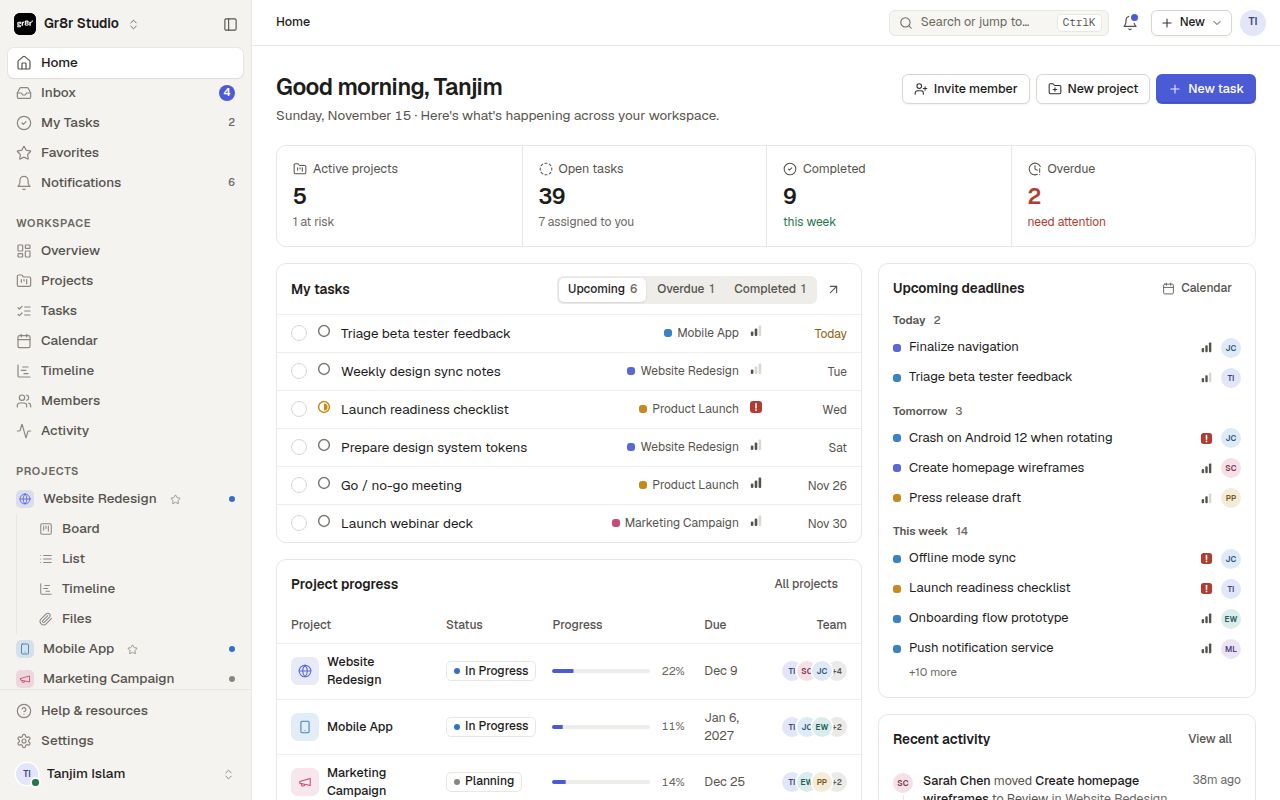
The demo page contains named colleagues, task titles, project percentages and an activity feed. Setproduct describes the demo as seeded data, so those details belong to an interface demonstration. The supplied X search also contains posts about studio services and a separate CRM product. Keeping those records attached to their actual subjects prevents a reader from confusing a design business's promotion with use of this particular repository. Demo workspace, seeded-data description, supplied X search.
gr8r-studio vs ClickUp and Vikunja
Inspect gr8r-studio for UI development after resolving reuse permission, keep ClickUp when the existing workflow suffices, and evaluate Vikunja for a documented shared self-hosted service. Those choices follow different evidence: the repository describes its interface, issue #8 supplies one ClickUp user's experience, and Vikunja's official site describes its application scope. The comparison is about the job each option is supported to address.
| Option | Evidence relevant to the decision | When to consider it |
|---|---|---|
| gr8r-studio | JavaScript workspace interface; issue reports describe browser-local data and default-account login | Inspect the UI or assess development work after resolving reuse permission |
| ClickUp | Issue #8's requester says their existing home-project workflow works well | Keep that workflow when it suffices and self-hosting is optional |
| Vikunja | Official site documents self-hosting, shared projects and task assignment | Evaluate a documented shared task service |
Issue #8's requester says ClickUp works well for their home-project workflow. They want a self-hostable alternative that lets Claude plan PRDs and manage tasks through an interface, and ask whether an MCP server exists. This is a specific replacement brief from an existing user. It explains why gr8r-studio interests them without turning their interest into a completed migration or a general assessment of ClickUp. ClickUp and MCP request.
Vikunja's official site documents self-hosting, shared projects and task assignment. It also lists List, Kanban, Gantt and Table views, giving it a documented overlap with the task-view requirements that draw readers to gr8r-studio. For the person who primarily wants to operate a shared service, those capabilities make Vikunja a relevant next evaluation. The selection follows its published feature scope rather than a speed or resource comparison. Vikunja's official features and hosting description.
What the other reviews get wrong
Setproduct lists member and team management, while issue #1 describes separate browser data and issue #3 reports default-account login. The overview supports evaluating the screens and seeded demo interactions. Its screen list needs to be read alongside those issue reports when deciding whether to use the repository for shared work. A member-management screen and a common storage service answer different requirements. Setproduct workspace description, storage discussion, login report.
The licensing question comes from the repository records and user requests. Issue #11 asks to use the interface as an internal-tools starting point with attribution; issue #2 requests terms for adaptations including rental operations. GitHub's supplied metadata returns no recognized license. Attribution is part of what those requesters offer, while the decision a prospective adapter needs is explicit permission covering the intended use. Internal-tools licensing request, adaptation requests.
FAQ
A Docker container would serve static files, while shared tasks require a backend, according to issue #1. That distinction answers the original request for a durable dashboard accessible to people on one network. The related questions concern account handling, cross-device data and reuse permission. Their answers below stay attached to the people who raised them and the implementation work described in the supplied records. Original Docker and shared-dashboard request.
Can I self-host gr8r-studio with Docker?
Issue #12 proposes an official image and Compose example serving the static build through nginx or Caddy. That is the requested packaging route. Our separate Compose-based attempt failed its safety step because the repository lacked the required file. Developers considering container work can use the proposal as a requirements list: build the output, serve it, map a port and document the deployment. Docker proposal.
Will people on my network share the same tasks and dashboard?
ShlomiPorush says in issue #1 that users on the same network would retain separate browser data. The original request asks for centralized, durable access, and the reply identifies a backend as the necessary addition. That makes shared persistence an application-development requirement for this proposed use. Serving one set of files to several browsers supplies access to the interface described in the thread. Network-sharing discussion.
Will my gr8r-studio data appear on my phone or in another browser?
Issue #1 describes browser-local storage, and tess1o explicitly raises opening the app on a phone or in another browser. Under the architecture described in that thread, each browser has its own data. This is the practical reason to decide how tasks should move between devices before using the interface as a personal planner or a central dashboard. Cross-device storage discussion.
Why does every login option open the default account?
Issue #3's reporter says email, Google and Microsoft login all enter the default credentials and describes the choices as unconnected. Issue #1 separately characterizes login as client side only. Together, those reports place account handling among the development work facing someone adapting the interface. The reported result is more specific than a generic login error: changing the chosen route still opens the default account. Default-account login report, client-side login description.
Does gr8r-studio have a license that permits forking and adapting its code?
Issue #2 asks for a license explaining permitted use and suggests MIT or Apache. The supplied GitHub metadata returns no recognized license, while issues #7 and #11 repeat the request for explicit terms. For a developer planning an adaptation, the useful next step is obtaining permission covering that adaptation before incorporating the source into another product. License request, GitHub license metadata.
Can I adapt gr8r-studio into a personal planner with my own backend?
Issue #7 proposes exactly that combination: a single-user planner with tasks, projects, a calendar and the requester's own backend. Its author asks for an open-source license so they can build on the interface and offers credit in the README and application. The request provides a concrete adaptation brief for readers with a similar goal, with licensing as its stated prerequisite. Personal-planner proposal.
Is there an MCP server for connecting Claude to gr8r-studio?
Issue #8's author says they do not see an MCP server in the repository and might make one. Their intended workflow is Claude-assisted PRD planning and task management through the interface. A reader with the same goal should treat that post as a connector requirement: the desired operations need an implementation that can read and change the relevant task data. MCP server request.
Can I reuse the interface as the starting point for internal business tools?
Issue #11 asks for permission to use gr8r-studio as an internal-tools starting point with attribution. The rental-company operator in issue #2 describes a related use involving owners, maintenance, inbox and deals. These requests explain the business appeal of the interface and identify the permission question that prospective adapters need answered before incorporating its code. Internal-tools request, rental-company adaptation request.
What we have not tested yet
Our evidence covers a source install and build at commit 904205c, skipped tests and a container attempt blocked before deployment. The conflicting deployment summary cannot support a successful deployed-app result. The image label lab-node:22 records configuration rather than actual runtime or operating-system versions. The safety failure concerns the harness's Compose requirement; it supplies no application-crash diagnosis. The clean npm audit concerns known dependency advisories rather than account isolation or application security.
Shared workspaces, provider authentication, cross-device synchronization, recovery after browser-data loss, concurrent edits, accessibility, mobile interactions and large task collections remain outside the recorded lab work. Deployment duration, runtime memory and task-completion benchmarks are also absent. Storage and login behavior are attributed community reports. The proposed adaptations and MCP request supply no completed implementation, and the licensing requests supply no permission grant. The alternative comparison contains no hands-on performance result.
The pack contains no lab screenshot records or known-answer task runs. Its video records supply no usable demonstrated workflow for attribution. Seeded demo activity and repository attention supply no evidence of sustained customer use, production reliability or abandonment. Support responsiveness also lacks an assessment. Rendered layout, related links, recommendation modules and other publication-template behavior are outside this private text correction.
All four score cards remain N/A because the evidence does not support numerical assessments of full setup, documentation effectiveness, community support or operational maturity. A successful source build answers an initial development question. The next decision-changing evidence would be explicit reuse permission and a demonstrated workflow in which one authorized account saves a task that a second authorized browser can retrieve.