It turns credential sprawl into one operating surface
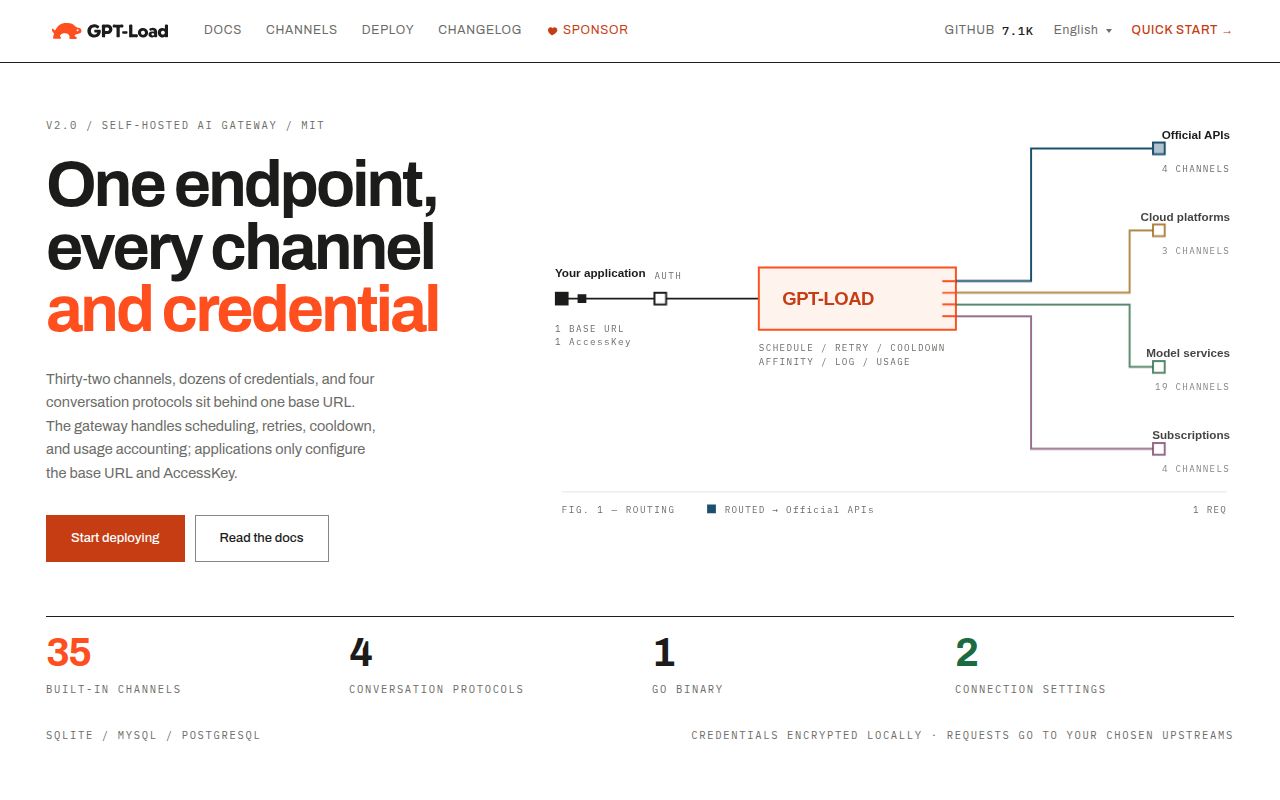
GPT-Load is for the point where calling an AI API stops being one URL plus one key. It gives an application a single base URL and AccessKey while an operator configures providers, accounts, credentials, models, and routing behind it. The project supports native client shapes for OpenAI Chat Completions and Responses, Anthropic Messages, Gemini endpoints, images, and embeddings. That is useful when several products or internal teams need shared infrastructure without each learning the details of 3 provider families.
The strongest idea is that API keys and subscription accounts use the same management machinery. Codex, Claude, Antigravity, Grok, cloud services, and compatible relays can sit behind groups with scheduling and health policy. Automatic weighting, retries, cooldown, blacklisting, and session affinity are concrete answers to overloaded or failing credentials. This is not merely a request forwarder: the embedded UI exposes health, routes, logs, usage, cache hit rate, token categories, and cost estimates, with SQLite, MySQL, or PostgreSQL underneath.
What happened when we ran it
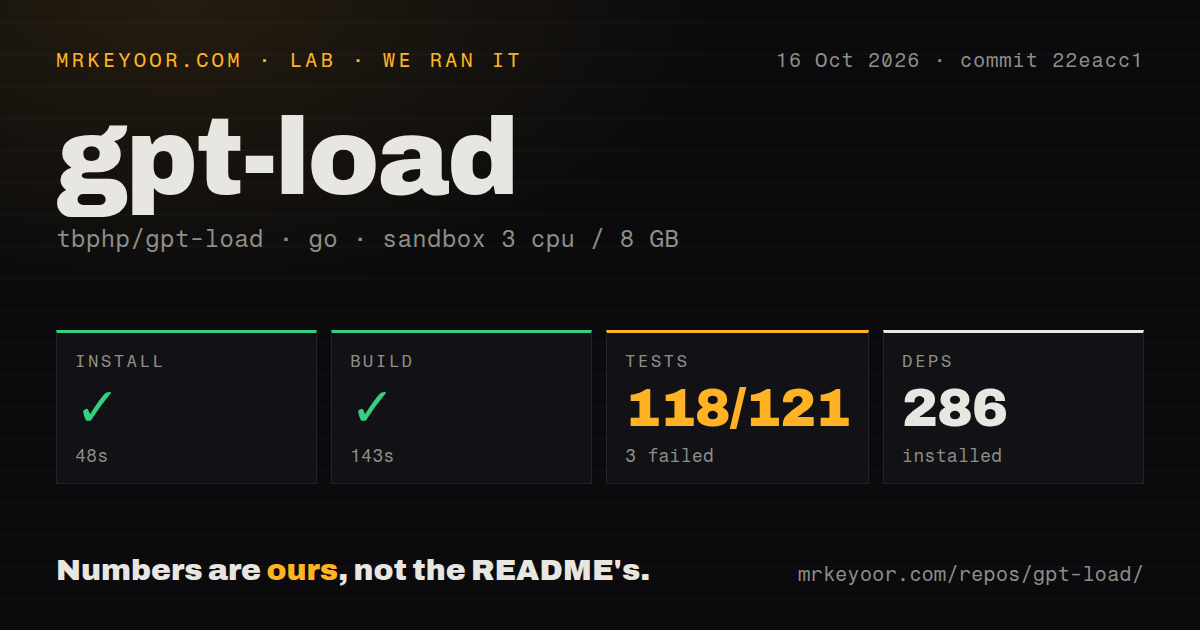
On our box, installation succeeded in 74 seconds and installed 276 packages. The build also succeeded, taking 123 seconds, which confirms that the measured checkout at commit 1ff3424 compiled in the supplied Go 1.24 Debian environment. The repository is substantial rather than tiny: 1,147 files, about 297,123 lines of source, and a 14 MB checkout. It also includes 2 CI workflow files, a Dockerfile, and a Compose file, although there is no top-level tests directory.
The test step was the important blemish. It ran for 83 seconds and exited with code 1, with the measurement summary recording 107 passed and 3 failed out of 110. The supplied log excerpt shows named failures in internal/webui around Compose port and host bindings, independent project names and volumes, named-volume paths, and release-image revision and version handling. We cannot infer a cause from those names alone. The honest conclusion is narrower: our build worked, but this checkout did not pass its full test command in the sandbox.
The routing scope is broad, but deliberately bounded
GPT-Load's protocol coverage is a meaningful strength because clients can retain OpenAI, Anthropic, or Gemini interfaces rather than all being forced through one invented schema. Each channel declares the protocols and capabilities it can execute, and the gateway converts only supported capabilities. That explicit limit is good engineering communication. Embeddings, for example, initially use the OpenAI-compatible wire only for 3 channel types: OpenAI, OpenRouter, and OpenAI Compatible API-key channels. Subscription channels and protocol conversion do not support them.
Access control also looks designed for actual shared use. An AccessKey can be restricted to groups and client protocols, and its read-only home shows only its own models, requests, usage, and cost allowance. Local credential encryption and a generated management key reduce obvious foot-guns, while the default loopback bind avoids accidental public exposure. Still, operators must store the auth key safely, control access to logs and usage data, and set explicit protocol filters for least privilege. An unfiltered existing AccessKey gains embeddings access after an upgrade.
Deployment has sharp edges that deserve a rehearsal
The README's fast path is familiar: clone the v2 branch, copy .env, run Docker Compose, check the health endpoint, then retrieve the generated key. The actual first usable configuration also needs at least 3 objects: a channel, a group, and an AccessKey. Subscription OAuth adds fixed callback ports, and only one default Compose instance can run on a host at once. Setting HOST to 0.0.0.0 publishes the application and callback ports on all interfaces, so remote convenience can become exposure if firewall and proxy rules are careless.
The largest operational warning is the 1.x to 2.0 boundary. Version 2.0 cannot open, import, or migrate 1.x data in place, making backup, parallel deployment, and rollback planning mandatory for existing users. There is also a version-channel ambiguity in the supplied snapshot: the latest release is listed as v1.4.11 on September 3, 2026, while the README tells new users to clone v2. Before production, verify which line is intended, pin an image or revision, and test configuration restore instead of following a floating branch blindly.
Activity is current, while support quality remains unproven
The project has 6,518 stars and only 10 open issues in the supplied snapshot, useful signs of reach and a manageable visible queue. More importantly, both the v1.4.11 release and the last push occurred on September 3, 2026, so this is active code, not a repository coasting on old popularity. That said, a single-day snapshot cannot establish release cadence, maintainer response time, or how quickly difficult issues close. Stars show attention, not an operations guarantee.
For a real stack, place GPT-Load between trusted applications and upstream model services, alongside your reverse proxy, database backups, secret handling, monitoring, and egress controls. It is most compelling when credential scheduling and native client compatibility would otherwise become custom platform code. Start with a noncritical workload, pin the deployed version, reproduce all 110 tests in your environment, and exercise provider failure and database recovery. If those gates pass, GPT-Load can remove a lot of repetitive gateway work without pretending every provider behaves identically.