More than 31 translations sit atop a Git forge without bundled CI
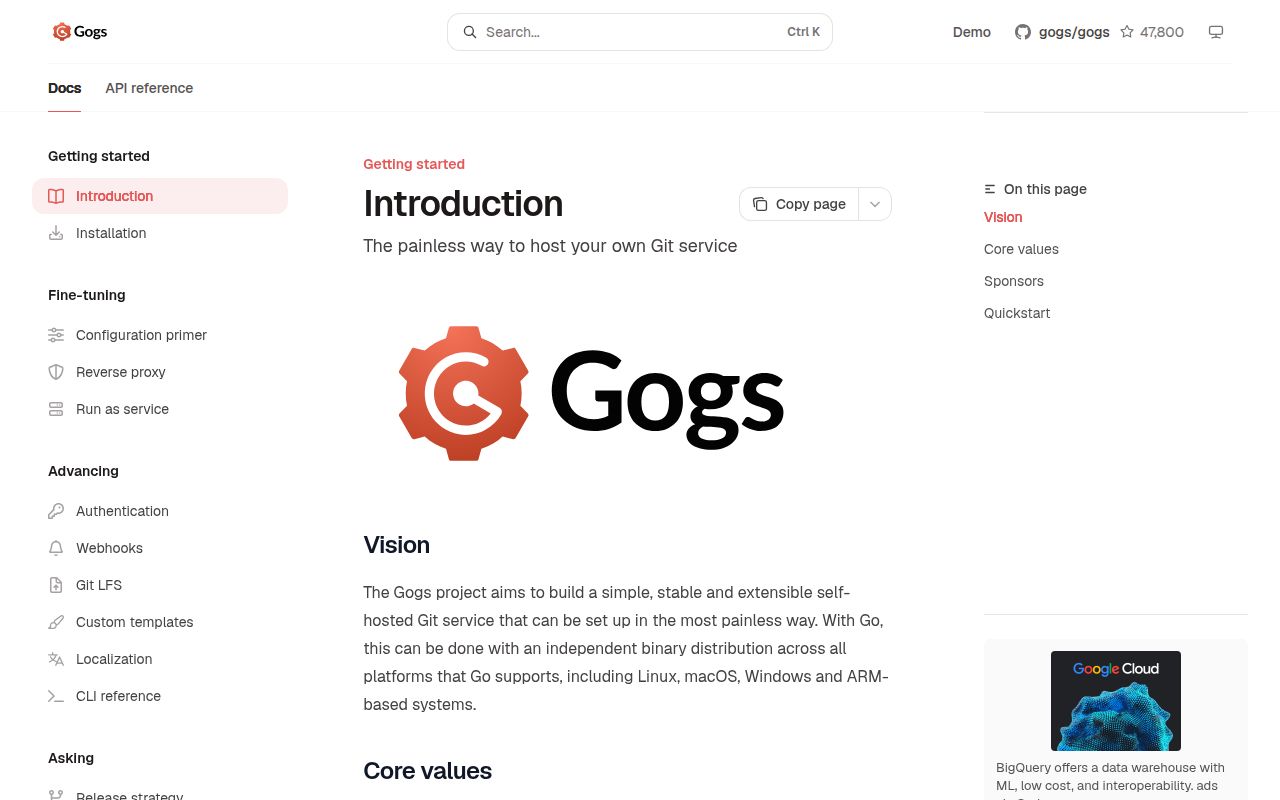
Gogs translates its interface into more than 31 languages and puts repositories, pull requests, issues, wikis, organizations, webhooks, Git LFS, and branch protection behind one web service. Users can clone over SSH, HTTP, or HTTPS. Authentication options include SMTP, LDAP, reverse proxy headers, GitHub, GitHub Enterprise, and two-factor authentication. That is enough for a private engineering team whose build system already lives elsewhere.
The boundary is as useful as the feature list. Gogs does not claim an integrated CI runner or package registry in its README. Its API is labeled experimental. The browser floor is also conservative: the smallest officially supported resolution is 1024 by 768. Teams wanting one product for source, pipelines, artifacts, planning, and modern phone layouts will reach Gogs' edges sooner than a group seeking a compact Git server.
The 16-second install did not expose a server build
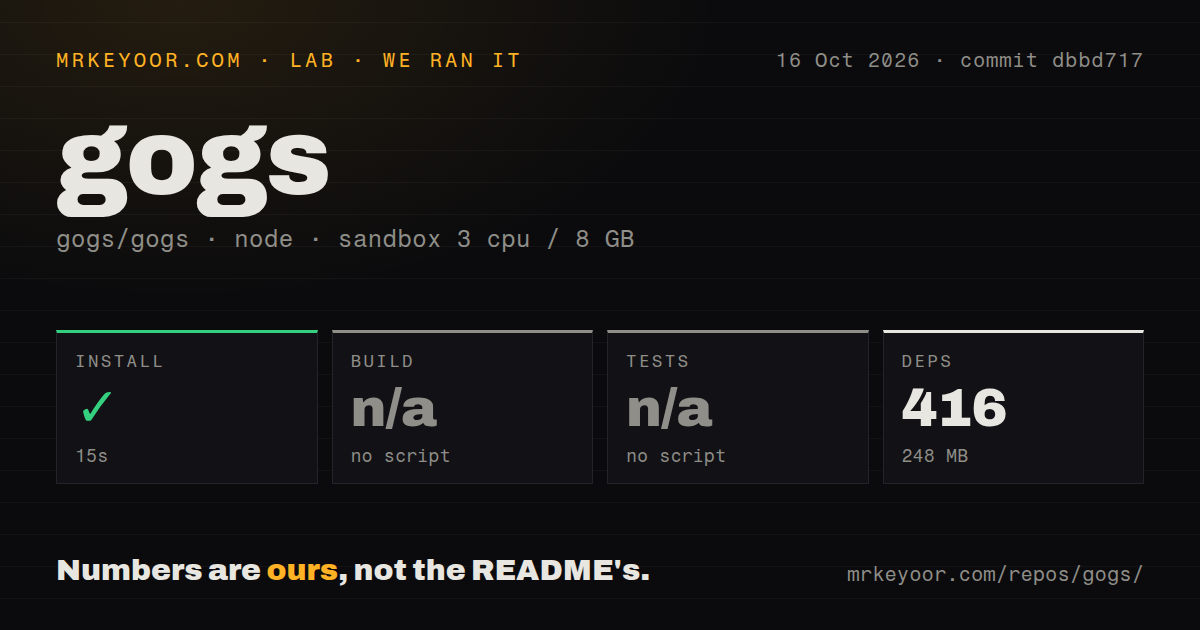
Our commit aec2b84 checkout installed 415 pnpm packages in 16 seconds and occupied 244 MB afterward. The repository is a workspace monorepo, but it had no build script or target and no test script or target available to our runner. Both steps were skipped. This is a narrower result than a passing Go compilation or an end-to-end login and clone test.
We measured 2,643 files, roughly 202,613 lines of source, and a checkout size of 38.8 MB. Our scan found 7 CI workflow files, a Dockerfile, and no tests directory. Those signals describe the measured commit, not every release artifact. They also explain why the quick package install should not be mistaken for proof that repository creation, SSH transport, database migration, or pull requests worked.
What happened when we ran it
In our fresh Debian sandbox, pnpm completed the available install in 16 seconds with 415 packages and 244 MB on disk. The container had 3 CPUs, 8 GB of RAM, no secrets, and no elevated privileges. Nothing in the install step failed. The project supplied no runnable build target, so our automation recorded the build as skipped rather than inventing a Go or frontend command.
Tests were skipped for the same reason: the checkout exposed no test script or target. We therefore have 0 measured server tests to report, not a passing test suite. The lab result is still useful because it identifies a verification gap in this 2,643-file repository. Anyone building from source needs a project-specific procedure and should test the compiled server, database migrations, web login, SSH clone, HTTP push, and backup restore separately.
SQLite is easy; SSH, secrets, and backups remain yours
The installation guide requires Git 1.8.3 or newer plus SQLite 3, MySQL 5.7 or newer, MariaDB 10.3 or newer, or PostgreSQL 9.6 or newer. Git over SSH adds either the built-in SSH server or a system SSH service. A custom/conf/app.ini sets the public URL and database connection. Gogs refuses to start with the unsafe default secret, which is exactly the right failure mode.
SQLite keeps a small installation compact, while a shared team may prefer a separate database. The sample PostgreSQL configuration points to 127.0.0.1:5432. The first person to register on an empty instance becomes the administrator unless an admin is created from the command line. Put TLS in front, restrict sign-up before publishing the URL, store the secret outside source control, and prove that repository data plus the database can be restored.
Version 0.14.3 is a security-mandatory upgrade
Release v0.14.3, published June 7, 2026, is almost entirely a security repair release. Its notes include fixes for remote command execution, server-side request forgery, stored cross-site scripting, authorization failures, arbitrary file writes, private attachment access, and cross-repository LFS disclosure. A code host receives untrusted names, Markdown, notebooks, webhooks, Git objects, and credentials, so these are operating concerns rather than obscure edge cases.
The release notes also describe a container transition that is still underway. A next-generation, non-root image began publishing in v0.14.1, while the traditional root-privileged image is deprecated. The current docs say the modern image lacks some container options. Test volume ownership, SSH ports, configuration variables, and backup jobs before changing image families, then pin a release instead of following a moving tag.
SAML issue 1221 remains open after 11 years
Issue 1221 has requested SAML authentication since April 2015 and remained open when checked. An OIDC implementation exists as open pull request 8032, but its checklist says test cases are still missing. The README's present authentication list names other methods and does not claim either SAML or OIDC. Companies with a required identity provider should confirm the released feature, not budget around an open contribution.
API coverage has a similar limit. Issue 2253, opened in December 2015 and updated September 2, 2026, asks for pull-request listing, file, diff, and comment endpoints. The project's own README calls API support experimental. A bot that only creates repositories or users may be fine, but review automation should map every required call against the current API reference before migration.
August code activity coexists with a large open queue
GitHub recorded the last push on August 26, 2026, and issue discussions were active on September 2. The repository had 47,800 stars and 1,011 combined issues and pull requests. That is an active project with a large backlog, rather than a project made stale by the June release date. Issue 8410, about source builds after the layout change, also shows that current changes can get ahead of the installation path.
Gogs is a sensible choice when you value a focused Git forge, modest documented hardware needs, and database flexibility. Our 16-second dependency install makes the checkout cheap to inspect, yet the missing build and test targets leave the important server behavior unproved. If SAML, OIDC, CI, packages, or pull-request API coverage is mandatory, settle that requirement before moving repositories.