Gitea puts the daily forge tools in one service
Gitea hosts Git repositories and surrounds them with the work most development teams expect: pull requests, issue tracking, project boards, wikis, package registries, organizations, and CI/CD. Its Actions system reuses the GitHub Actions format, which lowers the learning cost for teams moving familiar workflows. The service is written primarily in Go and supports the operating systems and processor families covered by Go, including Linux, macOS, BSD, Windows, ARM, RISC-V, and PowerPC.
That breadth is the main reason to pick it. A small company can replace separate Git hosting, issue tracking, a package registry, and a basic CI control plane with one application. The repository had 57,625 GitHub stars when fetched, and GitHub recorded its latest push on August 27, 2026. This is not a weekend forge experiment. It is a large project with an active maintenance queue and enough surface area that an administrator needs to understand what is enabled.
The official container is the shortest trial path
The README points new operators toward the official Docker image, Gitea Cloud, downloadable releases, or platform packages. A container is the least ambiguous evaluation route because it avoids compiling the Go backend and frontend assets. You still need persistent volumes, a database decision, an external URL, and SSH port planning. A useful trial should also cover outbound mail, repository import, authentication, backup restoration, and a runner job rather than stopping at the login screen.
Source work is more involved than the short README makes visible. It sends builders to dedicated setup, development, and source-build documents. Our checkout contained 6,237 files and roughly 538,535 source lines, so the separation makes sense. The codebase includes backend Go, frontend packages, templates, translations, migrations, and integration machinery. Contributors should follow the documented toolchain instead of treating the root package manager result as a complete build.
What happened when we ran it
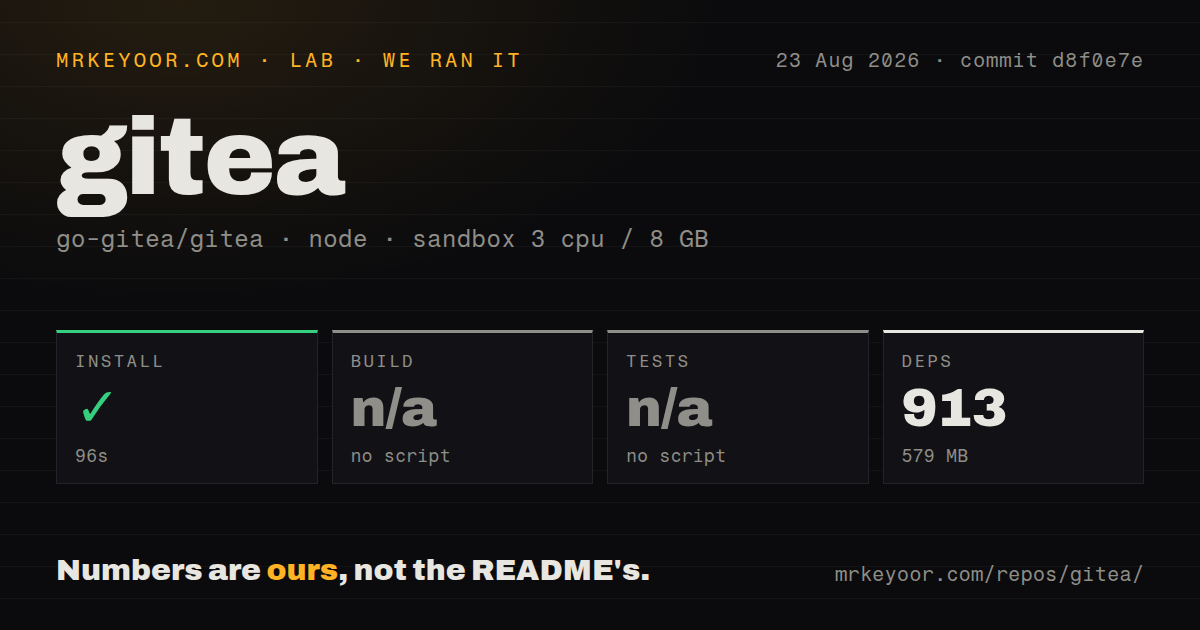
Our sandbox cloned commit d8f0e7e in an unprivileged Debian container with 3 CPUs and 8 GB of RAM. The 33.8 MB checkout installed 913 pnpm packages in 96 seconds, leaving 579 MB on disk. Installation succeeded without secrets. Those figures cover the detected Node workspace only; they do not show that a Gitea server binary was compiled or launched.
The harness found no build script or target and skipped that step. It also found no test script or target, so it skipped tests. The repository does contain a tests directory, 17 CI workflow files, a Dockerfile, and monorepo workspaces. The honest result is therefore narrower than a passing application check: dependency installation worked, while build and test validation require commands outside the generic target detection used in our run.
This matters for buyers reading a green setup card. A 96-second pnpm install proves that the frontend dependency graph resolved at commit d8f0e7e. It says nothing about database migrations, the Go binary, Git over SSH, large-file storage, package uploads, mail, or an Actions runner. Use the official deployment route for product evaluation, and use Gitea's contributor guides when the goal is changing the code.
Actions compatibility still needs workflow-by-workflow testing
Gitea says its CI/CD can reuse GitHub Actions, but reuse should not be read as perfect behavioral identity. The v1.27.2 release included fixes for pull_request_target reusable workflows, string handling in workflow_dispatch, rerun artifact access, and cancellation when no job is running. Those are practical edge cases in established pipelines. Run representative workflows before migration, especially jobs that use event payloads, reusable workflows, artifacts, permissions, or marketplace actions.
The runner is a separate official project, which keeps execution away from the forge process but creates another service to patch and monitor. Secrets, untrusted pull requests, network access, caches, and container privileges need explicit policy. A team migrating 20 repositories should test one ordinary build and one hostile-fork scenario before connecting every runner to internal networks. Gitea provides the coordination layer; it cannot choose a safe runner boundary for you.
Owning the forge means owning its state
A production installation holds source code, credentials, issue history, package artifacts, release files, and CI metadata. Database backups alone are insufficient if repository and package storage live elsewhere. Administrators need a restore procedure that covers each store, the configuration file, encryption material, and the exact application version. The README links a configuration reference and tells users to manage static settings through app.ini, while dynamic settings can appear in the admin panel.
Security maintenance is active and cannot be postponed casually. Release v1.27.2 was published on August 13, 2026 and lists security work involving collaborator access, HTTP signatures, WebAuthn verification, markup rendering, and Actions workflow resolution. GitHub showed 2,530 open issues and pull requests combined when fetched, not 2,530 confirmed bugs. The same-day push and busy queue show active work, but operators still need prompt release review and staged upgrades.
Gitea fits teams that want control and can staff it
Gitea is a sensible middle ground between a bare Git server and a larger DevSecOps suite. Its MIT license, broad platform support, familiar collaboration model, packages, and Actions compatibility make it easy to shortlist. The 579 MB dependency footprint from our partial source run is acceptable for contributors, but it also warns against judging the whole system by a tiny Go binary narrative.
Choose it when repository control and self-hosting are requirements, then assign clear ownership for backups, mail, storage, runners, security releases, and recovery drills. Choose Forgejo when its governance is the deciding factor, GitLab when the wider integrated suite earns its higher operating cost, or a hosted forge when infrastructure ownership has no business value. Gitea removes subscription dependence; it does not remove forge administration.