Godogen publishes instructions, then the coding agent builds the game
Godogen is easy to mistake for a game engine or a ready-made project template. It is neither. The source repository contains a runtime prompt, 3 short engine guides, a publishing script, and an asset-generation skill. Running publish.sh produces a fresh repository for Godot, Bevy, or Babylon.js and formats it for Claude Code or Codex. The chosen agent then creates the scaffold, writes the game, runs it, and judges the visible result.
That thin design is the main appeal. You do not inherit a large framework that dictates scene organization forever. You do inherit a model's decisions about architecture, scope, and implementation. The README describes an open-ended prompt as an interactive session with checkpoints, while a finished brief can run unattended and end with a 15 to 20 second proof recording. Either way, the useful output is the generated game repository, not Godogen itself.
Three engines mean three different workstation bills
Godot projects use Godot 4 with the .NET build and .NET 9. Bevy projects need a current Rust toolchain. Babylon.js needs Node.js 22.12 or newer, npm, and Chrome or Chromium with hardware WebGL2 for browser capture. Those are separate paths rather than one universal runtime, so a team should choose its engine before preparing the machine. Installing every prerequisite defeats the point of the small source checkout.
The proof machinery adds Vulkan tools, Xvfb, FFmpeg, and ImageMagick on Debian or Ubuntu. Software rendering can still capture browser output, but the setup guide says quality and speed are reduced. Godogen recommends a GPU server for a generation run that can take hours, plus tmux or screen to survive an SSH disconnect. This is closer to provisioning an agent workstation than installing a Python command.
What happened when we ran it
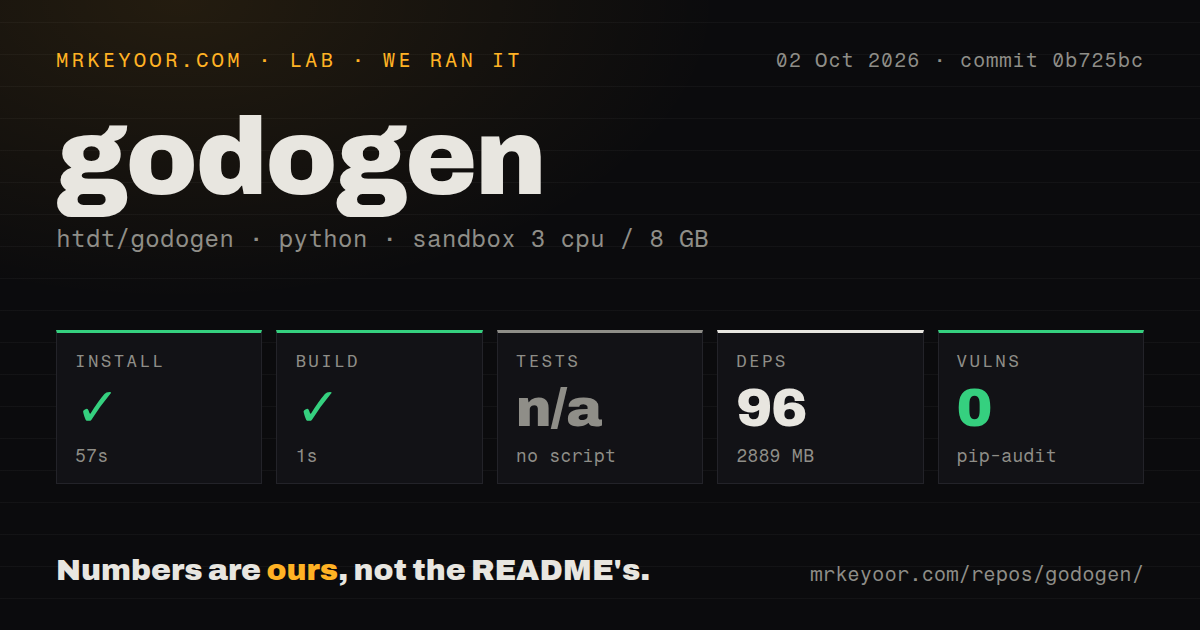
Our sandbox installed 92 packages in 49 seconds and left 3,078 MB on disk. The build succeeded in 7 seconds. Pip-audit reported 0 known vulnerabilities in that installed Python environment. The checkout itself was only 27 files, about 1,539 lines of source, and 0.1 MB, so most of the disk cost came after installation rather than from Godogen's own code.
There was no test script or target, so we skipped tests. Our scan also found 0 CI workflow files, no Dockerfile, and no tests directory. Those absences matter because this project delegates consequential work to an agent and several external generators. A clean build says the packaged tooling can be prepared in our Debian container; it does not tell us that a generated Godot, Bevy, or Babylon.js game will compile or look correct.
We did not run a full game-generation session or call paid asset APIs. The supplied measurements cover install, build, dependency audit, and repository signals only. There is no honest timing or success rate to report for prompt-to-game output, and a buyer should test that exact workflow with the chosen engine and art style before treating the demo video as representative.
Three service keys turn art generation into an operating cost
The asset skill uses GOOGLE_API_KEY for Gemini image generation, XAI_API_KEY for Grok image and video generation, and TRIPO3D_API_KEY for image-to-3D conversion. The README assigns different jobs to each service: precise references and characters, textures and simple objects, then 3D conversion and rigged animation. That division may produce more varied assets, but it spreads billing and service availability across 3 vendors.
A competent developer may stop here for policy reasons. Prompts and source art leave the machine, generated assets may have usage conditions outside the MIT license on Godogen's code, and unattended calls can cost money. The runtime does include decision checkpoints for taste, scope, and cost when the task is framed as open ended. Teams still need their own spend limits, key handling, asset review, and provenance rules.
Default macOS Bash can block the first publish command
The README says the project was tested on Ubuntu, Debian, and macOS, but open issue 37 documents a specific macOS failure. publish.sh uses ${ENGINE^}, which the system Bash 3.2 does not support. The reporter received bad substitution while publishing a Godot and Codex repository, then made the command work by replacing that expression locally. The issue was still open when checked.
This is fixable with a newer Bash or a small script change, yet it cuts against the copy-and-run setup shown in the README. More broadly, the published repository intentionally recreates its own scaffold and capture tooling from written guides. That keeps Godogen compact, but it also means model behavior is part of the build system. Pin the agent version, review generated scripts, and keep the first run disposable.
July code and August issues show attention without release packaging
GitHub listed 6,404 stars, an MIT license, and 8 combined issues and pull requests. The repository metadata recorded its last push on July 26, 2026, while new issue and pull request activity continued in August. There was no latest GitHub release endpoint to inspect; changes are documented in CHANGELOG.md, with the July 2 entry describing the current thin, documentation-led runtime.
Godogen earns a trial when the goal is to see how far an agent can push a game concept in one supervised session. Its 7-second build and tiny source tree make the generator easy to inspect, but the 3,078 MB environment, missing test target, engine stack, capture packages, and 3 service keys make the whole workflow substantial. Treat the generated game as a prototype until ordinary engine tests and human playtesting say otherwise.