go-zero joins API generation with service middleware
go-zero is both a web and RPC framework and a way of organizing services. Its goctl tool reads a .api definition and generates the Go server entry point, configuration type, routes, handlers, logic files, service context, and request and response types. It can also generate clients for iOS, Android, Kotlin, Dart, TypeScript, and JavaScript according to the README.
The runtime side bundles timeout propagation, concurrency limits, rate limiting, circuit breaking, load shedding, request validation, caching, service discovery, load balancing, tracing, metrics, and monitoring hooks. That saves integration work when a company wants the same rules across many services. It also places more behavior inside the framework, which can make an unfamiliar failure harder to trace than a small net/http stack.
A generated service starts on port 8888
The quick start installs goctl, creates a greet.api file, and generates a service directory from it. The generated YAML controls the service, which listens on port 8888 in the example. Business dependencies such as MySQL or Redis are passed through the generated service context. The handler calls logic code rather than asking users to write route and parsing boilerplate by hand.
This approach works best when the .api file is accepted as a source of truth. Open issue 5309 asks why go-zero cannot generate that file from OpenAPI, arguing that a private syntax can block adoption. That concern is specific and fair: an organization with an existing OpenAPI review, documentation, and client pipeline would either duplicate definitions or build a conversion step.
What happened when we ran it
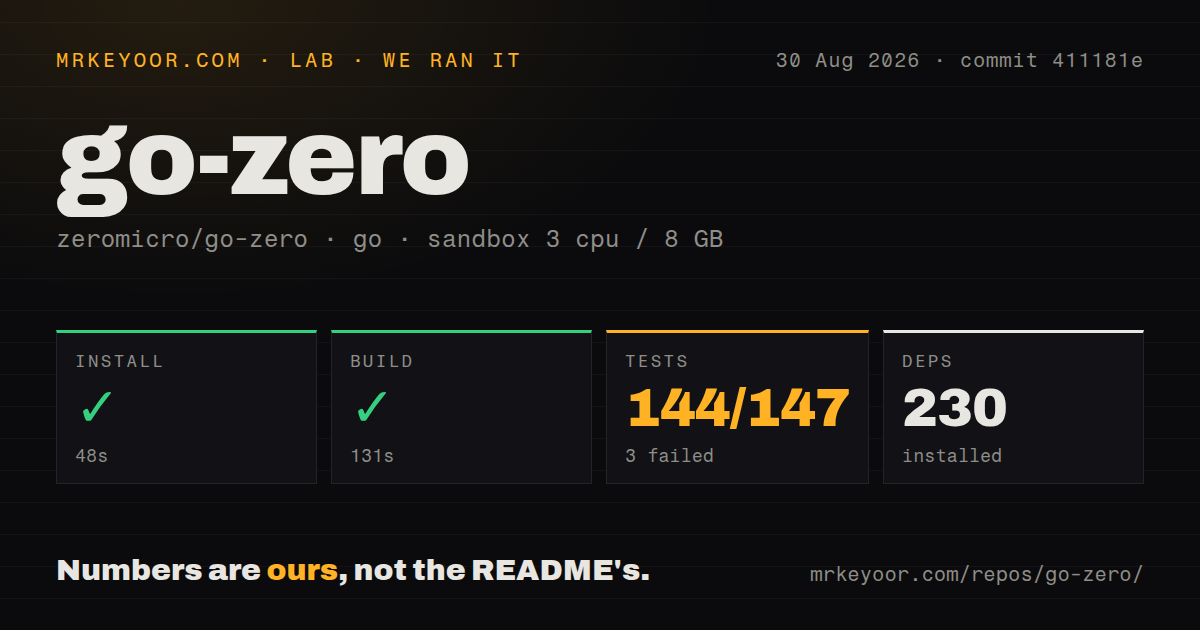
Our sandbox installed 230 Go packages in 48 seconds at commit 411181e. The checkout had 1,375 files, about 156,575 lines of source, and occupied 20.4 MB. Building succeeded in 131 seconds. The dependency and build results show that the repository compiles in the stated Go 1.24 Bookworm container without extra service credentials.
Tests ran for 108 seconds and exited with code 1. The harness counted 144 passed and 3 failed out of 147. The supplied end of the log lists successful packages under zrpc, including authentication, balancing, interceptors, and resolver packages, followed by the aggregate word FAIL. It does not include the names or errors of the 3 failed cases, so attributing a cause would be guesswork.
Our scan found 6 CI workflow files, no Dockerfile, and no separate tests directory. Go projects commonly keep test files beside the code, so that directory result does not conflict with 147 test outcomes. The useful conclusion is narrower: installation and compilation passed, but the complete command the lab ran did not. A buyer should reproduce those failures on the target operating system before choosing a workaround.
The framework makes resilience choices on your behalf
Timeouts, rate limits, circuit breakers, and load shedding are valuable only when their defaults match a service's traffic and failure modes. The README advertises adaptive behavior with little configuration. That is convenient for a first service, but production owners still need to know which requests are rejected, how thresholds move, what metrics expose the decision, and how retries interact with downstream timeouts.
Release v1.10.3 includes a Redis circuit-breaker fix for high concurrency and incompatible servers, which shows that these mechanisms continue to change. It also adds a consumer-group ID operation and fixes pointer-to-slice mapping, substring boundaries, and queue growth. Pinning the framework and reviewing release notes matters because a middleware change can alter behavior across every generated service.
Code generation saves typing and creates a contract
Generated files give teams a repeatable directory and keep request validation close to the API definition. The benefit grows when many services share the same conventions. The cost appears when a generator cannot express a case. Issue 4777 reports that Dart generation fails when a response embeds a common struct, with the template unable to find a property name. The report concerns that shape, not all Dart output.
Issue 5721 reports another boundary in v1.10.2: httpx.Parse rejected an interface{} field whose JSON value could be a string or number, while direct encoding/json decoding worked. That example tells adopters to test polymorphic request bodies, custom error responses, field tags, and generated clients before committing an API contract. Generated code removes repetition; it does not remove schema edge cases.
Documentation covers the path, but not every hidden decision
The English README provides installation, a complete small service, generated file layout, configuration, execution, and a curl request. English is the primary page, with Chinese and Korean translations linked. Longer examples and a separate documentation site cover multi-service work. A competent Go developer can get from an API definition to a running handler without reverse-engineering the first step.
Issue 4716 describes the harder phase of maintaining an older go-zero service. The reporter cites an 8 MB request-body parsing limit and default HTTP error behavior discovered in source rather than documentation. The issue is labeled stale and represents one user's experience, but the named examples are useful evaluation targets. Check limits, error formats, middleware order, and configuration overrides before standardizing a platform.
Same-day code activity outweighs the failed lab suite
GitHub recorded 33,290 stars, 259 combined open issues and pull requests, and a last push on August 30, 2026. Release v1.10.3 was published on August 1, while open issues received updates through August 29. That combination shows current code and issue activity; it does not explain the 3 failures in our separate sandbox.
go-zero makes sense for a team that wants a firm service template more than library-level freedom. The successful 131-second build and broad generated structure support a serious trial, while the failed suite requires investigation before approval. Build one representative service with the hardest request schema, downstream dependency, and client target, then decide whether the conventions remove more work than they create.