The official server turns GitHub actions into agent tools
GitHub MCP Server gives a compatible AI client structured access to GitHub. An agent can read code, search repositories, inspect commits, work with issues and pull requests, check Actions runs, review notifications, and query security products when the account has permission. Some tools can also create or update remote state. The MCP boundary replaces ad hoc command parsing with named operations and typed parameters, which makes tool use easier for a model and easier for a host to display.
The scope is broad for a 4.7 MB checkout. Our measured clone contained 552 files and about 109,568 lines of source. Toolsets cover repositories, Git data, issues, pull requests, Actions, discussions, projects, organizations, users, notifications, Dependabot, code scanning, secret protection, advisories, and more. The default is narrower: context, repositories, issues, pull requests, and users. That default still includes meaningful write surfaces, so configuration deserves the same attention as an API integration.
This server is most useful during exploratory work. A coding agent can inspect a failing workflow, open the changed files, connect the failure to a pull request, and draft a focused update without a developer copying context between browser tabs. For a fixed nightly task that always calls the same endpoint, MCP adds model choice where a GitHub CLI command or Octokit function would be clearer.
Hosted OAuth is easiest, while GHES needs the local server
GitHub operates a remote MCP endpoint for compatible clients. The README gives install paths for VS Code, Claude applications, Codex, Cursor, OpenCode, Windsurf, Zed, Copilot CLI, and other IDEs. OAuth removes the need to create a token manually in supported hosts. A personal access token remains available when the client cannot complete that flow. Host support varies, so the same JSON does not guarantee the same authentication behavior everywhere.
The local server runs as a Docker image or native binary. Its browser OAuth flow keeps the resulting token in memory and uses a loopback callback for the container example. Headless automation can use GitHub App authentication, while a personal access token takes precedence when configured. GitHub Enterprise Cloud with data residency has a hosted route, but GitHub Enterprise Server does not. GHES users must point a local server at their host.
Authentication is the real setup task. A server process can only do what its token allows, but an agent with a broad token can still make broad changes. Separate tokens by purpose, choose minimum scopes, protect configuration files, and avoid sharing a personal credential across unrelated projects. The README explicitly warns that some MCP hosts require hardcoded tokens because their environment-variable support is limited.
What happened when we ran it
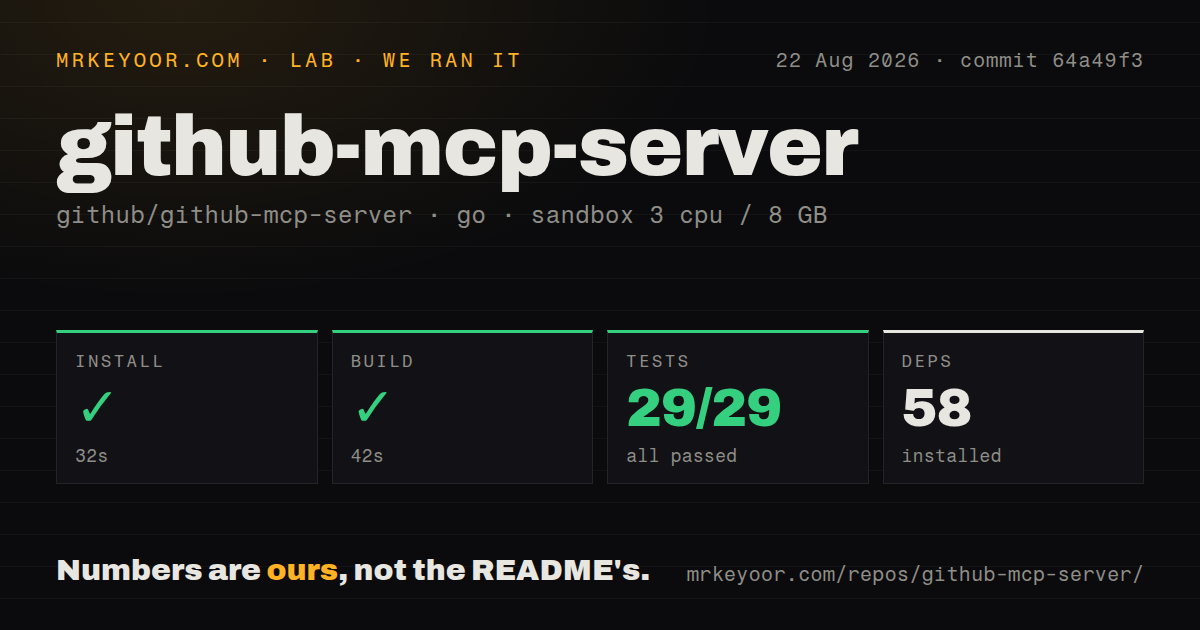
Our sandbox install at commit 64a49f3 succeeded in 32 seconds and added 58 Go packages. The build completed in 42 seconds. We used a fresh unprivileged Debian container with 3 CPUs, 8 GB of RAM, Go 1.24, and no secrets. The repository contained a Dockerfile and 13 CI workflow files, while tests were organized within Go packages rather than a separate tests directory.
The test command passed in 28 seconds. go test reported 29 passing tests and 0 failures out of 29. That clean result covers the command our harness invoked without GitHub credentials. It does not test a user's OAuth policy, enterprise host, MCP client, repository permissions, or a live write operation. Those integration boundaries should be exercised against a disposable repository before the server receives access to production work.
The combined install, build, and test path took 102 seconds. For an integration with dozens of tool families, that is a practical contributor baseline. More importantly, no failed test needs to be explained away. The remaining adoption risk sits in authorization, client behavior, and the agent's choice of tools rather than the measured Go build.
Read-only mode and narrow toolsets should be the default
Toolsets reduce both authority and context. Enabling only repositories and issues gives the model fewer similar operations to choose from and avoids advertising unrelated capabilities. Individual tools can be selected by name, and toolsets plus tools are additive. The README states that read-only mode takes priority and skips write tools even when they were requested explicitly. That is the right starting point for code search, issue triage, and workflow diagnosis.
Version 1.11.0 added per-call OAuth scope checks so each invocation can request the permissions it needs. The same release improved browser OAuth discovery routes, sub-issue creation, and HTTP caching for stdio use. Those changes show the authorization model is still being refined around real hosts. Treat an insiders endpoint as experimental and keep stable work on a tagged release.
Permission failures also need visible verification. Issue 3160 reports that an issue-write operation can silently omit labels when the caller lacks the label permission. A model may then say it completed the requested update because the overall call returned successfully. For consequential writes, read the issue or pull request back and confirm each changed field.
Daily releases and active bugs make this the default, not a free pass
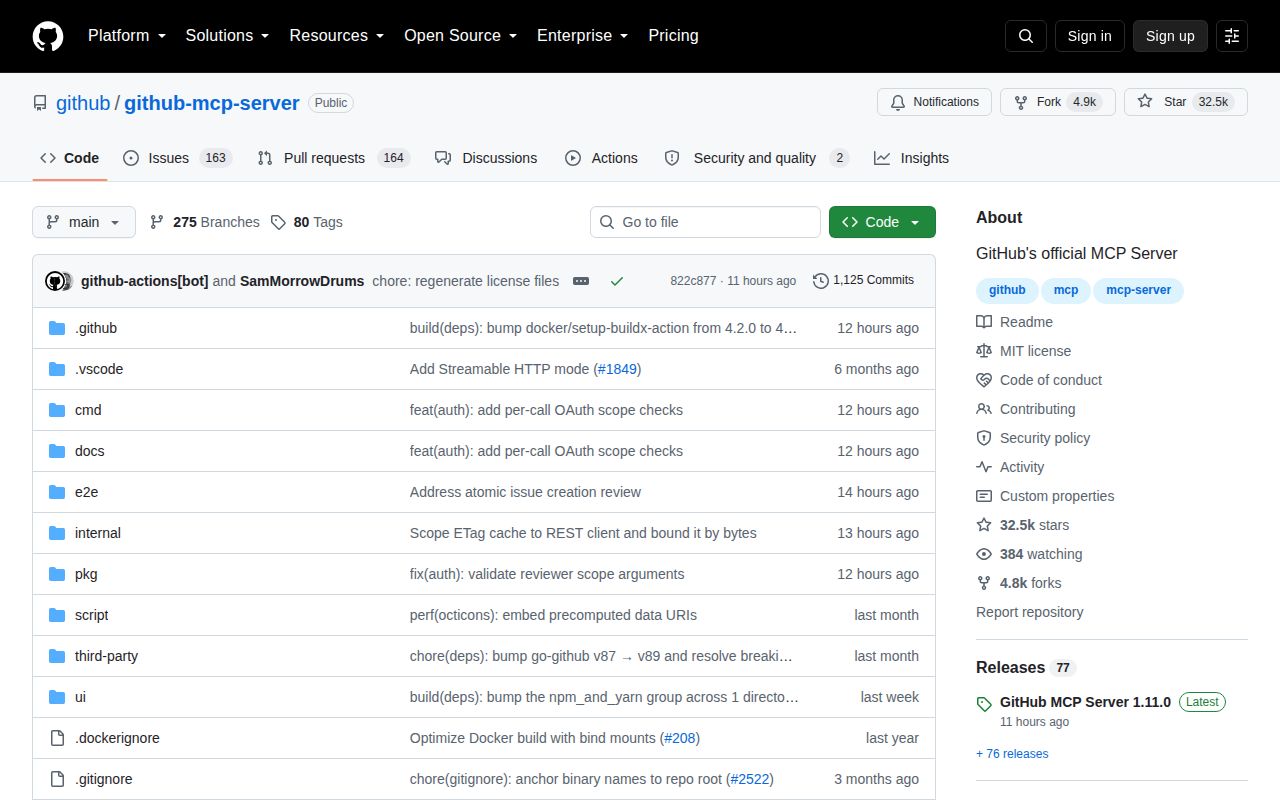
GitHub published v1.11.0 on 2026-08-25, the same date as the repository's latest recorded push. The project showed 327 open issues and PRs. Recent work covered rulesets, stacked pull requests, OAuth scopes, enterprise certificates, Copilot Spaces, API versions, and documentation mismatches. This is current product engineering, with bugs arriving alongside rapid additions.
GitHub MCP Server is the sensible default because it is maintained by the API owner, documents many clients, and passed our 29-test run. The recommendation comes with a boundary: let agents see only the tools and repositories needed for the task. A clean Go build cannot protect a repository from an over-permissioned token and a vague instruction.