Gentle AI v2.4.0 configures 16 agent integrations
Gentle AI is an ecosystem configurator for coding agents already present on a machine. The README lists 16 integrations, ranging from Claude Code, OpenCode, Cursor, Codex, and Gemini CLI to Windsurf, Kiro, Pi, and Hermes. Support is uneven by design: some clients get native subagents and phase routing, some operate as solo agents, Pi receives a package-managed harness, and Hermes is detected but installed manually. Gentle AI refuses to install a missing agent runtime and prints the command the user may choose to run.
Selected agents receive a common set of routing rules, skills, persona material, optional memory, MCP configuration, and spec-driven workflows. Small understood work is meant to stay direct. Broader exploration can be delegated, while durable specifications require an explicit request or accepted proposal. That policy is more thoughtful than forcing every edit through a heavyweight lifecycle. It is still policy encoded into generated configuration, so teams should read the resulting files and decide where local repository rules take precedence.
The 368,441-line system is larger than a skills pack
Our measured checkout at commit b01c52e contained 2,024 files, about 368,441 source lines, and occupied 24.6 MB. The primary implementation is a Go 1.25.10 module with a terminal interface, configuration logic, review state, installers, migration code, and agent-specific assets. Calling it a collection of prompts misses most of the maintenance surface. It manages state under ~/.gentle-ai, updates several clients, takes configuration backups, and coordinates optional tools such as Engram and OpenSpec.
Installation defaults to global agent directories, while workspace scope keeps supported prompts, skills, agents, and persona files inside one project. Global-only integrations remain global. The documentation recommends a dry run first and provides doctor as a read-only check for binaries, state validity, Engram reachability, and disk space. Every install, sync, and upgrade snapshots configuration, keeps 5 recent backups, and allows pinned backups. Those safeguards matter because the tool is intentionally changing other tools' configuration.
What happened when we ran it
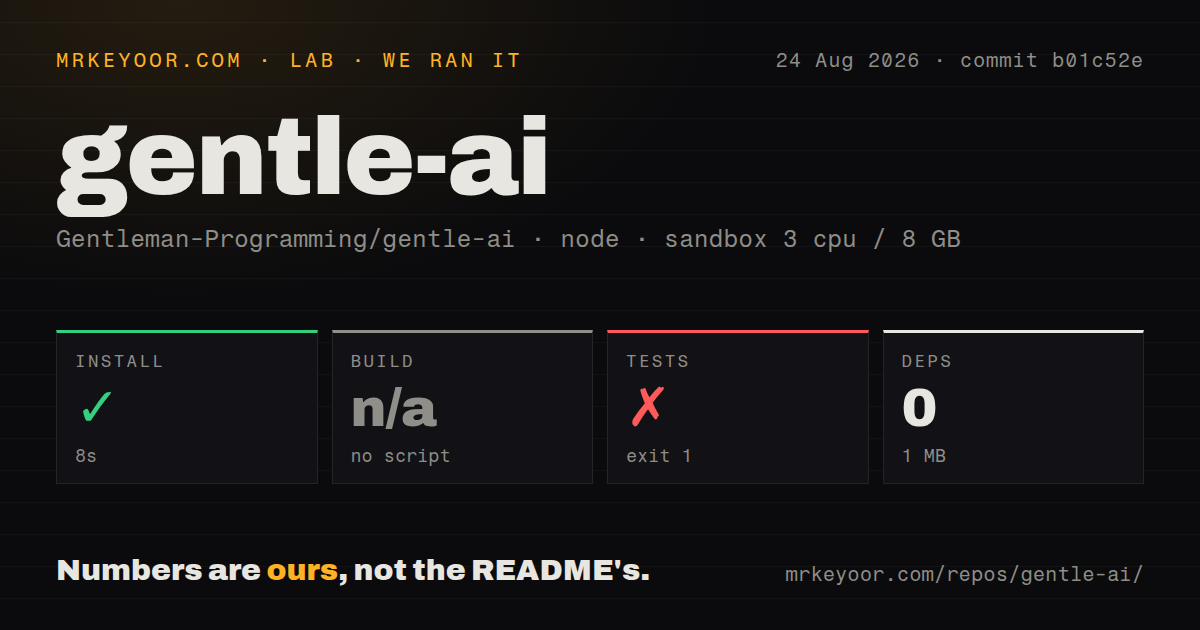
Our Node-oriented harness installed 0 packages in 8 seconds and used 1 MB on disk. It found no root build script, so build was skipped. The root package has a test script, but that script only echoes Error: no test specified and exits with status 1. The measured test step therefore failed after 6 seconds without executing a product test. It is a repository hygiene finding, not evidence that a Gentle AI Go behavior failed.
The harness classified the repository as Node because of that package file, although the product module is Go. We found 6 CI workflow files and no dedicated tests directory. Go projects commonly place test files beside source rather than in one directory, so that signal does not prove an absence of Go tests. The latest release says its exact commit passed the main CI and Windows full suite. Our standardized run did not reproduce those claims because it never invoked Go.
A useful local evaluation should begin with the documented dry-run command, then inspect every proposed destination. After a controlled workspace install, run the chosen agent and verify its rules, skills, MCP entries, and model settings. Upgrade testing must include gentle-ai sync, because replacing the binary alone does not refresh managed runtime assets. Our 8-second package step says almost nothing about that end-to-end operation.
Review receipts stay informational in every mode
Receipt-driven development, or RDD, freezes one candidate and records bounded evidence from a risk-based review. Low-risk work can receive structural readback, while higher-risk work can involve focused reviewers and one bounded correction. Version 2.4.0 changed the default to off. Users enable review explicitly, and existing explicit settings survive upgrade. When review is disabled, ordinary hooks, tests, CI, and repository policy remain responsible for delivery.
That boundary prevents a receipt from becoming accidental authority. The README repeatedly states that review does not authorize or block a commit, push, pull request, or release. Teams expecting an approval gate must supply one through their repository platform. The release also names unresolved cases: global authority locks slow down with lineage count, a path over 4 MiB can loop on refusal, and review lineages have no retention policy. store-reset exists as a manual exit, with preview as the default and confirmation required.
Windows still requires Go while macOS and Linux get archives
First installation requires Git 2.38 or newer, Node 18 or newer, npm, and a supported agent. Source builds require Go 1.25.10. Version 2.4.0 publishes 4 signed archives for Darwin and Linux across amd64 and arm64, with a Minisign-signed checksum manifest. The release deliberately omits Windows binaries until its Authenticode requirements are met, so Windows users install through the tagged Go module.
The main README we fetched still called v2.3.0 stable and v2.4.0-rc.1 the prerelease, while GitHub's latest release endpoint returned stable v2.4.0 from August 17. That is a documentation lag worth noticing in a tool that manages update channels. An exact Go tag is the clearest reproducible installation. The managed installer follows a channel's newest version and does not accept an arbitrary pin.
Same-day activity comes with an 870-item tracker
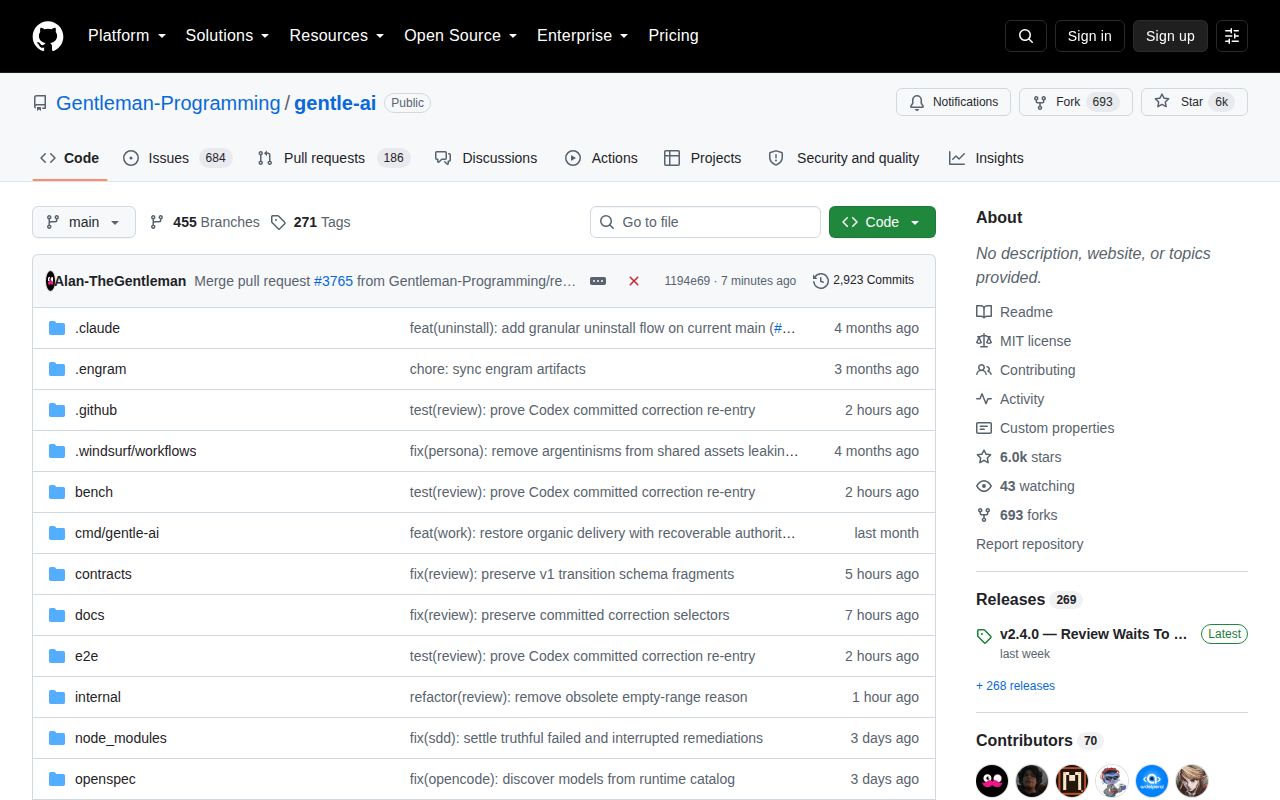
GitHub recorded 5,962 stars, 870 open issues and pull requests, and a last push on August 26, 2026. Issue discussions were also updated that day, and several carry dozens of comments. This is an active project with a very large public work queue. The combined count includes pull requests and generated maintenance items, so it cannot be translated into 870 bugs. It does show that evaluating one happy-path install is insufficient.
Current reports include invalid Claude Code tool frontmatter that prevents review lens agents from spawning, stale OpenCode binaries reading newer authority state, and fresh SDD attempts blocked by authority failures. These are central workflow paths, even though each issue needs version-specific confirmation. Gentle AI fits developers who want one explicit operating system for several coding agents and will monitor its fast-moving release notes. A single-agent user can get most of the value with a smaller skills project and ordinary repository checks.