Context7 gives coding agents version-specific library documentation
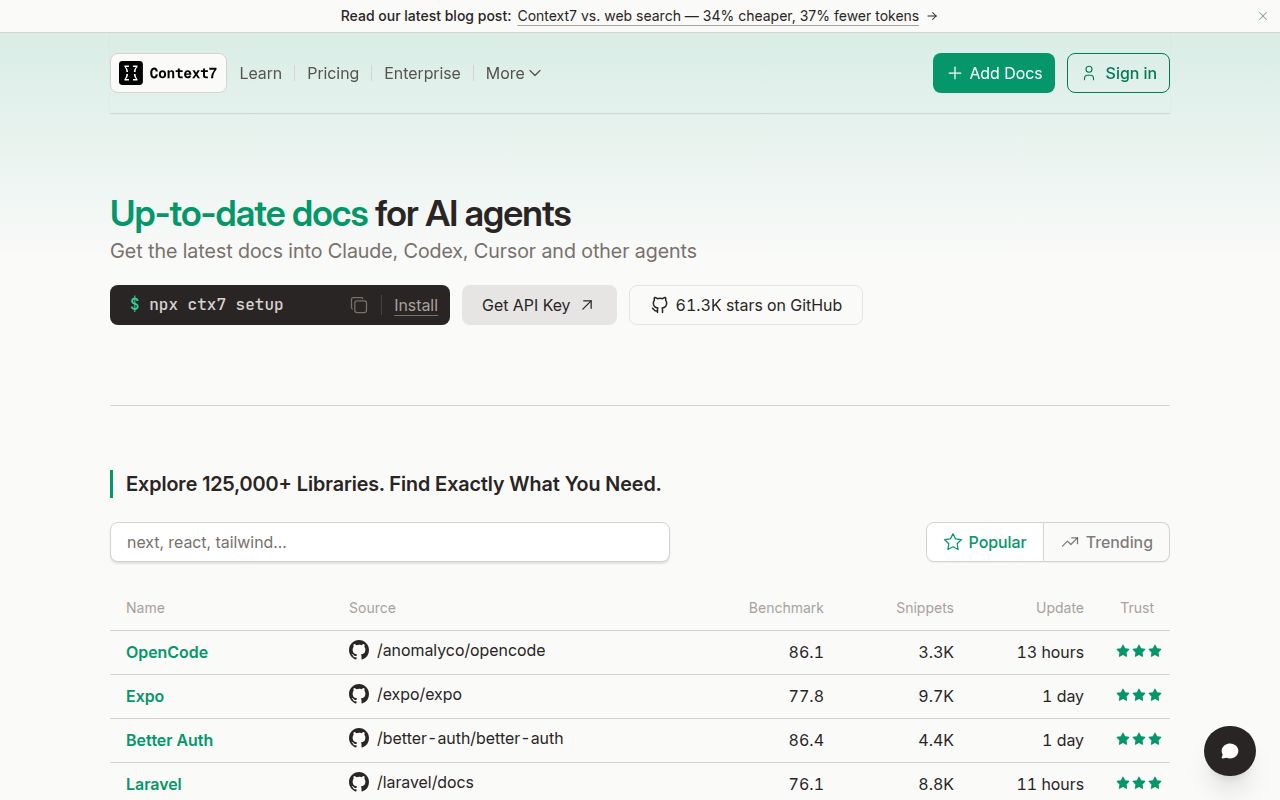
Context7 answers a narrow problem that shows up daily in agent-assisted programming: the model remembers an older API, invents an option, or mixes versions. The service resolves a library name to a Context7 ID, then returns documentation and examples relevant to a query. You can call it through two MCP tools, resolve-library-id and query-docs, or use the ctx7 command line when MCP is unwanted.
The README asks users to include an exact library ID and version when they know them. A prompt can name /vercel/next.js and Next.js 14, for example, which skips one matching step and narrows retrieval. That small discipline matters. A documentation service can supply current text, but the agent still needs a precise target and must apply the retrieved API correctly to the code in front of it.
One setup command installs a skill or MCP connection
npx ctx7 setup requires Node.js 18 or newer, authenticates through OAuth, creates an API key, and installs the selected integration. Flags target Cursor, Claude, or OpenCode. Manual clients connect to https://mcp.context7.com/mcp and send the key in an Authorization header. The key is recommended rather than mandatory because it raises rate limits, so a quick trial does not begin with local infrastructure.
That convenience comes from using Context7's service. The public repository contains the MCP server, CLI, TypeScript SDK, Vercel AI SDK tools, and a pi extension. Its README explicitly excludes the API backend, parsing engine, and crawling engine from the repository. A company that needs the whole ingestion path inside its own network cannot recreate the hosted product from this checkout alone.
What happened when we ran it
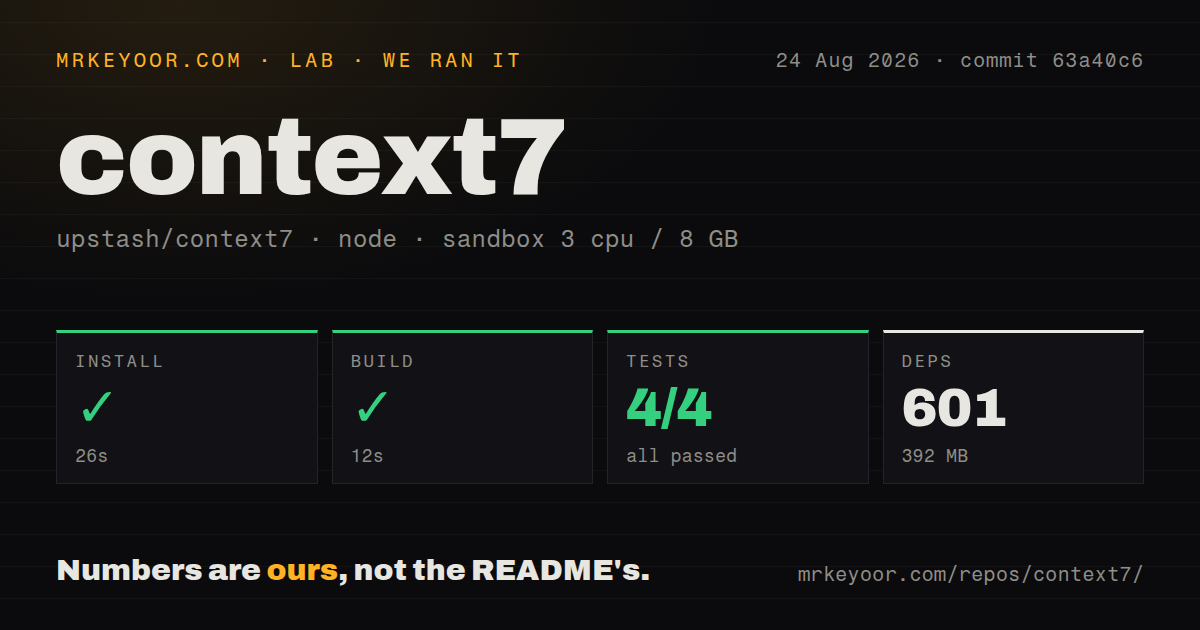
Our run at commit 63a40c6 installed 601 pnpm packages in 26 seconds and used 392 MB on disk. The monorepo build succeeded in 12 seconds. The checkout itself held 410 files, about 15,144 source lines, and 21.9 MB. Those figures make the client code approachable compared with many agent platforms, though 392 MB is still a meaningful dependency footprint for two simple retrieval operations.
The test command failed with exit code 1 after 10 seconds. Its top-level measurement recorded 4 passing tests and 0 failed tests. The log tail adds important detail: the pi package showed 4 passing tests, the CLI showed 254 passing tests, and the SDK showed 4 passing tests while 3 of its 4 test files were marked failed. pnpm then stopped at @upstash/context7-sdk with ERR_PNPM_RECURSIVE_RUN_FIRST_FAIL.
The supplied tail does not include the errors that made those 3 SDK files fail. Passing assertions alongside failed files can happen for several reasons, but this log does not establish one. The responsible conclusion is limited: install and build worked in our 3-CPU, 8 GB unprivileged Node 22 sandbox, while the full repository test command did not. Our scan also found 6 CI workflow files, no Dockerfile, and no top-level tests directory.
Community indexing can be incomplete or too large
Context7 says projects in its index are community contributed and disclaims guarantees about their accuracy, completeness, or security. That is more than legal padding for an agent tool. Retrieved documentation can enter a prompt and shape code, commands, or configuration. Developers should inspect the named library, version, and returned source before accepting a change, especially for authentication, deployment, or destructive operations.
Current issues show concrete ingestion limits. Issue #3079 reports an Unreal Engine API documentation source that ended as too large to process. Issue #3086 asks maintainers to refresh a 2,829,655-token library manually because automatic refresh cannot handle it. Another report, #3071, marks a documentation crawl as failed. These are catalog records rather than client crashes, yet they determine whether a query receives current and complete material.
Library selection can also introduce ambiguity. Context7 recommends exact IDs because a general name must first be resolved. If a team depends on a small set of frameworks, pin those IDs in agent rules and include the desired version in the question. Treat an empty or weak result as a reason to open first-party documentation, not permission for the model to fill missing APIs from memory.
August fixes show activity across CLI and MCP paths
GitHub recorded the last push on August 26, 2026, with 57 combined issues and pull requests. The latest release was @upstash/context7-mcp@4.0.3, published August 21. Recent work covers Git Bash path handling, cancelled JSON-RPC batches, Codex configuration preservation, and OAuth issuer metadata. New library verification and refresh requests were also being handled in the same week.
One open pull request, #3068, says it closes an authentication bypass in which unsupported bearer values could reach the MCP handler. Because the pull request was open when fetched, its proposed validation should not be described as released protection. Security-sensitive users should check whether that change reached the version they deploy and should keep the MCP package current rather than treating a hosted URL as maintenance-free.
Context7 saves lookup time when its catalog has the right source
The product is easiest to justify for developers who ask agents many framework questions and are tired of correcting old syntax. Its two-tool MCP surface is understandable, the CLI path avoids MCP overhead, and setup completed quickly in our sandbox. The service also supports more than one coding client, so a team can keep a common documentation source while editors differ.
The limits are equally plain. You cannot self-host the complete indexing system from this repository, some large sources need intervention, and our pnpm test command exited 1 despite passing assertions in the visible summary. Context7 should be a retrieval aid with source checking, rather than an authority that turns every generated answer into verified code.