It is a runtime inspection toolkit, not a conventional debugger
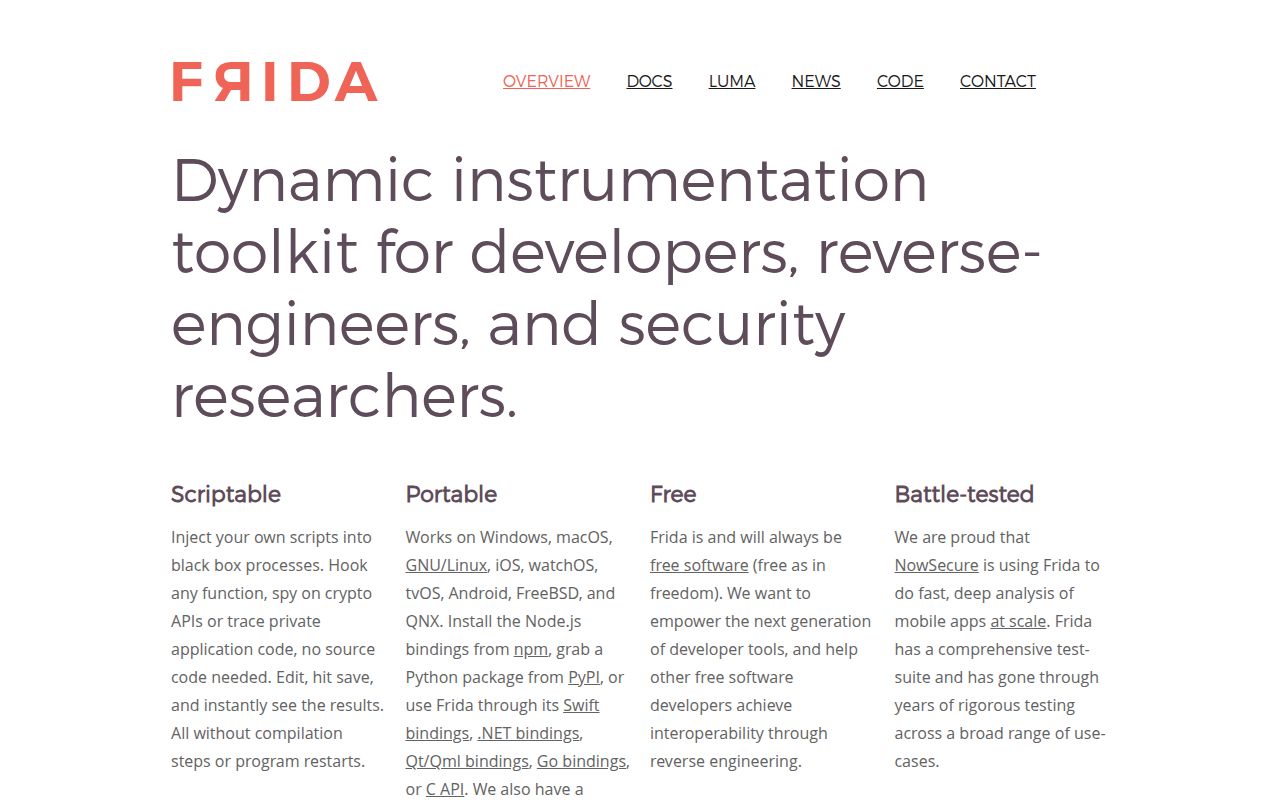
Frida exists for the moments when source code, logs, and ordinary breakpoints do not tell you enough. It attaches to running software and gives developers, reverse-engineers, and security researchers a way to observe or alter behavior through scripts and command-line tools. The repository dates to 2013 according to the supplied community item, and its 21,872 GitHub stars show that it is not a niche experiment. This is infrastructure for people who already understand processes, functions, and the risks of changing a live program.
The appeal is breadth without forcing everyone into one programming language. The README offers Python bindings through pip install frida, Node.js bindings through npm install frida, and a separate frida-tools package for the CLI. It names practical commands including frida-ps, frida-kill, frida-trace, frida-discover, and frida-ls-devices. That gives a team at least 3 useful entry points: scripts, application bindings, and interactive terminal work.
What happened when we ran it
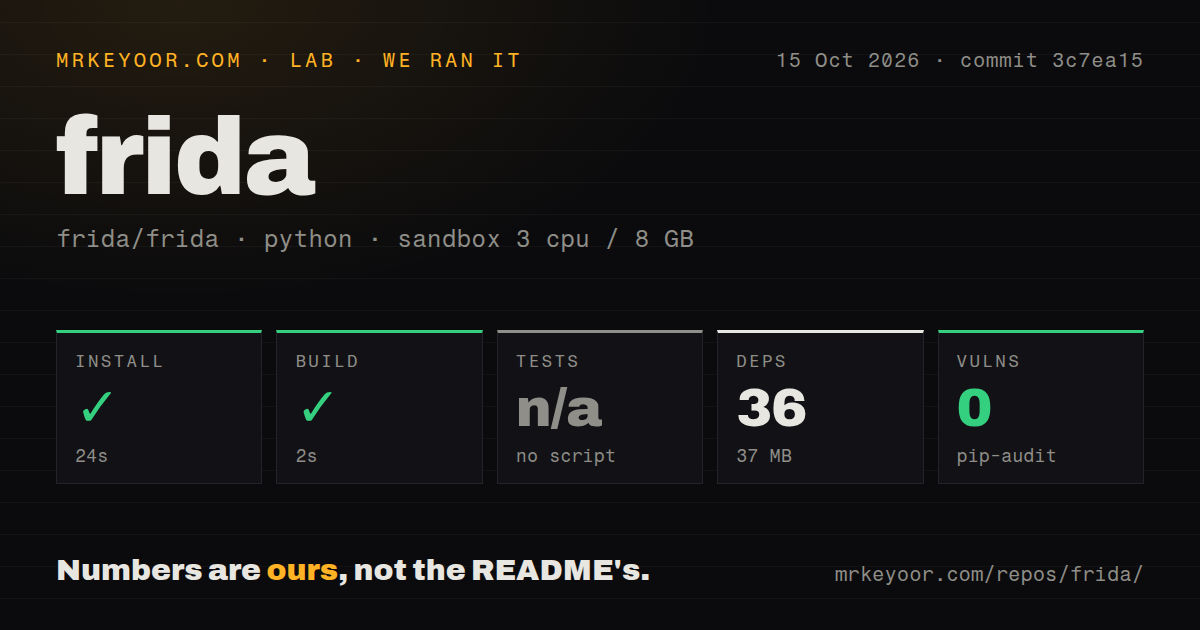
Our run used commit e71d1f5 in an unprivileged Debian container with 3 CPUs and 8 GB of RAM. The checkout was substantial: 52,604 files, about 1,665,075 lines of source, and 174 MB on disk. The measured Python ecosystem project lived under ./releng/meson/, which matters because a newcomer browsing the repository root may not immediately recognize that as the relevant project location.
Installation succeeded in 42 seconds. It brought in 36 packages and occupied 37 MB, then the build completed successfully in another 10 seconds. Those results are encouraging for a repository of this size, and they make the prebuilt-binary recommendation look sensible. They are not performance benchmarks for Frida itself, only setup observations from our box.
The missing piece was test evidence. Our automation found no test script or target, so it skipped tests instead of reporting a pass or failure. pip-audit found 0 known vulnerabilities in the installed Python dependency set, but that result does not audit 1.6 million lines of repository source. We also found 1 CI workflow, no Dockerfile, and no tests directory. The build result is real; the verification story in this particular sandbox remains incomplete.
The fastest route is packaged, while source builds expose platform work
The README is commendably direct about recommending prebuilt binaries first. The Python and Node.js commands are short enough to try in minutes, and release assets are another stated route for supported operating systems. For people evaluating Frida, that minimizes the distance between discovery and a first attached session. Version 17.17.0 was released on August 5, 2026, so the supplied package story is tied to a recent named release rather than an ancient snapshot.
Building from source is presented as make, optionally preceded by ./configure for a prefix or other choices. That simplicity has limits. Apple builds require a trusted code-signing certificate, inspection through security find-identity, and environment variables for macOS, iOS, watchOS, and tvOS identities. CLI use also calls for 4 additional Python packages: colorama, prompt-toolkit, pygments, and websockets. These instructions are useful, but they reveal that real setup effort depends heavily on target platform and intended interface.
Its strengths are practical interfaces and a focused purpose
Frida does not bury its identity beneath a sprawling product pitch. The README says who it is for, offers 2 installation routes, names concrete tools, and points to dedicated documentation at frida.re. That focus is valuable in security work, where the operator often wants to enumerate processes, trace calls, or connect a script to a live target without adopting a full integrated development environment. Python and Node.js bindings also make it easier to place instrumentation inside repeatable internal tooling.
The project also shows current maintenance signals. The repository was pushed on September 8, 2026, one day before our review, while the latest release was about 5 weeks old. Taken together, those dates indicate active development, not a project surviving only on historical popularity. The 21,872-star audience gives users a large pool of potential shared knowledge, although stars alone do not promise fast support or compatibility with every target.
The rough edges are scale, assurance, and implied expertise
The first concern is verification. A successful 10-second build is helpful, but no runnable test target means our environment could not demonstrate expected behavior after compilation. The repository metadata supplied to us also reports the license as NOASSERTION. That is not proof that the project lacks licensing terms somewhere, but it is a clear due-diligence task for any company planning redistribution, embedding, or policy-controlled use.
Issue volume deserves similar nuance. There are 1,962 open issues, which may reflect both the large user base and the difficult cross-platform surface. Combined with a push from 1 day ago and release 17.17.0 from August, the number does not support calling the project abandoned. It does suggest that adopters should search existing reports, reproduce problems against their exact OS and architecture, and avoid assuming that a popular tool provides a quick resolution for every device-specific failure.
It belongs beside scripts, debuggers, and security workflows
In a real stack, Frida fits as a specialized runtime lens. A researcher can use the CLI during exploration, move stable observations into Python or Node.js automation, and keep ordinary debuggers and static-analysis tools for questions they answer better. Objection is the easier alternative when the task is a guided mobile assessment because it builds on Frida, while DynamoRIO, QBDI, or Microsoft Detours may fit teams creating lower-level or platform-specific instrumentation.
Adopt Frida deliberately. Start with the prebuilt route, pin the 17.17.0-era components you validate, and test against the exact devices, applications, and operating systems in scope. Treat scripts that modify live behavior as privileged engineering artifacts, with review and controlled execution. The project earns a place in a serious reverse-engineering toolbox, but its 174 MB checkout, platform signing requirements, undeclared license metadata, and unexercised tests make it a poor casual dependency.