Five products under one free account
Freebuff applies the same agent system across a terminal command, desktop application, browser builder, hosted GitHub worker, and research chat. The CLI is the easiest entry: install the freebuff package globally, run it inside a project, and describe the change. Agents find relevant files, edit them, run commands, and review the result.
Desktop adds parallel local workspaces, which reduces collisions when several agents act on one repository. Web focuses on building and publishing full-stack applications. Cloud works against connected GitHub repositories in hosted environments, while Chat handles research and general reasoning. This range is convenient for one user moving between tasks, though each surface introduces a different data and permission boundary.
The orchestration comes from Codebuff. Tasks can be split among agents for context gathering, implementation, browser research, and review. Desktop can also call locally installed Claude Code and Codex agents through the user's existing provider accounts. Those connections are separate from Freebuff's included model catalog and its session allowances.
Free means ads, quotas, and conditions
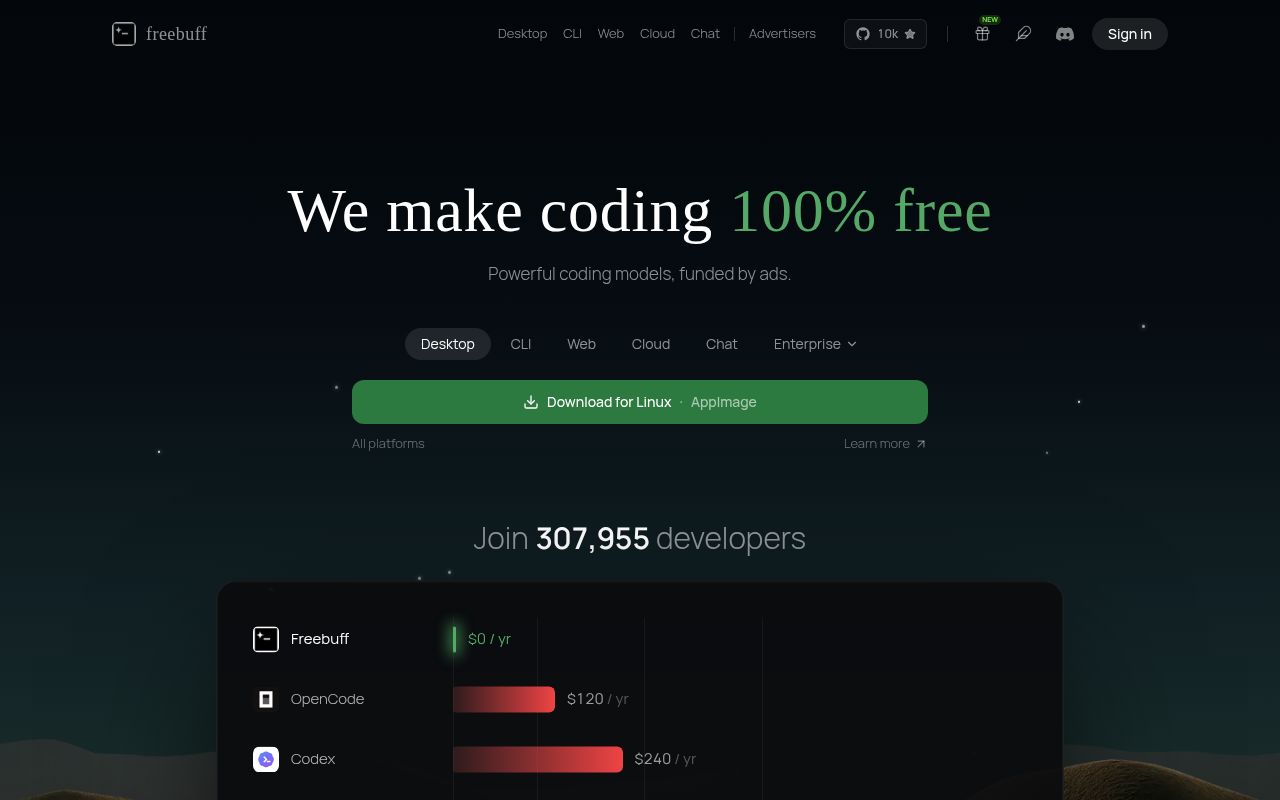
No subscription, credits, or personal API key are required for included models. Text ads fund that access. The regular model picker changes with capacity and tier, and the README describes daily limits on some models as temporary. Limited-mode access also differs by region and VPN status. A free coding session is therefore available, but a particular model at a particular allowance is not a durable interface contract.
The data terms deserve a full read before pointing Freebuff at work code. Prompts, messages, code, files, and repository data are processed to provide the service. Freebuff may analyze prompts and messages, including pasted material, to personalize ads. It says separate uploads and connected repositories are not given to advertising providers.
Training use depends on the notice attached to a model or feature. When that notice says data may be used, Freebuff or the provider may retain submissions to develop, train, test, evaluate, fine-tune, or improve models and products. That is materially different from a blanket promise that code never contributes to training. Regulated teams and developers handling customer secrets should choose models and accounts under an approved data agreement, or use a self-hosted alternative.
What happened when we ran it
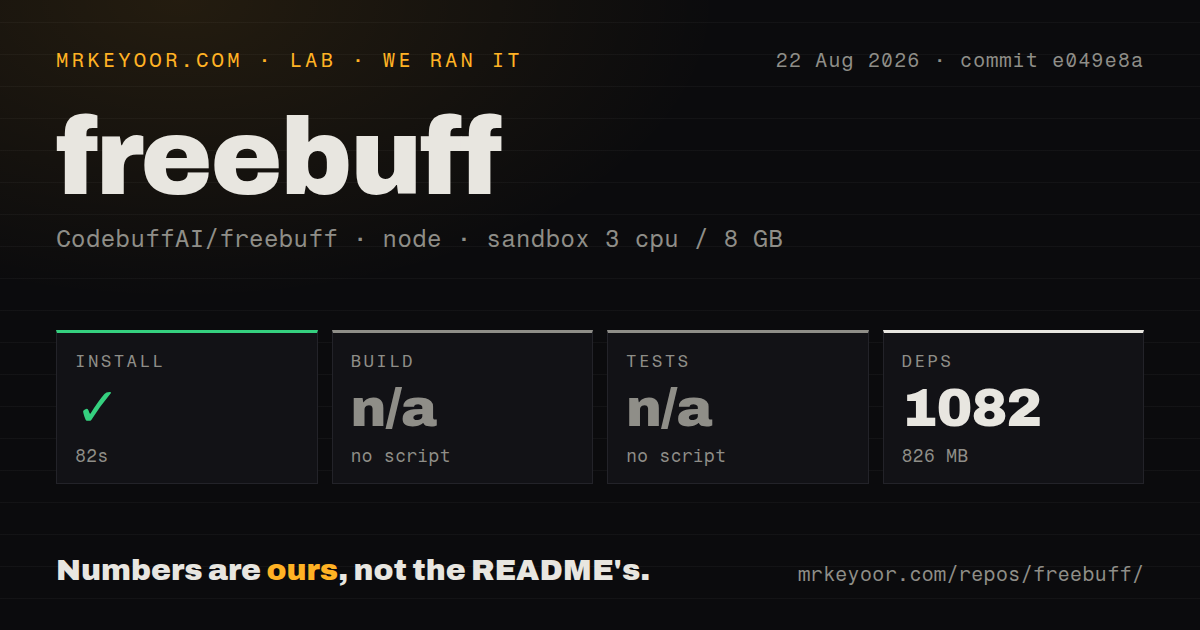
We cloned commit e049e8a into a fresh Debian container with three CPUs, 8 GB of RAM, Node 22, no secrets, and an unprivileged user. The TypeScript monorepo contained 1,432 files, about 260,848 lines of source, and occupied 30.5 MB before dependency installation. It uses Bun workspaces and had two CI workflow files, with no Dockerfile or tests directory detected by the harness.
Installation succeeded in 82 seconds. Bun installed 1,082 packages, and the resulting dependencies used 826 MB on disk. The root workspace did not provide the standard build script or target our harness looks for, so no build ran. It likewise exposed no test script or target, so no tests ran. These skipped steps are neither passes nor failures.
Contributor documentation names component commands including bun run build:sdk and bun run build:freebuff, and the testing guide describes a large set of package-specific CI jobs. Our result says the generic root path did not expose a single build or test gate to an automated fresh-checkout runner. It does not say the repository contains no buildable packages or tests. That distinction should be made clearer in the root scripts.
Open source with a private center
The public repository is a mirror of a private source tree. Contributions are welcome in the CLI, SDK, common libraries, agents, runtime, code map, model providers, selected Freebuff code, tmux scripts, and documentation. Backend, database, billing, deployment, secret-management, internal packages, and the private web application are excluded.
Accepted public pull requests do not merge normally. A maintainer ports the change into the private repository, and a later export brings it back. That process can work for focused fixes, but it weakens the normal Git chain between contribution, merge commit, and release. It also means this Apache-licensed checkout is insufficient for running an independent copy of every advertised service.
Issue and pull-request triage is automated daily. Inactive items can be closed after 28 days, with a warning seven days beforehand, and replies can keep or reopen them. Model outages and daily limits are sent to Discord rather than tracked as repository defects. That policy bounds a busy queue, but researchers comparing issue history should account for automated closure.
Tests exist, but the entry point is specialized
The testing guide shows serious thought about false green builds. Package tests use shared environment fixtures, CI guards fail when test or file counts drop below recorded baselines, and unit suites that pass only on retry are treated as failures. The guide also documents real past defects involving shared ports, timers, global DOM state, and test-order dependence.
This is useful engineering evidence, yet it lives far from the quick start and did not translate into a root test target our harness could execute. A contributor must follow package-specific setup, provide a safe fixture environment, run SDK preparation where required, and choose the correct workspace command. Local development also requires Docker and .env.local.
The repository was pushed August 22, 2026, and issues were active the same day. GitHub showed 292 open issues and pull requests combined. There was no latest GitHub release, so users installing the published CLI or desktop app cannot use this repository's release feed as a clean map from source commit to distributed version.
Freebuff is easiest to recommend as an experiment for personal or non-sensitive code. The included model access lowers the first-use cost, and the product range is broader than most coding-agent projects. Teams that need stable entitlements, strict data handling, full self-hosting, or a conventional public contribution history should choose a different tool.