mrkeyoor.com_
Sat 26 Sept 10:52 UTC
AI Toolsevaluationupdated 26 Sept 2026

undress-service review

Dress AI Service presents itself as a self-hosted wardrobe catalog, outfit recommender, and AI visualization API built with Python and FastAPI. The checked-in source does not deliver that complete product: runtime modules and Docker inputs are missing, while the Python package metadata installs an unrelated archive downloader called CoomerTool.

Verdict

Our install pulled 158 packages, used 5,880 MB, and returned 228 known vulnerabilities, while the checked-in service still lacks modules required by its own routes. Do not deploy this repository or use it as an application foundation in its current form. It is suitable only for a disposable source-reading exercise, and a focused virtual try-on project is the better starting point.

We ran it

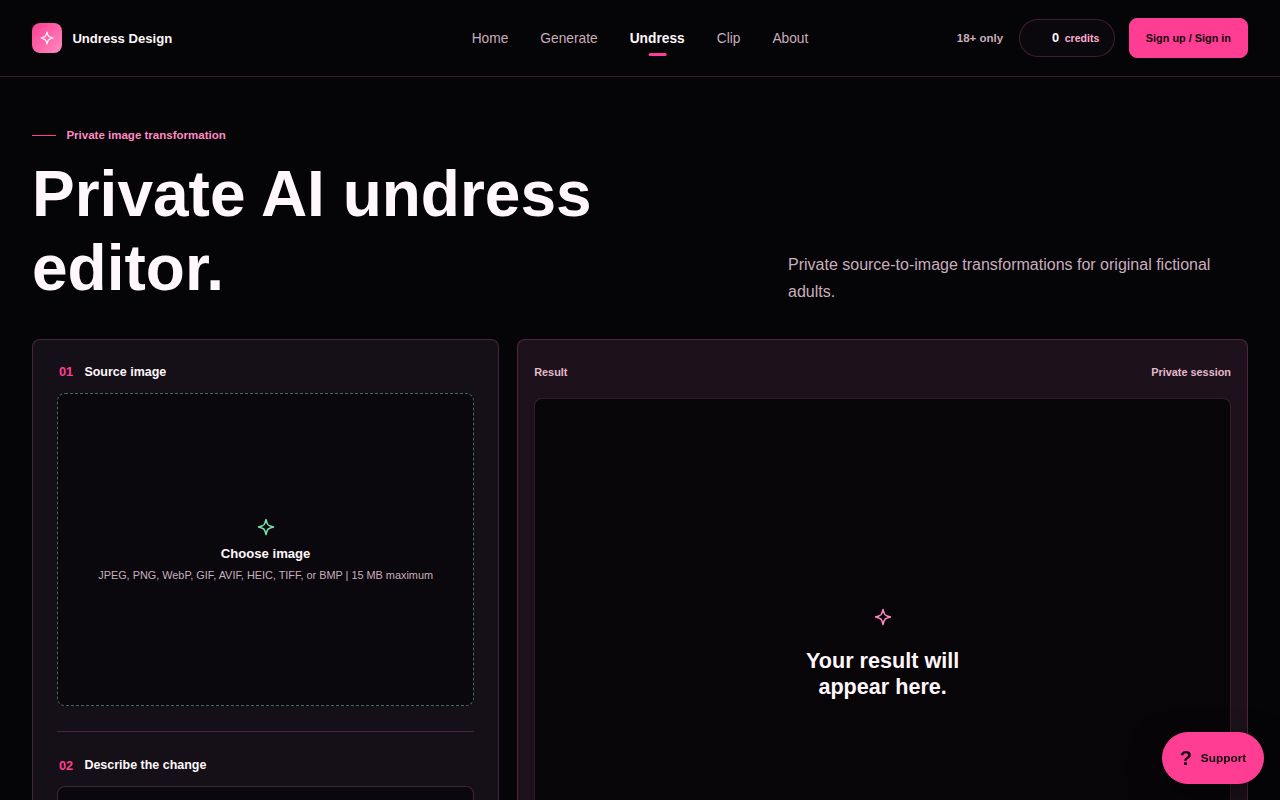
Lab card: what happened when we ran undress-serviceScreenshot of undress-service (undress.design/undress)
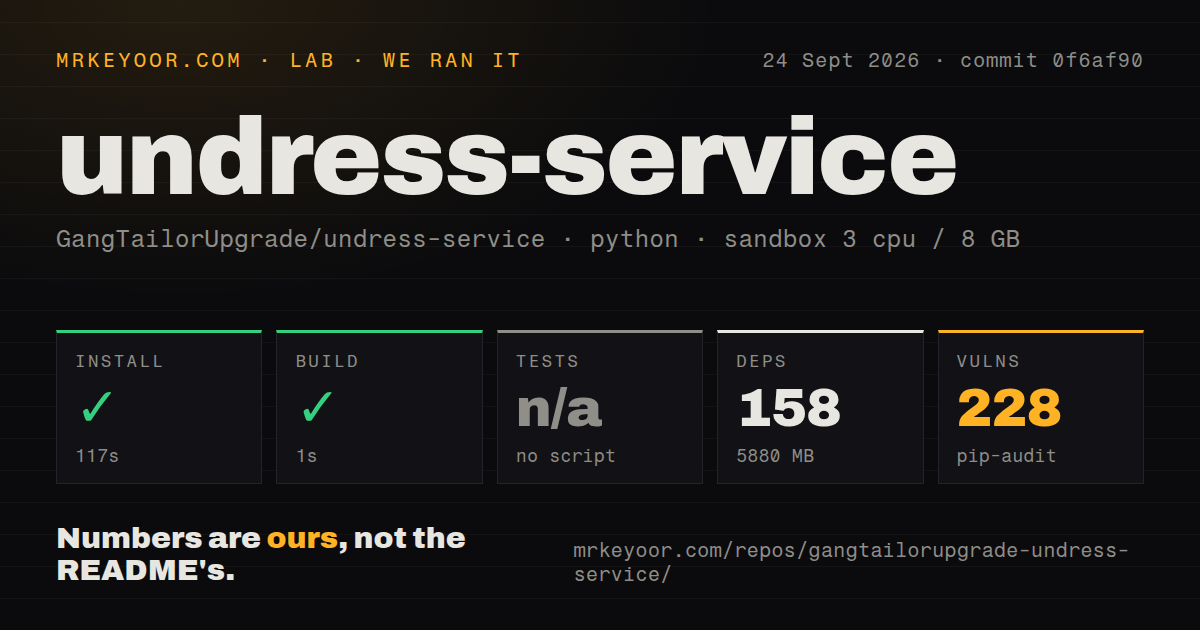
Install✓ · 117s158 packages · 5880 MB
Build✓ · 1s
Testsn/ano test script
Known vulns228(pip-audit)
Repo32 files~1,902 lines of source · 1.5 MB · 0 CI workflows · Dockerfile

Answers from our run

Does undress-service build from source?

Dependencies installed in 117 seconds (158 packages), and the build succeeded in 1 seconds. We cloned commit 0f6af90 into a clean Debian container with 3 CPUs and no project-specific setup.

Does undress-service have tests you can run?

Not through a standard command: the project exposes no test script or target that our harness could run.

Does undress-service have known vulnerabilities in its dependencies?

pip-audit flagged 228 known advisories in the dependency tree at the time of our run.

Who should not use undress-service?

Anyone who needs the advertised Docker quick start: the Dockerfile copies scripts/, migrations/, and alembic.ini, none of which exists in the repository tree.

What are the alternatives to undress-service?

OpenTryOn, FASHN VTON v1.5, IDM-VTON. Our install pulled 158 packages, used 5,880 MB, and returned 228 known vulnerabilities, while the checked-in service still lacks modules required by its own routes.

Setup1/5117-second install, but runtime modules and Docker paths are missing
Docs1/5README commands, package metadata, and checked-in source conflict
Community2/51,221 stars, one unanswered issue, and little issue discussion
Maturity1/5No release, CI workflow, tests directory, or complete app tree

Who it’s for

Developers studying how a small FastAPI wardrobe prototype might be arranged, without expecting it to run unchanged.
Researchers willing to inspect the code in a disposable environment and replace missing services themselves.
Maintainers interested in repairing a 1,902-line scaffold rather than adopting a finished fashion application.

Who it’s NOT for

Anyone who needs the advertised Docker quick start: the Dockerfile copies scripts/, migrations/, and alembic.ini, none of which exists in the repository tree.
Teams handling personal clothing photos on a reachable server: the upload, listing, and delete routes show no authentication dependency, and the default secret is change-me-in-production.
Developers following the Mac one-line setup: the README tells them to run npm install against a Python repository with no package.json.
Buyers expecting the described outfit generator to be complete: its routes import absent image_gen.py and outfit_engine.py modules, while setup.py publishes the separate coomertool command.
Teams that require a tested dependency base: our run found no test target, no tests directory, no CI workflows, and 228 known vulnerabilities.

Setup reality

Our 3-CPU, 8 GB sandbox installed commit 0f6af90 in 117 seconds. It pulled 158 packages and used 5,880 MB on disk. The build succeeded in 1 second, no test script or target existed, and pip-audit reported 228 known vulnerabilities.

The README's Mac command uses npm, although the checkout is Python and has no package.json. The Python path needs a model download for CLIP, local storage for uploaded images, and optional Ollama and OpenWeather services. SQLite is the default, so the basic configuration does not require a database credential.

A successful build did not prove that the web service starts. The FastAPI routes import two modules absent from the 32-file tree, and the Dockerfile copies three absent paths. GPU deployment also expects the NVIDIA container runtime and model assets that our sandbox did not exercise.

The README promises a wardrobe app, while the package installs a downloader

The README describes Dress AI Service as a private wardrobe catalog with automatic tagging, outfit recommendations, weather-aware styling, and generated outfit pictures. That would be a useful self-hosted product. The repository does contain FastAPI models and routes for wardrobe items and outfits, so the pitch is not detached from every file. The problem is that the pieces do not form the application the page says you can start.

The clearest conflict sits in setup.py. It names the package coomertool, registers a coomertool command, and describes a downloader for Kemono and Coomer archives. That downloader occupies its own top-level directory beside the wardrobe code. In a checkout with only 32 files and about 1,902 source lines, this is a major identity split rather than incidental sample code.

Missing files keep the FastAPI service from being a usable base

The application tree is incomplete. app/routers/outfits.py imports app.services.outfit_engine and app.services.image_gen, while app/routers/generate.py also imports the image generator. Neither module exists at commit 0f6af90 or on the current main branch. app/main.py mounts app/static, another absent path. These are startup dependencies, so a buyer would have to implement or recover them before evaluating the advertised outfit flow.

The Dockerfile copies missing inputs: scripts/, migrations/, and alembic.ini. Its compose file maps port 8080, mounts data and model directories, and offers optional Ollama and NVIDIA overlays. Those instructions look complete at a glance. The 1.5 MB checkout tells a less flattering story because required application material never made it into the tree.

What happened when we ran it

Our run used commit 0f6af90 in a fresh Debian container with 3 CPUs and 8 GB of RAM. Installation succeeded in 117 seconds, adding 158 packages and leaving 5,880 MB on disk. The build step succeeded in 1 second. Those results show that the dependency resolver and the harness build command completed. They do not show that the FastAPI process served a request, and the supplied lab record does not claim that it did.

There was no test script or target, so our harness skipped tests. The checkout also had 0 CI workflow files and no tests directory, even though the README tells contributors to run pytest tests/ -v --cov=app. Pip-audit reported 228 known vulnerabilities in the installed environment. That figure needs remediation and triage before any deployment, especially because the dependency set includes web handling, image parsing, model runtimes, and cryptography packages.

The implemented feature set is much smaller than the checklist

The tagging service loads CLIP for clothing category guesses and uses K-means for dominant colors. Fabric and pattern recognition are placeholders that always return cotton and solid. Brightness can label an item minimalist or luxury, and color rules add tags such as trendy. That is prototype logic. It cannot support the README's broad claims about automatic fabric, pattern, style, and wardrobe analysis without more work and validation.

The 32-file repository also lacks a visible authentication layer for its photo routes. The checked-in upload endpoint writes the original and a thumbnail, while list and delete operations depend only on an item ID. Configuration defaults to host 0.0.0.0 and a secret value of change-me-in-production. If you repair the missing modules, keep port 8080 off the public internet until you add access control, request limits that are actually enforced, and an image retention policy.

A September 26 push does not establish product maintenance

GitHub recorded the last push on September 26, 2026, and the repository had 1,221 stars when fetched. The recent sequence is dominated by README edits, including the five latest commits, while the latest code-shaped upload was a zip file. The project has no GitHub release. Its single open issue has no replies, and the only recently closed pull request corrected README grammar. That is activity, but it offers little evidence that runtime gaps are being worked through with users.

The lab snapshot gives the health signals sharper edges: 0 CI workflows, no tests directory, 228 known vulnerabilities, and no runnable test target. A small project can be young without being careless, but here the documentation claims a complete platform while the source omits its central engines. Stars do not resolve that conflict. A release containing a complete tree, a verified Docker build, and tests that exercise upload through visualization would materially change this assessment.

Focused virtual try-on projects are better starting points

OpenTryOn is aimed directly at fashion AI APIs and models. FASHN VTON v1.5 and IDM-VTON narrow the job further to virtual try-on research and inference. None gives you the exact wardrobe dashboard promised here for free. Their narrower boundaries are useful because you can evaluate the garment-transfer component before writing catalog, identity, storage, and consent controls around it.

For this repository, the buying decision is unusually clear. Our 117-second install and 1-second build completed, yet 5,880 MB of dependencies led to no test run and an audit count of 228 known vulnerabilities. The source then asks you to supply the missing image generator, outfit engine, static app, and Docker inputs. Start elsewhere unless your actual goal is to document and repair this incomplete scaffold.

Alternatives

ProjectWhat it isPick it when
OpenTryOnOpen-source APIs, SDKs, and models for virtual try-on and fashion image work.pick this instead when you want a fashion-focused project whose stated scope includes try-on APIs and SDKs.
FASHN VTON v1.5A maskless virtual try-on model that works in pixel space.pick this instead when virtual try-on quality is the job and you can build the surrounding application yourself.
IDM-VTONThe official implementation of a diffusion model for virtual try-on in real-world images.pick this instead when you need a research implementation for garment transfer rather than a wardrobe management API.

What people are saying

  1. [velocity-scout] GangTailorUpgrade/undress-service

Sources

  1. GangTailorUpgrade/undress-service repository
  2. Dress AI Service README at measured commit
  3. Python package metadata at measured commit
  4. FastAPI application source at measured commit
  5. Dockerfile at measured commit
  6. AI tagging service at measured commit
  7. Repository commit history
  8. Repository issues and pull requests

More ai tools reviews

khazix-skills · nobodywho · desktop-cc-gui · langextract · openrig · skills · the whole board →