Clone it to edit topics, use roadmap.sh to study
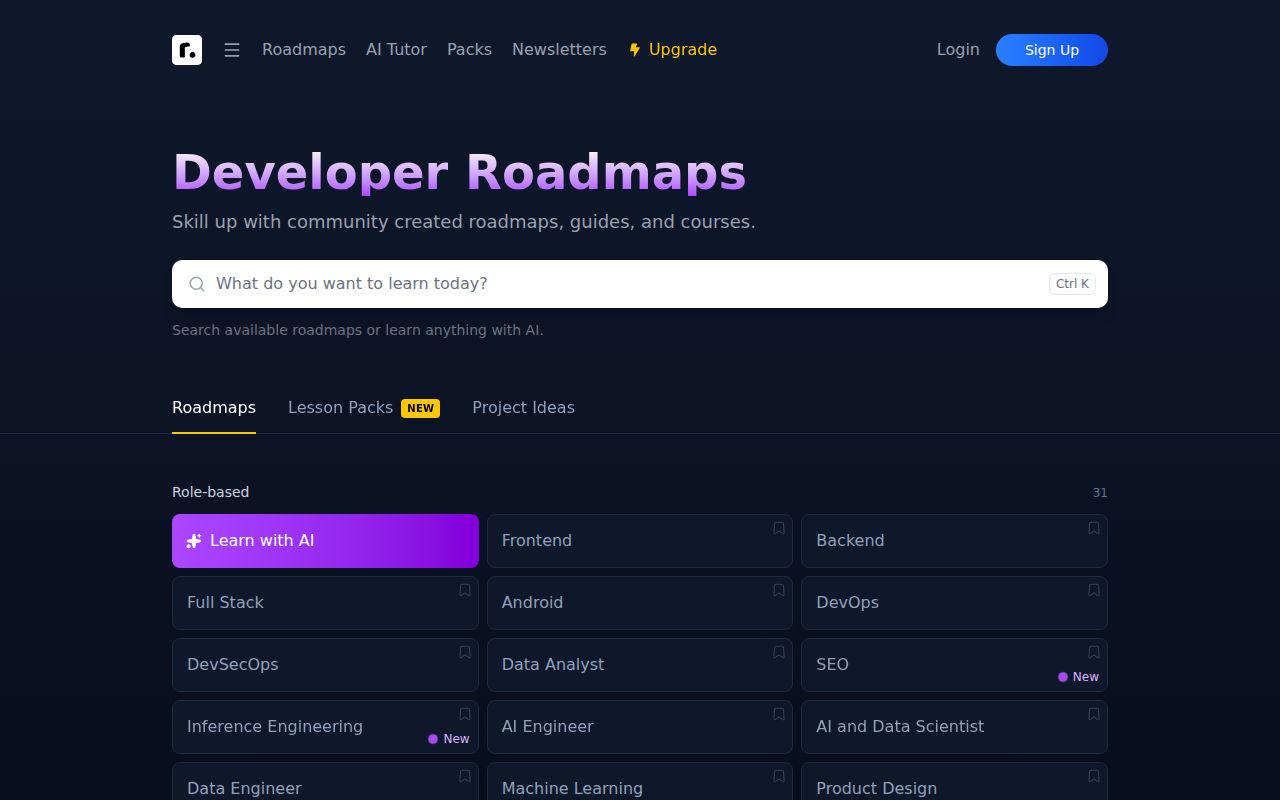
Open the frontend roadmap, click a topic, and follow its explanation to a resource you can actually study. That's the useful action developer-roadmap supports. Its README points learners to roadmap.sh and describes this repository as the content behind those maps. If you came looking for a learning portal to deploy inside your company, the contribution guide explicitly says there's no app to run here.
The checkout contained 11,077 files and occupied 7.8 MB in our sandbox. That makes a clone practical for inspecting or correcting topic text, even though the file count looks intimidating. For a learner, browsing the hosted maps is the more direct route. Frontend and backend have beginner variants, while narrower paths cover subjects such as PostgreSQL and API design. Pick the path that matches something you're trying to build.
What happened when we ran it
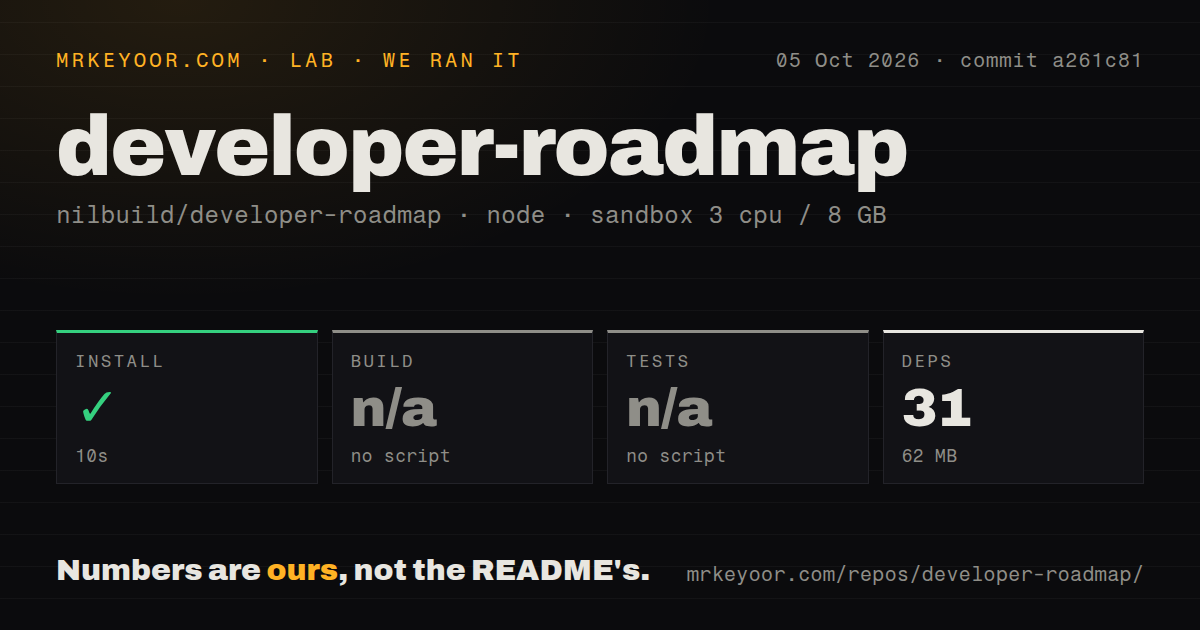
Our run installed 31 pnpm packages in 10 seconds and left 62 MB on disk. We cloned commit a261c81 on October 5, 2026. Installation succeeded. The build and test steps were skipped because the repository had no build script or target and no test script or target. Those skips are the result, and they provide no evidence that a website builds or that a suite passes.
The measurement setup was a fresh Debian container with 3 CPUs, 8 GB of RAM, and image lab-node:22, running without elevated privileges or secrets. The scan found workspace packages and 8 CI workflow files, with no Dockerfile or tests directory. This run establishes that the dependency installation completed in that environment. It doesn't measure the hosted site's responsiveness, the correctness of its lessons, or how much a learner improves.
Short topic explanations send you elsewhere for depth
The contribution guide asks for a short explanation and limits each topic to 8 resource links. Contributors label links by type, including official documentation and courses, so the site can categorize them. That editorial choice makes the popup a useful starting point. You can get a definition, then choose a resource appropriate to the question you're trying to answer instead of reading a long lesson inside the diagram.
Our scan counted roughly 824 lines of source alongside those 11,077 files. The useful material is the topic content, and judging it calls for reading the explanations and their destinations. A mentor can use the backend map to identify a missing subject, then assign work around it. Someone who needs sustained instruction should expect to leave the popup: the project's own writing guidelines keep explanations to about a single paragraph.
Topic filenames connect contributions to the hosted database
The repository stores topics under roadmaps/<roadmap-slug>/content/<topic-slug>@<node-id>.md. The README tells contributors to preserve the filename because the node identifier connects the text to its place on a map. A correction therefore has a small, visible scope: edit the relevant Markdown file and submit a pull request. Changes to nodes or their titles go through an issue, according to the contribution guide.
The 8 CI workflow files found in the scan sit alongside documented maintainer tooling. The sync guide explains how merged content reaches the website's database and how database content returns through pull requests. Those sync commands use GH_SYNC_SECRET and the hosted sync endpoint. Reading or editing Markdown doesn't need that maintainer secret. Running the sync machinery yourself would require access beyond the public checkout.
The license restricts republishing the roadmap content
The license file permits personal use and sharing links, while requiring prior consent for distributing repository content through other media. It also makes an exception for GitHub forks used to contribute. That's a concrete reason to pass if your goal is to publish the topic text in a paid course or another learning website. A public repository alone doesn't give you that reuse permission.
The installed checkout occupied only 62 MB, so disk space wasn't a barrier in our run. The permission to copy its material is a separate decision. For an internal training program, I would start with links to the relevant roadmaps and independently written assignments. If the program needs to reproduce the maps or their text, read the stated terms and seek the consent they require before committing to that format.
October contributions show activity, while topic errors remain
The last push was October 9, 2026, and GitHub listed 11 open issues and PRs. Recent contributions include a merged content sync and a closed pull request replacing dead resources. The latest release tag is 4.0, published January 5, 2023, but that old tag doesn't describe the current maintenance cadence. The October activity is better evidence that people are still working on the content.
Keeping 11,077 files available doesn't establish that every explanation is correct. Issue 10435 reports an AWS Route53 description about DKIM, and issue 10432 reports duplicated text for distinct NumPy topics. These are open user reports, separate from our sandbox results. I'd verify a topic against its official documentation before turning the popup into an interview rubric or a lesson for other developers.
Choose a curriculum when you need assigned practice
The Odin Project pairs web-development lessons with projects and is my pick when you want exercises attached to a teaching sequence. OSSU organizes computer-science courses with prerequisites for a broader foundation. Project Based Learning groups application-building tutorials by language. Choose among them according to the work you need assigned, rather than how many topics a roadmap displays.
Developer-roadmap's 10-second install makes contributing approachable, but studying still requires choosing a resource and doing the work. I'd use its maps to locate a gap, then open the linked documentation and build something that exercises that skill. For a backend learner, that might mean implementing the API behavior they're reading about. When you return to the map, have working code that gives you a reason to move past the topic.