The repository is a generated distribution, not the source workshop
Font Awesome Free 7 packages the same icon system in several forms: SVG assets, JavaScript packages, CSS, and web or desktop fonts. That breadth is the practical reason to choose it. A designer can name an icon and a web team can consume the matching asset through its preferred delivery path. The repository is less useful for understanding how icons are drawn or generated because the contribution guide says its files come from another system.
That distribution is huge. Our checkout had 23,250 files, about 230,643 lines of source, and occupied 70.4 MB before installation. Those figures cover the repository, while the executable lab target was only js-packages/@fortawesome/fontawesome-common-types/. Keeping those scopes separate matters: the tiny npm result does not describe installing every icon family or framework adapter in Font Awesome 7.
The measured package is shared TypeScript declarations only
@fortawesome/fontawesome-common-types abstracts type definitions used across the JavaScript packages. It has no dependencies and points types to an index.d.ts file. Its README carries an unusually direct warning: application code should import types such as IconName from @fortawesome/fontawesome-svg-core, which re-exports them. Direct use of the common-types package ties an app to an internal package boundary without a stated benefit.
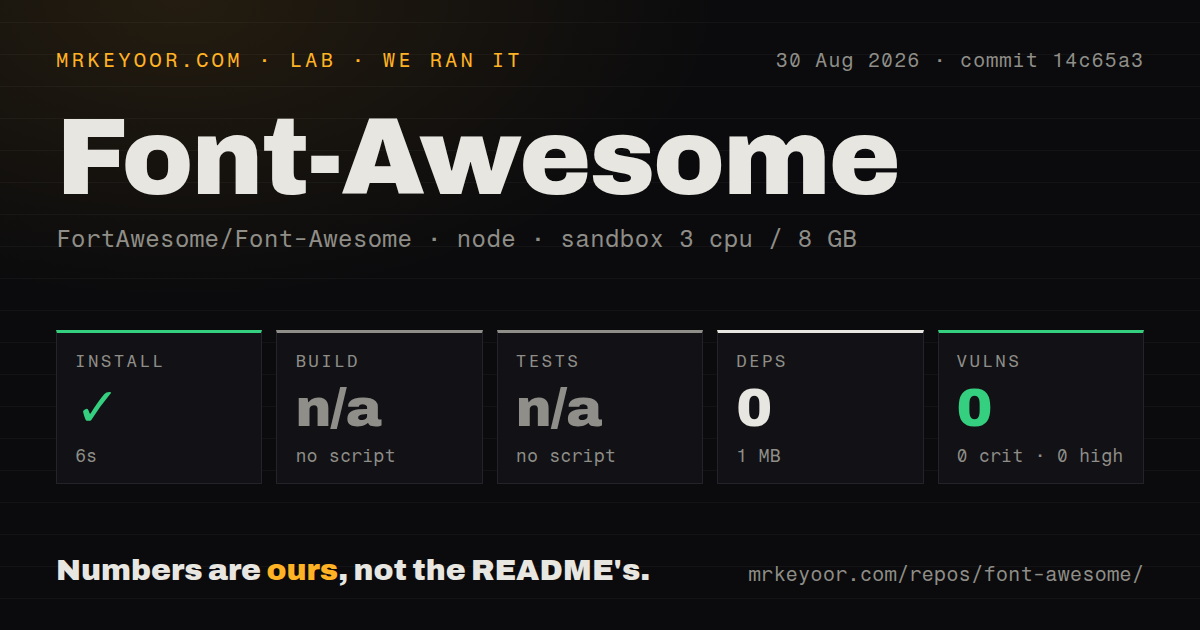
Our sandbox install finished in 6 seconds, added 0 packages, and used 1 MB. The package declared neither a build script nor a test script, so the lab skipped both steps. That is different from two green checks. It tells us the published declaration package is mechanically simple, while giving no runtime, rendering, browser, or type-regression evidence for the larger 23,250-file repository.
What happened when we ran it
We ran the package at commit 14c65a3 in an unprivileged Debian container with 3 CPUs and 8 GB of RAM. Npm completed installation in 6 seconds. With 0 dependencies added and only 1 MB used, there was almost nothing for the package manager to resolve. Npm audit reported 0 known vulnerabilities at every severity level in that measured environment.
There was no build target and no tests target, so our run could not verify generated declarations against the rest of Font Awesome 7. The supplied scan also found 0 CI workflow files, no Dockerfile, and no tests directory. Consumers should read this as a package-scope finding. Compile the actual application against the types, render the icons it uses, and keep those checks in the consumer repository.
Version 7 permits visual and minor-release compatibility changes
Font Awesome uses SemVer as a guideline with explicit exceptions. The README says an existing icon's design, appearance, or branding can change in any release. A minor release may also contain backward-incompatible changes, with upgrade instructions promised. Patch releases are intended to preserve compatibility, and neither minor nor patch releases removes icons. A loose version range may therefore change visual output even when an import name survives.
Release 7.3.1 was published on July 15, 2026, the same date as the repository's last push. Version 6 is now the long-term-support line and receives critical bug fixes only. Versions 3, 4, and 5 are end-of-life. Teams maintaining an old site should choose deliberately between a frozen legacy dependency, version 6 maintenance, and a tested version 7 migration rather than assuming every historical class behaves identically.
Accessibility and icon geometry need consumer tests
Open issue 20729 reports that the SVG and JavaScript path in version 7 no longer emits a <title> element supplied through the title option, unlike version 6.7.2 in the reporter's example. That is a concrete migration risk for apps that used the generated title for an accessible name. Verify the current package behavior and follow an explicit accessibility pattern in your framework instead of assuming an icon library makes unlabeled controls understandable.
Geometry reports are current too. Issue 21645 says the person-pregnant SVG extends outside its viewBox and clips the head. Issue 20870 lists several other icons whose paths may be cut off, and issue 21623 argues that version 7 changed the mosque symbol enough to lose its intended meaning. Our 6-second declaration-package install could not catch any of these visual defects. Screenshot tests should cover the small set of icons central to a product.
Three licenses apply to three kinds of artifact
The repository metadata cannot reduce Font Awesome Free to one SPDX license because the distribution mixes them. SVG and JavaScript icon files use CC BY 4.0, fonts use SIL OFL 1.1, and non-font, non-icon code uses MIT. The README says downloaded files already include attribution comments sufficient for normal use and asks users not to remove them. Asset pipelines that strip comments should get a license review before release.
GitHub showed 76,892 stars and 315 open issues and pull requests when fetched. Recent August activity includes icon geometry, accessibility, and brand-update discussion, while the latest release remains 7.3.1 from July. The 1 MB common-types package is easy to consume, and the wider project is mature enough to be familiar across teams. Its unusual release rules make pinning and visual regression tests part of responsible adoption.