You can try Fluxer before taking on its server
Open Fluxer in a browser before you volunteer to host your community's conversations. The project provides text messaging and voice chat for friends and groups, with downloadable desktop clients and a separate self-hosting route. That gives you a sensible first decision: whether people want to use it. A community that won't leave its existing chat app gains little from your control over a new server. The README links directly to the hosted web client.
Taking responsibility for the source is a larger commitment. Our checkout contained 14,470 files and roughly 1,328,942 source lines across a pnpm workspace monorepo, occupying 299.1 MB before installation. You're adopting the code behind a communications platform, including its desktop application. I would separate trying the client, operating the published server images, and changing the source into distinct adoption decisions. Success at one doesn't establish success at the others.
What happened when we ran it
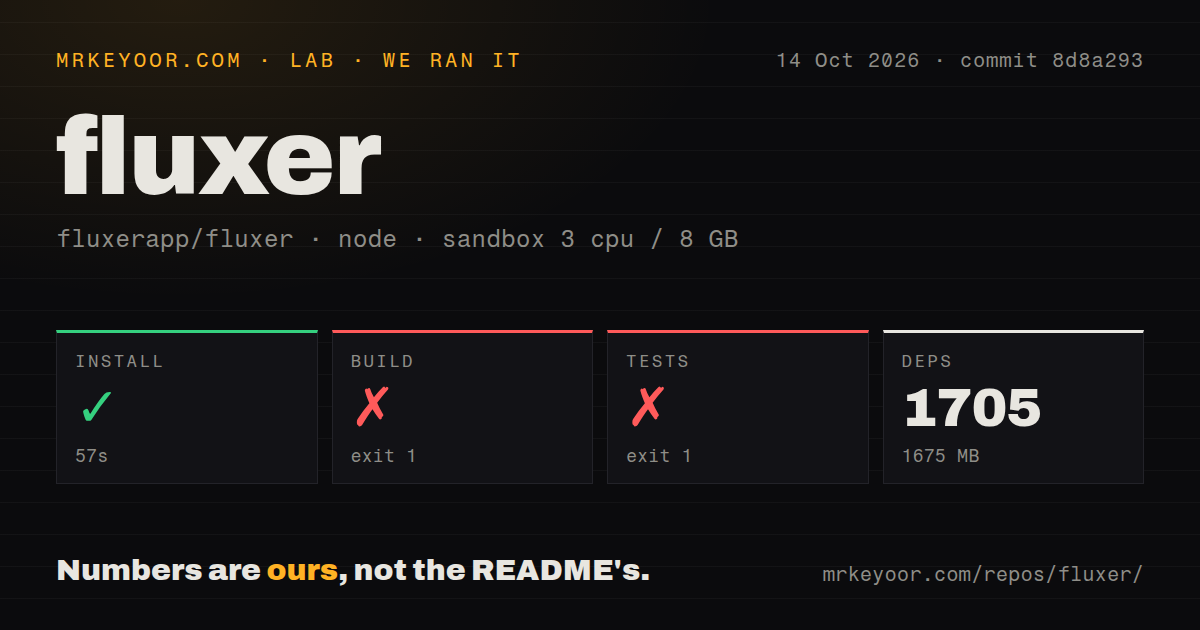
Our run installed 1,705 packages in 57 seconds, leaving 1,675 MB on disk. We cloned commit 8d8a293 on October 14, 2026, inside a fresh, unprivileged Debian container using lab-node:22, with 3 CPUs, 8 GB of RAM, and no secrets. Installation succeeded. That gives a prospective contributor a concrete starting cost, though it doesn't establish that the application can run.
The build failed with exit code 1 after 180 seconds. Its supplied log tail points to fluxer_desktop/scripts/build.mjs:936:1, followed by a failed pnpm build command. The excerpt contains the failure's wrapper and location without the underlying diagnostic. Blaming memory, a missing system library, or an application defect would go beyond what it shows. We did not obtain a successful source build in that environment.
The test step failed after 14 seconds. This log is more useful: Rust couldn't compile serde_core for wasm32-unknown-unknown, reported E0463, and suggested rustup target add wasm32-unknown-unknown. The failure propagated through fluxer_app's wasm:codegen command. This identifies a WebAssembly toolchain prerequisite blocking our test run. It provides no passing test count and no evidence that adding the target would resolve every subsequent problem.
Our scan also recorded 28 CI workflow files, no Dockerfile, and no tests directory. Those are scan findings for that checkout, not proof that the whole monorepo lacks container definitions or test files. Most consequentially, our failed source commands don't establish whether the currently documented deployment images work. The supplied run contains no successful deployment or voice-call result to support that claim.
Self-hosting includes storage, search, and a voice service
The current Compose configuration connects PostgreSQL, Valkey, NATS, Meilisearch, SeaweedFS object storage, and LiveKit alongside Fluxer's application services. Bundling them makes the intended arrangement concrete. It also leaves you responsible for persistent chat data and uploads. The environment example allows an external database or object store, so an operator can reuse infrastructure instead of accepting every bundled component.
That 1,675 MB source environment is only part of the storage question. The operator guide requires recovery copies of the database, upload volume, and secret-bearing .env. Its installer generates credentials and a setup token for the first administrator. Username sign-in needs no email service, while SMTP is an option. Voice needs reachable media ports beyond the web proxy. Choose this route only if you can maintain the data and network configuration after the initial launch.
The Flathub client may lag private-instance support
Fluxer's operator guide warns that the Flathub desktop build may not connect to a private instance yet and points to Fluxer's own Flatpak repository while an update is pending. That's an awkward exception because the README recommends Flathub for most Linux desktops. Check which package your members actually have. The README also labels Android downloads beta and sends iOS users to TestFlight. A group with mobile-dependent members should trial those paths before moving its daily conversations.
Source validation won't settle those client questions. Our 180-second failed build stopped inside the desktop build script, and the test command stopped at WebAssembly compilation. Neither result tells you how reliably a packaged client reconnects or whether notifications reach your members. For adoption, I'd ask the actual group to try calls and notifications on its own devices before making Fluxer the only place an important conversation happens.
October activity is visible, but reports moved off GitHub
The repository was pushed on October 16, 2026, and the latest desktop release that day was tagged fluxer-desktop-stable@2026.1016.10911. GitHub listed 10,596 stars and 147 open issues and PRs combined. Recent pull-request activity included desktop notification work. Those signals show ongoing maintenance, rather than proving reliability. The release entry links a change comparison rather than explaining each change to an operator.
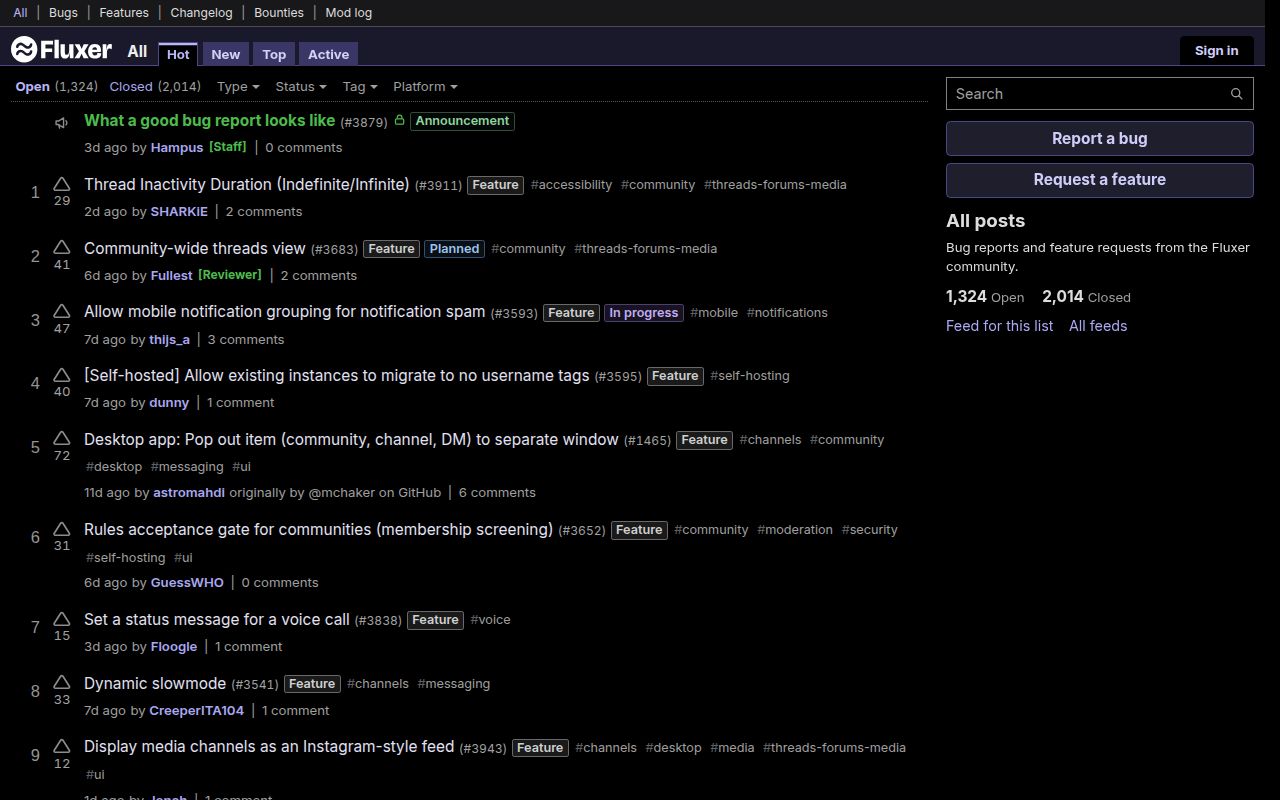
The 28 workflows our scan found aren't a substitute for an accessible reporting process. The README says GitHub Issues and Discussions are closed and directs reports to feedback.fluxer.com, which requires a Fluxer account. The contribution policy also requires approval before submitting a pull request. If you expect to file an issue and immediately contribute a fix through GitHub, account for that extra coordination.
Choose another chat model when your group needs it
Zulip is my alternative for teams whose main problem is following asynchronous conversations: its topic-based threading directly addresses that job. Mattermost fits workplace collaboration and integrations. Element is a Matrix client for groups choosing that ecosystem, with a homeserver decision alongside it. Choose Fluxer when its community chat experience earns the move, then establish that your instance can recover its messages and uploads before inviting everyone in.