
Mattermost trades vendor control for operator work
Mattermost gives an organization its own chat and collaboration service. The core experience includes channels and direct messages, while the product also covers workflow automation, voice calls, screen sharing, and AI integration. Native clients exist for Android, iOS, Windows, macOS, and Linux. The proposition is strongest when internal conversations must stay in a chosen network or cloud account and when integrations need to sit close to development systems.
The repository is open core, written mainly in Go and React, and described as a single Linux binary backed by PostgreSQL. Our checkout at commit c5835cd was 434.3 MB, with 15,578 files and about 1,815,609 lines of source. That size matches the product surface: server, web application, plugins, platform code, and release machinery live around one collaboration system. This is closer to operating a business application than running a disposable chat container.
PostgreSQL is only the first service decision
The README links several deployment paths: Docker, Ubuntu packages, a tar install, Omnibus, Kubernetes, and Helm. Choice matters. A single server can suit a controlled internal rollout, while a larger deployment needs decisions around proxies, storage, database availability, monitoring, and upgrades. Mattermost's documentation is more useful than a one-command demo because it acknowledges those different operating shapes.
A working organization also needs a domain, TLS, email delivery, file-storage policy, backups, and a recovery drill. Desktop and mobile clients must reach the server, and integrations introduce their own credentials. The README recommends subscribing to security bulletins for critical updates. That subscription should be paired with an owner and an upgrade window; receiving an alert without a tested update process does little for a self-hosted service.
What happened when we ran it
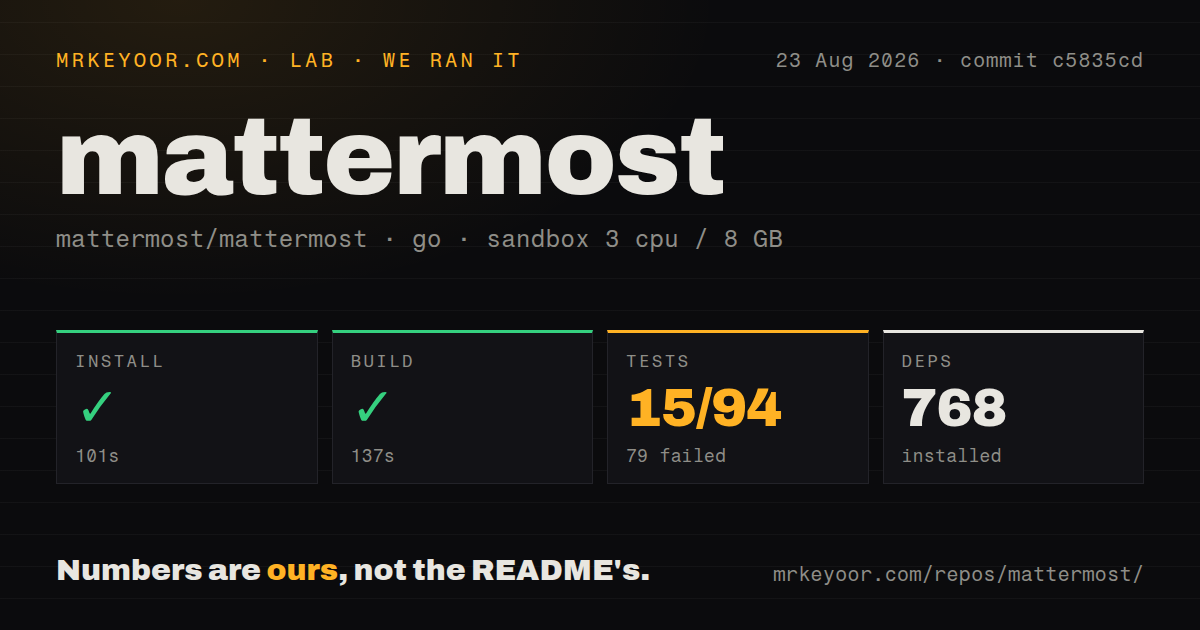
Our sandbox entered the Go project under server/. Installing 768 packages took 101 seconds, and the build succeeded in 137 seconds with 3 CPUs and 8 GB of RAM. That result is useful: the source compiled in a fresh, unprivileged Debian container at commit c5835cd. It does not prove a complete Mattermost deployment because we did not configure PostgreSQL, clients, TLS, mail delivery, or persistent storage.
The test command ran for 402 seconds. Go reported 15 package results passed and 79 failed out of 94. The tail included repeated mail-send log messages, a failure in platform/shared/mail, a build failure in platform/shared/mfa, and another build failure in scripts/default_permissions_generator. The excerpt does not establish one shared cause, so we are not attributing the failures to PostgreSQL, networking, missing services, or a code regression.
Open core means checking the edition before migration
Mattermost's README calls the platform open core and says a compiled version is released under the MIT license each month on the 16th. A buyer should map required features to the exact edition and current terms before moving users. Chat retention, authentication, governance, support, and advanced operational features often drive collaboration purchases; assumptions based on the repository license can produce a costly surprise if the required capability sits elsewhere.
The latest GitHub release was v11.10.1 on August 24, 2026, described as a bug-fix release. The repository was pushed again on August 25. GitHub listed 974 open issues and pull requests, a combined work queue rather than 974 confirmed product defects. Those dates show active maintenance, but operators should still read release notes and security notices for every version they deploy. A monthly cadence rewards an automated, rehearsed upgrade process.
Integrations are the reason to accept the weight
Mattermost publishes API documentation and supports webhooks, slash commands, apps, drivers, and plugins. The README points to more than 700 marketplace integrations. That is valuable for incident response and software delivery: alerts can arrive where engineers coordinate, and commands can update external systems without switching windows. Self-hosting also lets an organization place those connections inside its own trust boundary.
Each integration expands that boundary. Tokens need scopes and rotation, webhooks need validation, plugins need review, and an unavailable chat server should not block recovery of the systems used to restore it. Keep emergency access outside Mattermost. Record which integrations are business-critical, test them during upgrades, and avoid giving a convenience bot broad production credentials. The platform can centralize workflows, so a careless integration can centralize risk too.
The best fit has a clear control requirement
Mattermost makes sense for a company that can state why managed chat is unacceptable or insufficient. Data residency, isolated networks, regulated operations, and deep internal integrations are concrete reasons. Its active releases, native clients, deployment choices, and extension points make it a credible long-term platform. The build succeeding in our fresh container also gives contributors a better starting point than many repositories of this size.
Zulip is worth choosing for topic-centered asynchronous discussion. Rocket.Chat overlaps more closely and may suit customer-facing communication. Matrix Synapse is the different answer when federation is the requirement. For a small team with no infrastructure mandate, any self-hosted option deserves skepticism: PostgreSQL, backups, monitoring, and incident response remain yours long after the first channel opens.