Flux v2.9.4 runs reconciliation inside Kubernetes
Flux installs controllers that watch declared sources and Kubernetes custom resources. A GitRepository, OCIRepository, HelmRepository, or Bucket supplies artifacts. Kustomization and HelmRelease objects describe what should reach the cluster. Notification resources report events, while image controllers scan registries, select versions, and can commit updated references to Git. The cluster pulls and applies its desired state instead of waiting for an external deployment server to push changes.
That model suits teams already treating Git review as the deployment approval record. Each cluster can continue reconciling from its configured sources, and Flux status lives in ordinary Kubernetes APIs. Multi-tenancy and multiple repositories are supported, but they demand deliberate service accounts, namespace boundaries, source permissions, and promotion rules. A weak tenancy design can give one repository or controller more cluster authority than its owners intended.
The GitOps Toolkit is also available as a set of APIs and specialized controllers. Platform teams can compose source watching, Kustomize application, Helm reconciliation, notifications, and image automation rather than adopting every component. That flexibility is valuable for an internal platform. A small team with one cluster may find the same flexibility turns a simple deployment job into several CRDs and controllers to learn.
What happened when we ran it
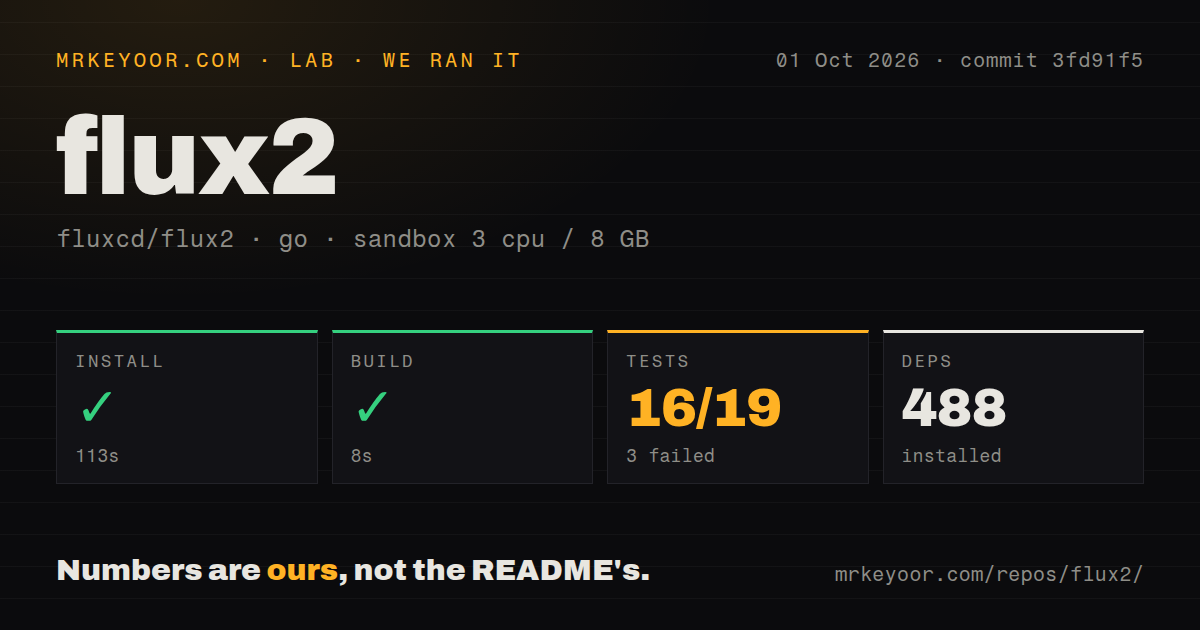
Our sandbox installed 483 packages from commit da2d22d in 91 seconds. The checkout contained 749 files, about 46,725 source lines, and 3.2 MB. The Go build succeeded in 9 seconds in an unprivileged Debian container with 3 CPUs and 8 GB of RAM. The repository scan found 13 CI workflow files, a Dockerfile, and a tests directory.
The test command exited 1 after 132 seconds. Its summary reported 8 passed and 1 failed out of 9. The supplied log tail shows pkg/manifestgen/install, sourcesecret, and sync succeeding, while several other packages report no test files. It then ends with a bare FAIL. That evidence does not name the failing package or show an assertion, so attributing a cause would be guesswork.
This was a repository build and test, not a Kubernetes acceptance trial. We did not bootstrap a cluster, reconcile a Git source, render a Helm release, decrypt a SOPS secret, update an image reference, or test controller recovery. The 9-second build confirms compilation for the checkout. The failed test command means maintainers and contributors should reproduce the full suite before trusting a change, even though most discovered packages passed.
Bootstrap needs cluster authority and source credentials
The quickstart sends readers to a bootstrap workflow rather than pretending installation is only a binary copy. Flux needs a Kubernetes cluster and enough access to install CRDs, controllers, service accounts, and other resources. The bootstrap command also needs credentials for the chosen Git provider or another source route. Those credentials should be scoped to the repository and operations Flux genuinely needs.
A production setup then needs repository structure, reconciliation intervals, dependency ordering, health checks, pruning policy, and secret handling. Image automation adds registry reads and Git writes. Notification receivers add inbound network paths, while outbound providers need their own secrets. Flux documents Kustomize, Helm, image updates, and SOPS well, but each feature expands the permission and failure surface inside the cluster.
Version upgrades cross several components. Release v2.9.4 updates source-controller, source-watcher, notification-controller, and both image controllers. Its notes explicitly say ArtifactGenerator and ImageUpdateAutomation CRD schemas changed and must be updated with the controllers. Pin the CLI and manifests, read component changelogs, apply CRDs as part of the same planned change, and confirm every controller reports ready before normal reconciliation resumes.
Recursive diff can hide cascaded deletions
Issue #6042 reports that flux diff ks --recursive in v2.9.4 shows a removed parent Kustomization as deleted but omits the child resources that pruning would also remove. Updates to an existing child appear in the recursive diff; deleting the parent takes another code path that does not walk the child's stored inventory. A review gate can therefore understate the effect of one removed file.
Teams using nested Kustomizations should inspect the live inventory of any parent being deleted. Policy can also require an explicit resource list or a second cluster-aware preview for destructive pull requests. The issue is new and includes a proposed implementation, but until a fix ships and is verified, the safe assumption is that a one-line parent deletion may remove a much larger subtree.
Issue #5889 describes another visibility problem on kustomize-controller v1.8.4. The reporter found updated source artifacts containing new resources, while repeated reconciliation kept old build output: additions were not applied and removed entries remained. Restarts and source suspend/resume did not change the result. This report targets an older controller than v2.9.4 includes, yet it is a good reason to compare source revision, rendered inventory, and live resources during incident checks.
August activity and v2.9.4 support production use
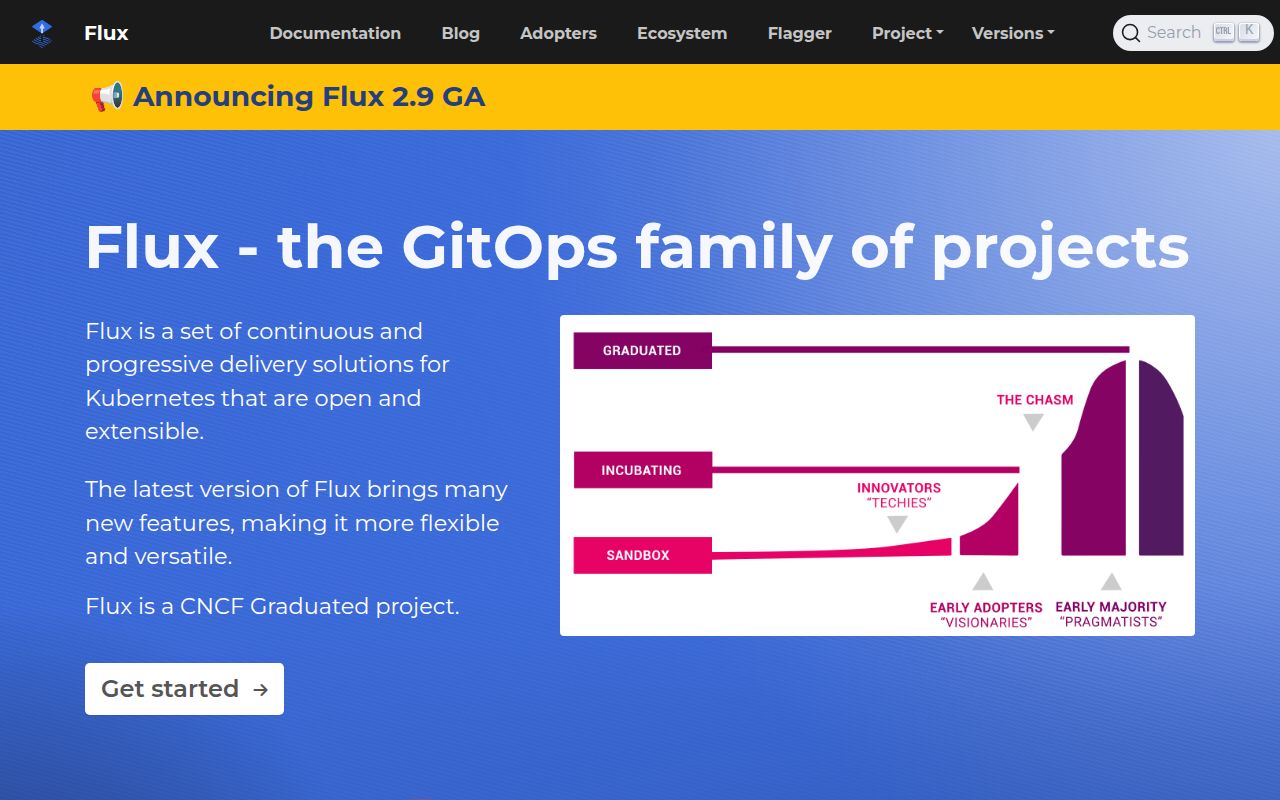
GitHub recorded the latest push on August 25, 2026, and pull request activity continued on August 26. Release v2.9.4 was published on August 7. The repository had 8,372 stars and 253 open issues and PRs combined when fetched. Flux is also a CNCF graduated project, and the README points to public adopters, support channels, security material, and component documentation.
Flux is mature enough for production, but maturity does not make GitOps self-operating. The controllers will faithfully act on source and pruning rules, including mistakes that pass review. Use it when the team can own Kubernetes permissions, observable reconciliation, source availability, upgrade compatibility, and deletion review. Choose Argo CD when a central visual application interface is the more important operating model.