Short answer: choose it for a particular LaTeX page
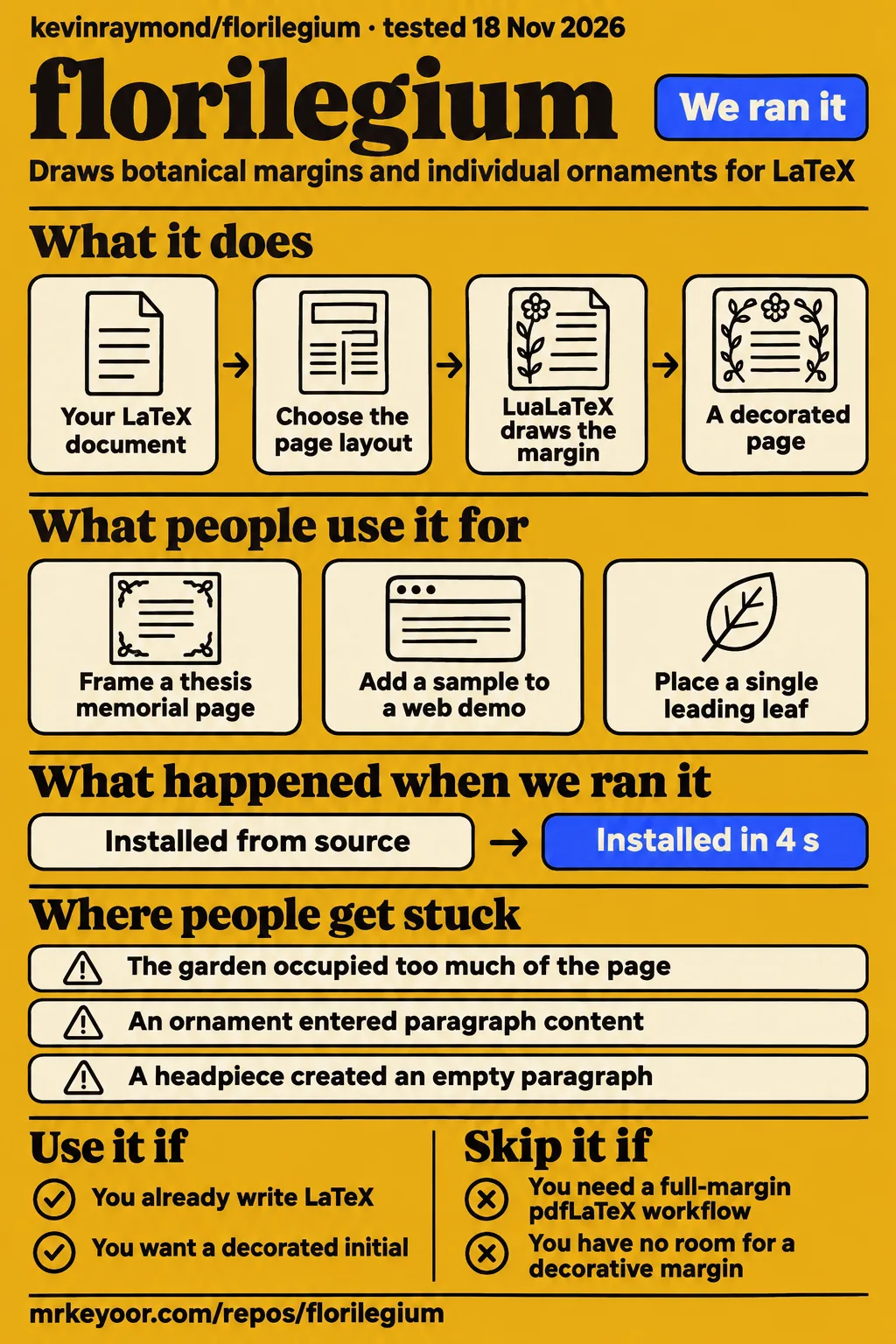
Florilegium draws botanical margins and individual ornaments for LaTeX authors who want decoration to serve a particular document. Use it for a frame, an opening leaf or a decorated initial when those elements suit the page. Avoid the full-margin workflow if your document must use pdfLaTeX or its required layout leaves no room for the garden. Kevin Raymond's package is the subject of this review, rather than the books, botanical collections or musical ensemble sharing its name.
The most useful reported use is specific: a reader used florilegium to frame their father's memorial page in a thesis. That gives a prospective author a concrete decision to make. A memorial page may justify a frame even when the rest of the thesis stays plain. Begin with the text, required formatting and available white space, then choose the amount of decoration. The memorial-page report describes that use in the reader's own words.
What you can do with florilegium
The full page margin uses LuaLaTeX, while the separate TikZ library draws individual elements under pdfLaTeX as well. This engine distinction matters before installation: a document already using LuaLaTeX can follow the package workflow, whereas a pdfLaTeX document can use the individual TikZ pictures. The upstream quick start presents both routes and specifies the files each needs.
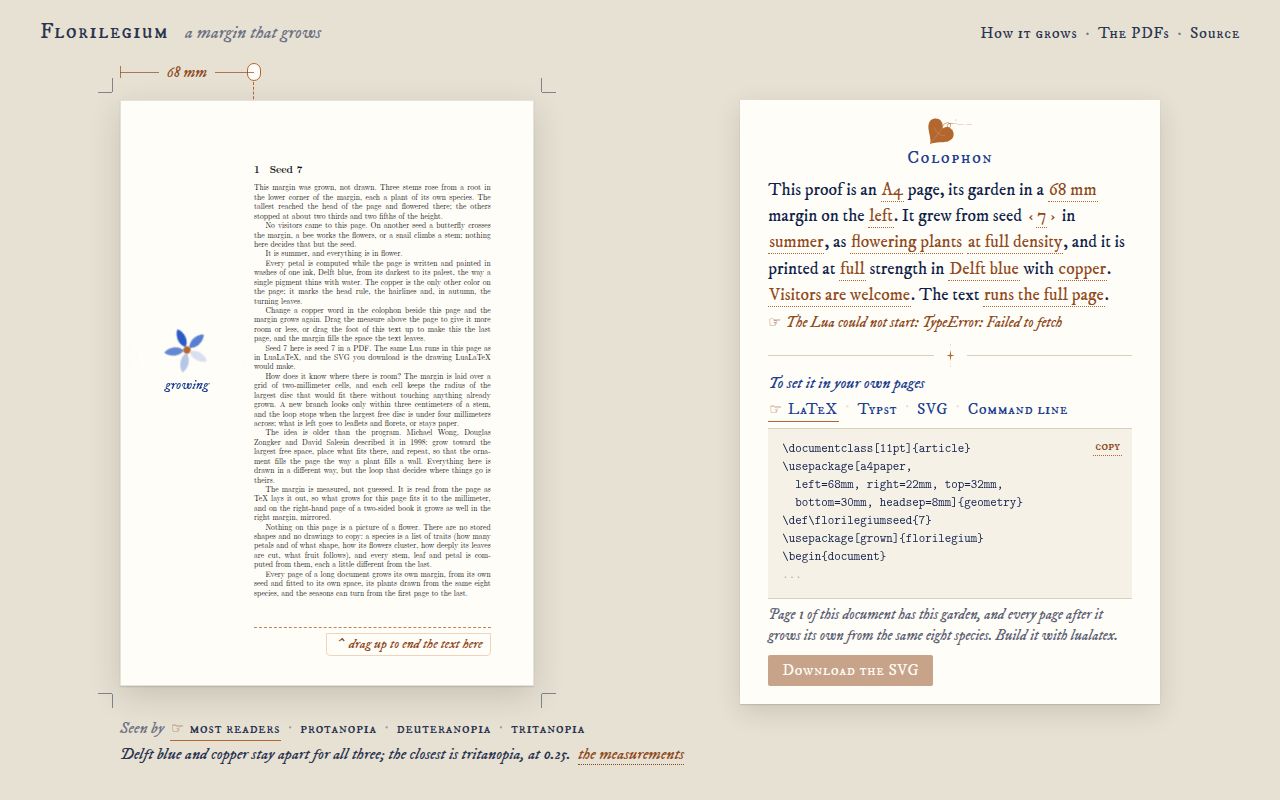
For the LuaLaTeX route, place florilegium.sty and the florilegium*.lua files beside the document, or upload them to an Overleaf project configured for LuaLaTeX. The usage guide also describes installing them together in a TeX tree. Its first-document example sets an A4 page with a 68 mm left margin and a 22 mm right margin, loads the grown composition and enables flowers beside headings. Those dimensions describe the example's layout, rather than a measured minimum requirement.
The current usage guide distinguishes the grown margin, which fits the page, from the authored composition, which is tuned for A4 with a 68 mm left margin. It also documents individual ornaments and the nomargin option, which leaves ornaments and initials available without a garden. That gives an author a smaller starting point than a fully decorated manuscript. The package usage guide supplies the commands and their page-layout behavior.
What people use florilegium for
Two supplied GitHub exchanges describe actual uses: a thesis memorial frame and a selectable sample in the retex web demo. These reports answer different practical questions. The memorial page shows a reason to decorate a particular piece of writing; the demo exchange shows someone adapting the package for a document tool. Each report has a named source and an outcome recorded in the discussion.
| Reported use | Who reported it | Outcome in the supplied exchange |
|---|---|---|
| Frame a father's memorial page in a thesis | The reader in issue #11 | Said they were using the package and thanked the authors for meeting the need |
| Add a selectable sample to the retex web demo | GitHub user skadge in issue #5 | Reported that florilegium could be selected in the new-project view after receiving permission |
The memorial report supports considering the package for personal or ceremonial typography. It also suggests a useful way to judge the result: evaluate the decorated page as part of its surrounding document. A frame that suits a memorial page may have a different role beside equations or ordinary chapters. The report describes the reader's purpose and satisfaction; your institution's formatting requirements still determine what belongs in your thesis.
The historical reuse exchange records explicit permission: maintainer kevinraymond said the MIT license covered skadge's proposed demo use. Current adaptation guidance must also follow the README's component exception. The README assigns florilegium-pgfmath.lua to LPPL 1.3c rather than MIT. Preserve the applicable license and component notices when adapting the package; the historical permission exchange does not replace the current component-specific terms. The README license section states that exception.
What happened when we ran it
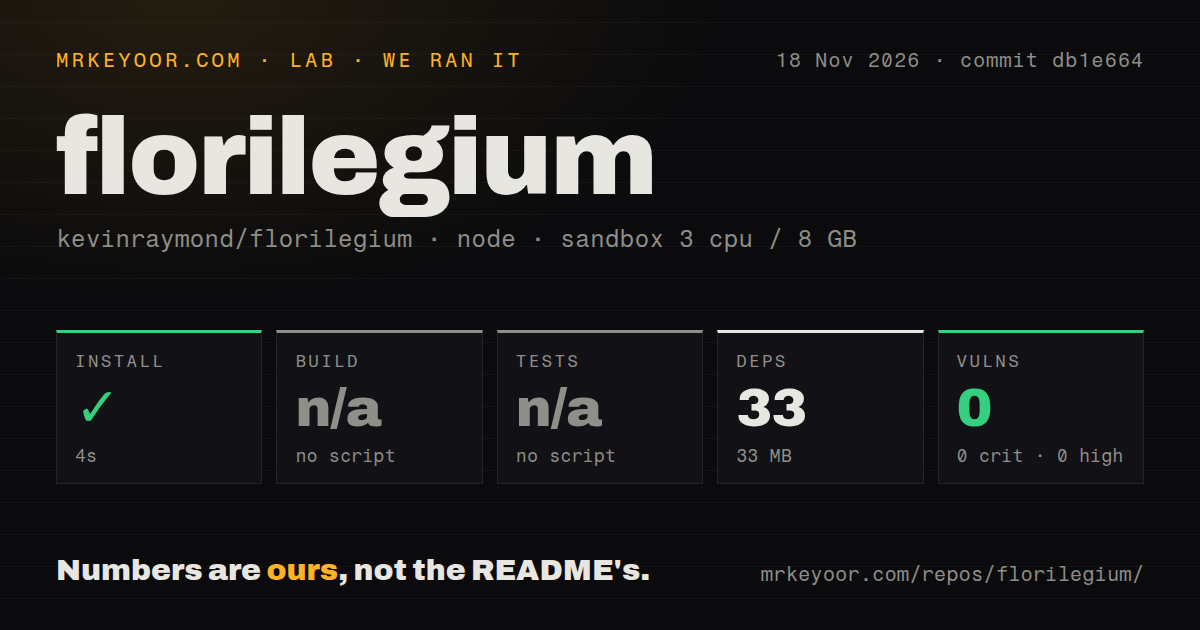
Our npm helper installation succeeded in 4 seconds at commit db1e664 on 2026-11-18. The measured scope was ./tools/playcheck/, with 33 dependencies recorded and 33 MB on disk. The separate hands-on attempt stopped at its safety step because no accepted Compose file existed. Our harness measurements and the detailed hands-on failure describe these two operations separately.
| Recorded operation | Result | Verdict | Why it matters |
|---|---|---|---|
| Hands-on safety check | FAILED: none of compose.yaml, compose.yml, docker-compose.yaml or docker-compose.yml existed | Stopped | The hands-on rule required a Compose file |
| Hands-on teardown | ok | Completed | The teardown record reports success |
| npm install in ./tools/playcheck/ | Succeeded in 4 seconds | Installed | The helper dependencies installed in the measured scope |
| Dependency footprint | 33 dependencies, 33 MB on disk | Recorded | These figures belong to the npm helper scope |
| Build | No build script/target, skipped | Skipped | The harness recorded no build execution |
| Tests | No tests script/target, skipped | Skipped | The harness recorded no test execution |
| npm audit | 0 known vulnerabilities: 0 critical, 0 high, 0 moderate, 0 low | Recorded | This is the helper's dependency-advisory result |
The build/test sandbox configuration was 3 CPUs, 8 GB RAM and image label lab-node:22. The checkout contained 189 files, approximately 2,071 source lines and 37.7 MB on disk. Its scan recorded 3 CI workflow files, no Dockerfile and no tests directory. These are observations from our run at db1e664. They describe the harness checkout and scan, rather than substituting for upstream's documented make targets.
The hands-on summary says the project was deployed with its own Docker Compose and every port bound to 127.0.0.1. The detailed safety record instead says the required Compose file was absent. The detailed failure is the operative outcome. The run summary therefore conflicts with the failed step, while the teardown record reports ok. A required Compose deployment is also a different workflow from the README's LuaLaTeX document setup.
Where people get stuck: scale, page switches and distribution
Issue #4 reports that the garden occupied too much of the page for a reader who wanted a single leading leaf. The same reader asked for colors and a new random shape on rebuilding. Maintainer kevinraymond replied that a PR should cover the requested features. The current README and usage guide document ornaments, color controls, random ornament seeds and reduced density, giving readers specific controls to inspect.
| Issue | Reported problem | Supplied outcome or documentation |
|---|---|---|
| #4: smaller-scale flowers | The decoration occupied too much of the page | Maintainer pointed to a PR; current docs describe inline ornaments and density |
| #21: CTAN distribution | Readers wanted a CTAN package | Maintainer reported submitting v2.0.1 and then confirmed a catalog listing |
| #35: selected bare pages | A reader wanted a bare cover without removing every margin | Current usage docs describe on/off commands and page-specific hiding |
| #48: tagged PDF | Decorative content affected tagging | Maintainer described artifact handling and ornament descriptions in #50 |
The page-switch instructions contain an important placement rule: put the on command after the page break ending the last bare page. The commands act on the page where they end up, and the last switch on a page decides. Page-specific hiding counts physical PDF pages from one, regardless of printed numbering. By contrast, nomargin removes the garden throughout the document, and the on command cannot restore it. These are the current usage guide's page-control rules.
Accessibility depends on what the decoration means
Current main-branch documentation describes artifact handling, alt descriptions and actualtext replacements for tagged PDFs. Decorative drawings are passed over; an ornament with alt becomes a figure with a description, while actualtext supplies text for reading and copying. With both options present, alt takes precedence. These documented choices give authors a way to distinguish visual decoration from a symbol that communicates something in the text.
Maintainer kevinraymond reported that an ornament and an initial's tile entered paragraph content, while a headpiece created an empty paragraph. Those findings came in the maintainer's response to the request opened by cfr42 in issue #48. The maintainer then described #50 as marking drawings as artifacts by default and adding alt and actualtext ornament options. The supplied issue record remains open.
The usage guide says an initial's letter stays in its word and describes checks with TeX Live 2026. It also states that TeX Live 2023 has early tagging support and the package marks nothing there. These details make the typesetting environment part of an accessibility decision. For a meaningful separator, choose the intended reading text; for a purely decorative leaf, use the documented decorative treatment. The tagged-PDF instructions explain that distinction.
Security evidence covers the helper and upstream release claims
Our npm audit recorded 0 known vulnerabilities for the measured helper scope. Separately, issue #31 describes a red-team review covering document-controlled file, process and network access, malformed inputs and the browser playground. Its extract records scope and a first look. The supplied v2.0.1 release notes go further, reporting completed input checks and changes to error handling. These are distinct sources with distinct subjects.
The v2.0.1 release notes report 87 SVG pages drawn under three Lua interpreters and 54 hostile links loaded into the playground. They also report that the attached PDFs passed qpdf checks and contained no JavaScript, launch action or embedded file. Attribute those results to upstream: they are the release author's reported checks. The v2.0.1 release record supplies those figures; our own installation and advisory figures appear in the run section.
For developers, the README names florilegium-svg.lua as the entry point to call from another tool and tells port authors to pin a release tag. It describes the command line and page-function options as the stable boundary, while other files and functions may change between releases. That gives an integration a concrete starting point. The ports and adaptations guidance explains the published boundary without requiring a new API example here.
Florilegium vs the Typst alternatives
Two separately maintained Typst ports provide alternatives for documents already written in Typst. Groeneveld's port offers Delft blue and sumi-e plum styles; Baldomo's port says it follows florilegium 2.0.1. Their READMEs describe different layout controls, so choose by the document system and page behavior you need. The comparison below uses their published descriptions and identifies the source for each project.
| Project | Documented workflow | Choose it when |
|---|---|---|
| kevinraymond/florilegium | LuaLaTeX page margins; separate TikZ elements also support pdfLaTeX | Your document uses LaTeX and you want its native commands |
| groeneveld/florilegiumTypst | Typst port with Rust/WebAssembly drawing and Delft or sumi-e styles | You use Typst and its left-margin composition fits |
| Baldomo/florilegium-typst | Typst port whose README says it follows florilegium 2.0.1 | You want its documented command mapping and template controls |
Groeneveld's README describes a left-margin-only implementation and tells authors to set geometry through the package options. Baldomo's README says its template owns page.background and replaces a user background. These are practical selection criteria for an existing template. Inspect who controls the margins, background, headers and footer before adopting a port, especially when the document already has a required visual structure or custom page furniture.
The software shares its name with books and music
Kevin Raymond's florilegium is a LaTeX package; the botanical source defines a florilegium as a book of flowers. The supplied Guardian review concerns a musical performance. Those subjects explain why an unqualified search can lead away from document software. Use kevinraymond/florilegium and LuaLaTeX when seeking package instructions. The botanical definition and the festival review concern those separate entities.
FAQ
The maintainer confirmed a CTAN catalog listing after reporting submission of v2.0.1. Distribution, reuse, small ornaments, page switches and tagged PDFs are the practical questions raised in the supplied issue discussions. The answers below pair those questions with the relevant exchange or current documentation, so a new author can find the instruction that applies to the document they want to make.
Is florilegium available on CTAN for distribution through TeX Live or MiKTeX?
The maintainer confirmed that florilegium was in the CTAN catalog in issue #21, after reporting submission of v2.0.1. The discussion began with requests for CTAN distribution. Use the linked CTAN entry to identify the package, then inspect your chosen distribution's package manager for the version it supplies. The CTAN discussion records the submission and catalog confirmation.
Can I reuse florilegium in a web demo while retaining its license and attribution?
Maintainer kevinraymond approved skadge's proposed retex demo use under MIT, and skadge subsequently reported adding the sample. For a current adaptation, also retain the applicable component notices: the README assigns florilegium-pgfmath.lua to LPPL 1.3c rather than MIT. Read the historical permission exchange together with the current license section when deciding which files and notices to redistribute.
Can I place a single leading leaf at the beginning of a paragraph?
The current usage guide documents an inline leaf ornament in a box the size of a letter, including use at a paragraph opening. Its nomargin option leaves ornaments and initials available while removing the full garden. That directly addresses the smaller decoration requested in issue #4. The inline-ornament instructions describe the command and available ornament choices.
Can I change leaf colors and generate a different random leaf shape when rebuilding the PDF?
The current usage guide documents an ornament's ink option and says seed=random draws a new shape whenever the PDF is built. An explicit seed fixes the shape instead. That gives an author separate choices about color and repeatability: explore changing forms while selecting a design, then choose a fixed seed when the approved ornament should stay consistent through text edits. The ornament color and seed instructions supply those controls.
How can I turn the margin off for a cover or selected pages?
Current main-branch documentation gives off and on commands for stopping and restarting the margin, plus hide for individual pages or numbered ranges. Place the on command after the page break ending the bare page. Numbered hiding uses physical PDF pages from one, including front matter. The page-switch instructions also distinguish these controls from the document-wide nomargin option.
Can florilegium support accessible tagged PDFs and include tagging checks in CI?
Current main-branch documentation describes decorative artifacts and ornament descriptions, while issue #48 requests tagging compatibility and suggests l3build checks using SHOWPDFTAGS. Maintainer kevinraymond describes specific changes in #50. Use the tagging exchange to understand the reported problem and response, and the current usage guide for the documented handling of decorative and meaningful ornaments.
What we have not tested yet
Our supplied sandbox run contains no compiled LaTeX document, rendered page, screen-reader check or inspected tag tree. Appearance, rendering time, memory use and behavior in a real thesis therefore remain unmeasured here. The image label lab-node:22 also leaves the actual runtime and operating-system versions unidentified; those require raw toolchain logs. The helper installation and blocked Compose route provide the narrower results recorded above.
The latest-release record identifies v2.0.1, published on 2026-11-05, while the supplied usage guide comes from main. We have not mapped its page-switch and tagging instructions to that released artifact or reproduced tagging CI. Released accessibility behavior is therefore unresolved for this review. The documentation's TeX Live 2026 checking statement is upstream's account, and the open issue's response is evidence of described changes rather than our confirmation of a released fix.
The npm advisory result is not an independent security audit of the TeX/Lua package, generated PDFs or playground. Upstream's release checks were not reproduced here, and neither Typst alternative was exercised. The two reported uses support their specific outcomes rather than adoption totals or support-capacity ratings. The supplied repository metadata records a push on 2026-11-18; choosing a release still requires keeping its files and documentation aligned. The next useful acceptance result is a representative document produced with the exact release and typesetting environment you intend to retain.