Ten agents produce drafts, not approved financial work
Anthropic packages 10 named workflows, including pitch books, earnings reviews, DCF and LBO models, GL reconciliation, KYC screening, and fund reporting. You can install them as Cowork or Claude Code plugins, or deploy the same prompts and skills through the Managed Agents API. That shared source is useful because an analyst can try a workflow interactively while a platform team wraps it in a controlled service. The repository is Apache-2.0 licensed, so firms can inspect and adapt the instructions.
The boundary matters more than the breadth. The README says these agents draft work for professional review. They do not make investment recommendations, execute transactions, post to a ledger, or approve onboarding. A GL template, for example, gives the document reader only Read and Grep access, caps and validates its JSON output, and keeps the report writer away from outsider files. Ledger adjustments still require approval outside the agent. Those are sensible defaults, but each firm must preserve them while replacing connectors and prompts.
The 7-second install hides the integration job
Our sandbox installed 35 Python packages in 7 seconds and occupied 37 MB. That makes the checkout cheap to inspect, but installation is the smallest part of adoption. Managed deployment needs an Anthropic API key, a workflow engine to handle events, and firm-owned endpoints for jobs such as GL reconciliation. The core plugin lists 12 MCP providers, including FactSet, Morningstar, PitchBook, LSEG, Box, and S&P Global. Several require their own subscription or API key.
There is no complete anonymous dataset in the repository for evaluating a workflow before connecting real sources. Open issue 267 asks for sample statements, CSV files, reports, and demo cases because users currently provide their own data. That leaves a buyer with two choices: build sanitized fixtures or test against controlled internal data. For financial documents, the first route is safer and easier to repeat. A realistic pilot should include planted errors, permission failures, stale records, and adversarial text, not just a clean happy-path workbook.
What happened when we ran it
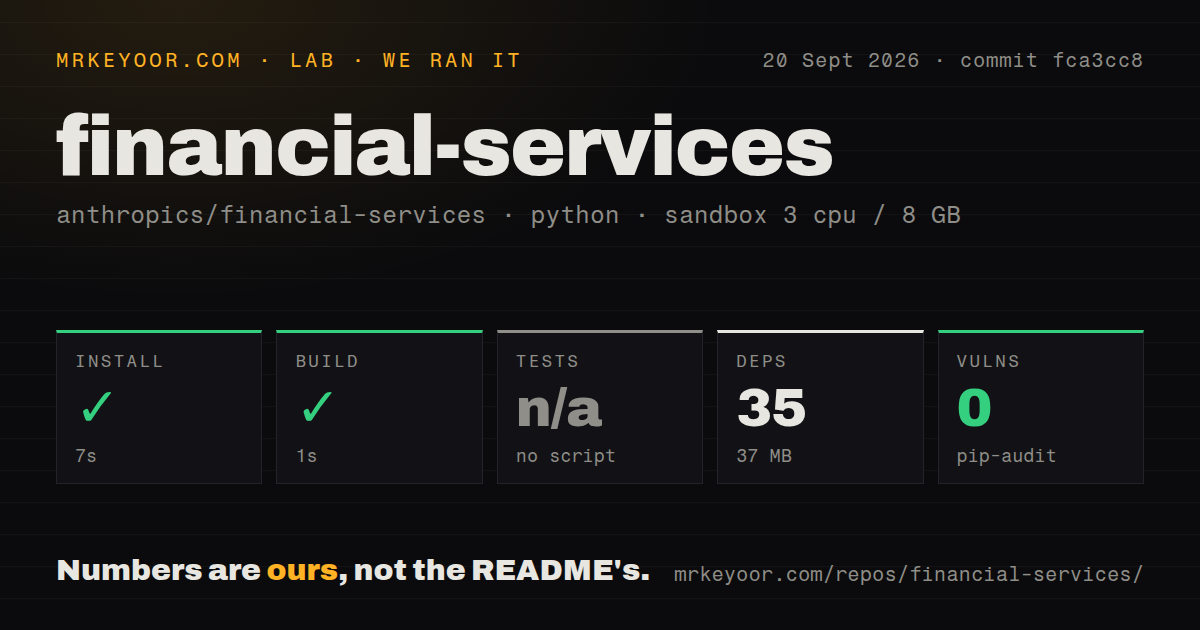
We cloned commit fca3cc8 into an unprivileged Debian container with 3 CPUs and 8 GB of RAM. The install succeeded in 7 seconds, adding 35 packages and using 37 MB on disk. The build completed in 1 second. Pip-audit reported 0 known vulnerabilities. Those results say the repository's Python tooling is easy to provision in a fresh container. They do not measure Claude output quality, connector authentication, Excel correctness, or the cost of the external data services.
The checkout contained 387 files, about 3,743 lines of source, and 3 CI workflow files. It had no Dockerfile or tests directory. More important, there was no tests script or target, so our harness skipped tests. A skipped test step is different from a passing suite. For a repository that includes calculation helpers and validation scripts, the absence leaves adopters responsible for constructing regression cases around their own templates and the financial rules they intend to rely on.
Invalid JSON can disable all 12 core connectors
Open issue 355 reports that the financial-analysis MCP file at the measured commit is malformed: a comma and closing brace are missing around the Egnyte and Box entries. The reported result is blunt. All 12 connectors fail to register, even though the plugin and its skills can still install. That combination can mislead an analyst into debugging credentials for a connector that never loaded. A pilot should parse every JSON manifest before installation and confirm each expected tool appears in the client.
The connector count also makes least-privilege work unavoidable. Research, document storage, market data, and internal ledgers should not share one broad credential merely because their definitions sit in one file. The managed GL example separates untrusted documents, trusted sources, and the one worker allowed to write a report. Use that pattern as a minimum. Each workflow needs an allowlist, schema checks, narrow scopes, output limits, and a human approval point matched to the action it can influence.
A 35% WACC can pass one included validator
Issue 337 reproduces a DCF validator returning PASS for a workbook containing a 35% WACC. According to the report, the code calls a method that the workbook object does not have, catches the resulting exception, and turns the failed check into a warning. Issue 340 separately challenges the skill's use of net debt when weighting WACC. Issue 342 shows a number parser treating the letter in bps as a billion suffix, turning 150 basis points into 150,000,000,000.
These are open reports, not findings from our sandbox test run, and linked fixes were under discussion when we fetched the repository. They still change the buying decision. Finance teams should compare generated formulas with approved methodology, recalculate outputs in independent code, and keep a fixture set with known answers. The repository's own warning already says qualified professionals must verify the work. With no runnable test target in our measured checkout, that warning needs to become an engineering requirement, not a footer.
September activity is high, while releases are absent
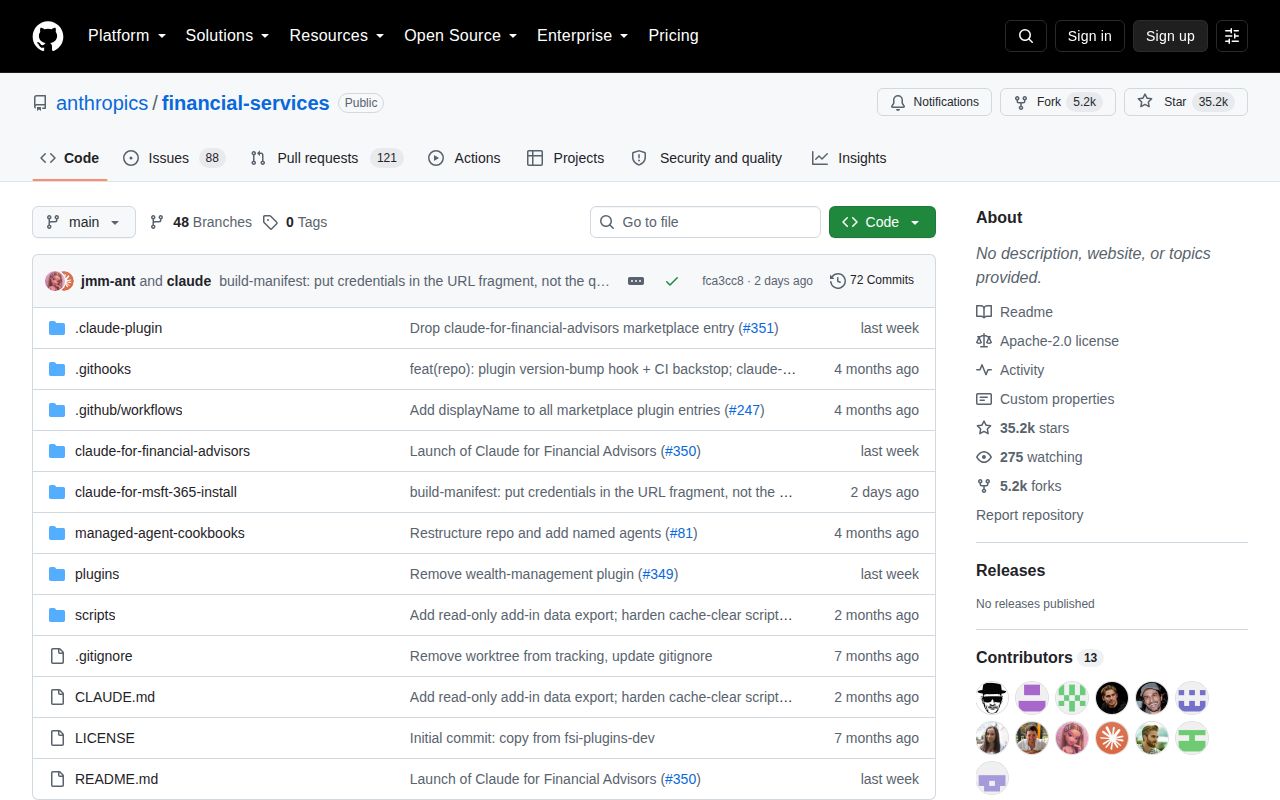
GitHub showed 35,224 stars, 209 combined open issues and pull requests, and a last push on September 18, 2026. Several issues and pull requests were updated on September 20, so the project is active. GitHub returned no latest release, however, and the large combined queue contains both substantive fixes and unrelated spam. Pinning a commit is safer than treating the default branch as a versioned product.
Financial Services is most useful as a map of how Anthropic expects controlled finance agents to be assembled. The 10 workflow templates, explicit sign-off boundaries, and split worker permissions save design time. The missing test target, malformed connector manifest, and open calculation defects prevent the same conclusion about production readiness. Start with one read-only workflow, use sanitized fixtures with known answers, and promote it only after your finance and security reviewers can explain every permission and every number.