Higgsfield provisions Ubuntu GPU nodes through GitHub Actions
Higgsfield wraps distributed model training in a Python API and a repository-driven operating flow. You define an experiment with decorators, generate deploy.yml and run_<experiment>.yml, push them to GitHub, then launch the job from the Actions interface. On the training side, the framework supports PyTorch FSDP and DeepSpeed ZeRO-3, queues competing experiments, monitors runs, and saves checkpoints.
That design is unusually legible. A generated project contains source files, a Dockerfile, an environment file, and requirements. The example wraps a Llama model and data loader in an @experiment function while leaving the optimizer loop recognizable to a PyTorch user. Higgsfield aims to remove infrastructure boilerplate around the loop, rather than replace the loop with a separate configuration language.
The quick start needs root-adjacent access to every node
The README requires Ubuntu machines with SSH access and a non-root user that has passwordless sudo. Configuration includes each node IP, one username and port shared across hosts, plus a process count tied to GPU capacity. higgsfield setup-nodes then installs Docker, installs its invoker, configures a deploy key, and pulls an image. That is substantial access to hand a pre-1.0 framework.
GitHub is part of the runtime path, not merely where the source lives. The setup guide tells you to create an empty repository, put the SSH private key into a repository secret named SSH_KEY, add the generated public deploy key, and run experiments from Actions. Teams with internal Git hosting or tighter secret rules should expect adaptation. Open issue 37 describes a user hitting assumptions around public GitHub URLs and unexpected Hugging Face access.
What happened when we ran it
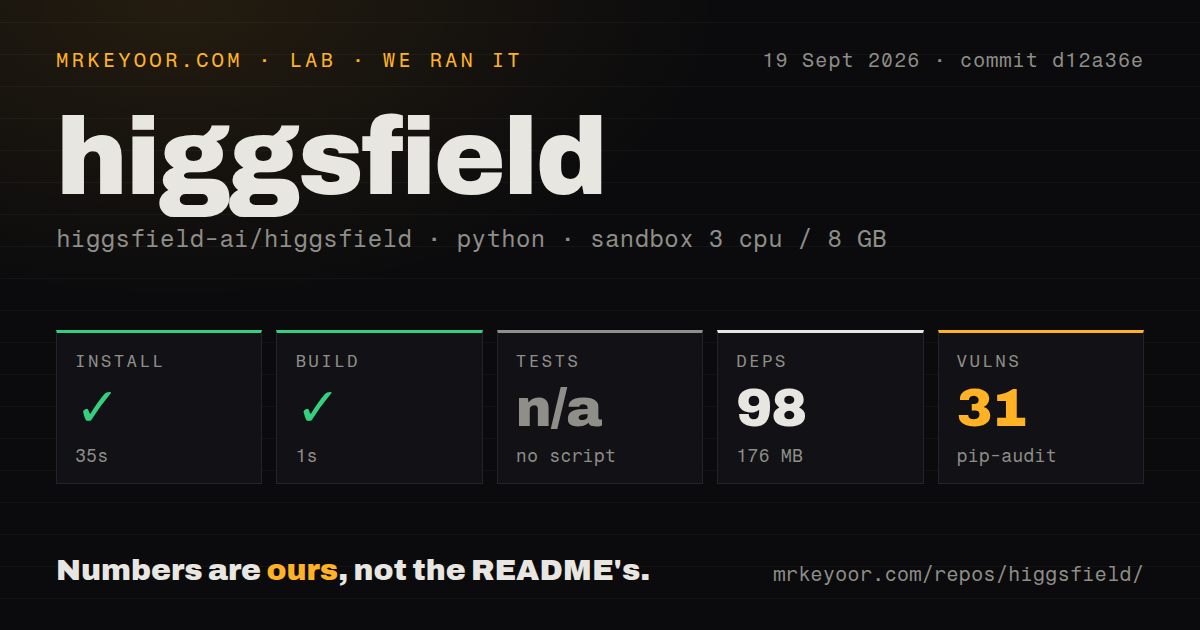
Our sandbox installed Higgsfield in 35 seconds, pulling 98 packages and using 176 MB on disk. The build completed in 1 second. Those two steps show that the Python package can still be resolved and packaged on Python 3.12 in a fresh Debian container, even though its metadata starts at Python 3.8.13 and the README pins Higgsfield 0.0.3.
There was no test script or target, so the lab skipped tests. That is different from a passing suite. The checkout had no tests directory, although it did contain 2 CI workflow files. We measured 88 repository files, roughly 3,094 lines of source, and a 5.8 MB checkout at commit d12a36e. No Dockerfile was present at the repository root; the CLI generates one inside a new training project.
Pip-audit reported 31 known vulnerabilities in the environment we installed. The log block supplied for this review does not assign those findings to individual packages or severities, so we will not guess which code paths are exposed. The decision is still straightforward: refresh and re-audit the dependency set before giving this software SSH access, GitHub secrets, or expensive GPU machines.
A one-second build says little about a distributed run
Our 1-second build did not provision an Ubuntu node, connect over SSH, install Docker, download model weights, start a multi-node job, or restore a checkpoint after failure. We also did not measure training speed, scaling, recovery time, or model quality. Higgsfield's claims about fault tolerance and training models with billions to trillions of parameters therefore remain outside this lab result.
The missing tests make small interface bugs more consequential. Open pull request 55, created September 19, 2026, reports that boolean experiment parameters coming from GitHub Actions arrive as strings. Converting "false" with Python's bool() produces True, so a run can receive the opposite setting without an error. The proposed patch has not reached main. Any fork should add regression coverage around generated workflows and parameter conversion before launching a costly job.
The package and release history stop in 2024
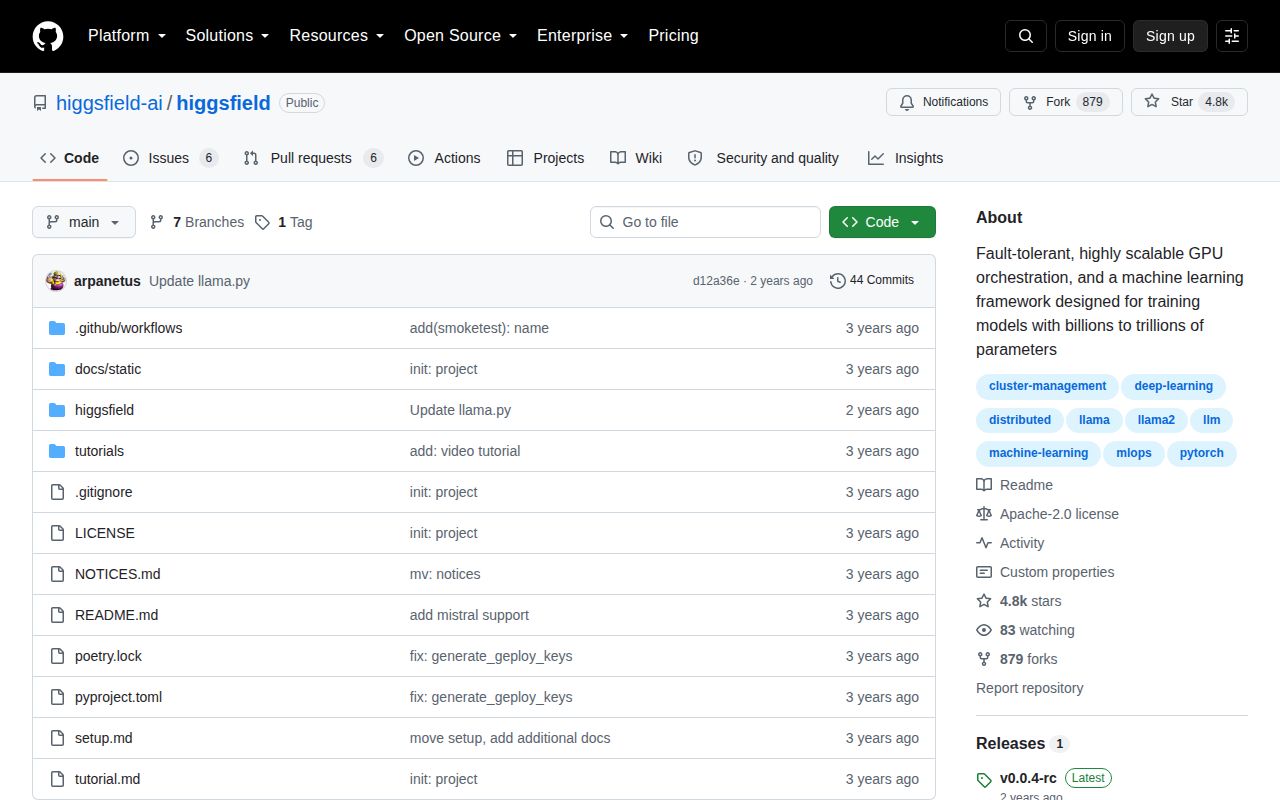
The README tells users to install version 0.0.3. GitHub's latest release is v0.0.4-rc, published March 23, 2024, while the head of the default branch is commit d12a36e from February 13, 2024. There are no later merged main commits to reconcile the package, release candidate, and current dependency state. Pinning an old version can aid reproduction, but here it also freezes the audit result and known behavior.
Repository-level activity looks newer at first glance. GitHub reported a September 14, 2026 push and 12 open issues and pull requests. A September 19 pull request addresses the boolean bug, and another recent branch proposes dependency fixes. That activity is real, yet neither change is on the default branch. Several older pull requests also remain open. The right health reading is mixed: contributors still arrive, while the published and merged product remains dated.
Three tested clouds do not make the control plane portable
The README names Azure, LambdaLabs, and FluidStack as tested clouds. Higgsfield primarily talks to nodes over SSH, which may make other hosts possible, but the project asks users to open an issue when another cloud causes trouble. There is no documented Kubernetes control plane, multi-tenant permissions layer, or provider abstraction comparable to a current cluster scheduler.
For an educational fork, the 3,094-line source is small enough to study. You can trace node setup, workflow generation, queues, and PyTorch helpers without crossing a huge monorepo. For production training, that compactness does not cancel the 31 audit findings, absent test target, old main branch, or privileged setup path. Ray, TorchTitan, and SkyPilot each cover a different slice with more current upstream development. Higgsfield makes most sense as a readable design artifact for a team willing to replace its unsafe and dated parts.