mrkeyoor.com_
Sat 19 Sept 15:46 UTC
AI Toolsevaluationupdated 19 Sept 2026

json-render review

json-render is a TypeScript framework for turning JSON descriptions into working interfaces. An AI model can choose only the components, properties, and actions that your application places in a catalog, which is safer and easier to validate than letting the model write arbitrary interface code.

Verdict

Our json-render run passed all 1,212 tests in 67 seconds, but its 2,502-package install used 2,986 MB and the full build ended with exit 137 after 42 of 53 tasks. Adopt an individual renderer package when you need AI to arrange a controlled set of real application components. Avoid taking on the whole monorepo for a fixed form, and test your exact framework version before committing to its fast-moving 0.x API.

We ran it

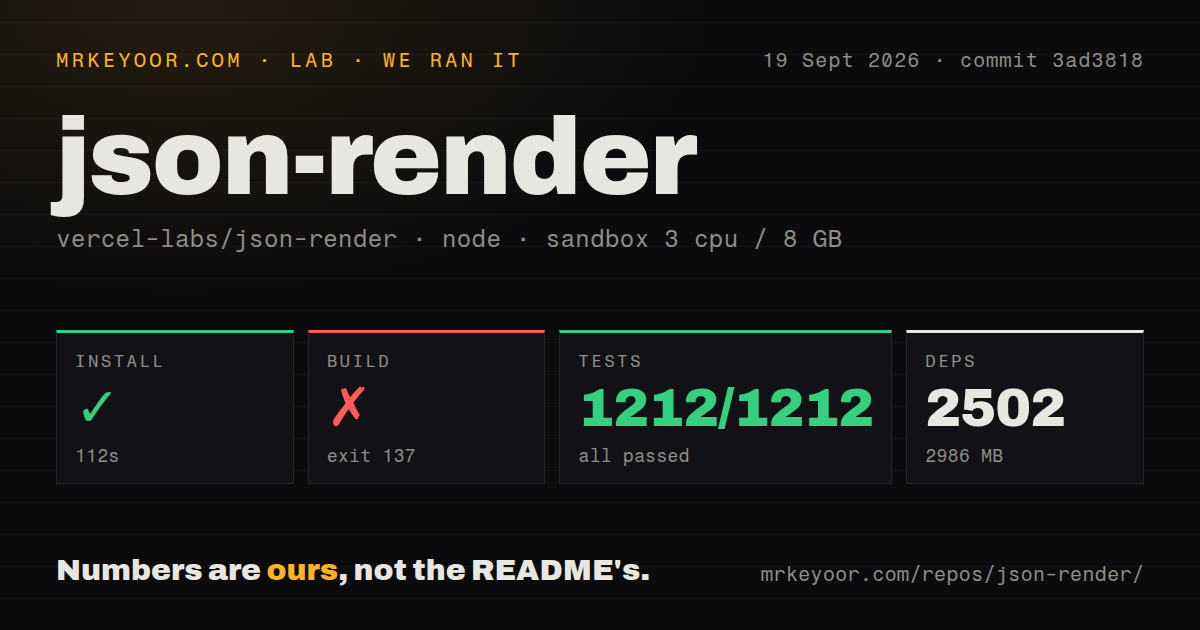
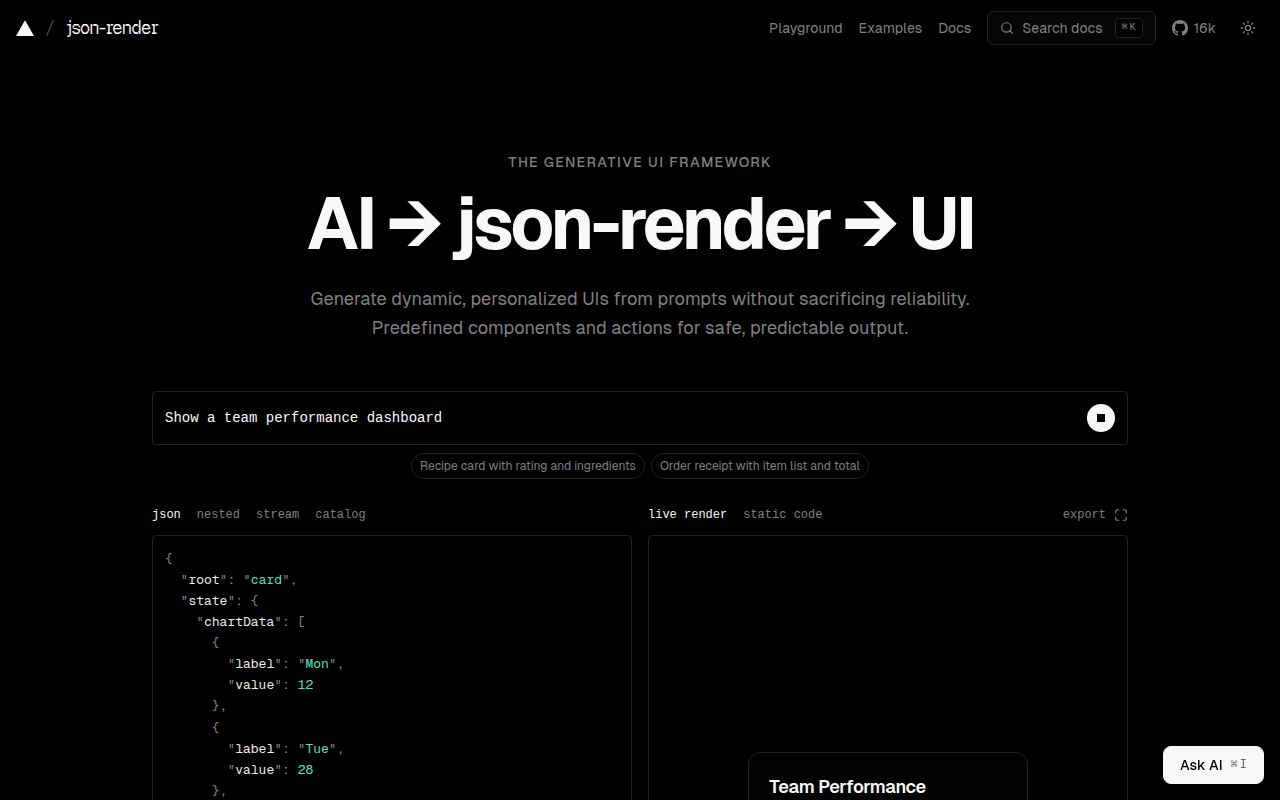
Lab card: what happened when we ran json-renderScreenshot of json-render (json-render.dev)
Install✓ · 112s2502 packages · 2986 MB
Build✗ · 284s
Tests✓ · 67s1212 passed · 0 failed of 1212 (vitest)
Repo1653 files~163,176 lines of source · 9.2 MB · 2 CI workflows · tests dir

Answers from our run

Does json-render build from source?

Dependencies installed in 112 seconds (2502 packages), and the build failed. We cloned commit 3ad3818 into a clean Debian container with 3 CPUs and no project-specific setup.

Do json-render's tests pass?

Yes: 1212 of 1212 passed when we ran the project's own test command (vitest). Some failures need services or credentials a bare container does not have.

Who should not use json-render?

Small projects that only need fixed forms: the full monorepo installed 2,502 packages and used 2,986 MB in our sandbox.

What are the alternatives to json-render?

A2UI, CopilotKit, react-jsonschema-form. Our json-render run passed all 1,212 tests in 67 seconds, but its 2,502-package install used 2,986 MB and the full build ended with exit 137 after 42 of 53 tasks.

Setup3/5Package use is direct; the full 2,502-package workspace is heavy
Docs5/5Catalog, renderer, state, streaming, and example setup are explicit
Community5/516,747 stars with a release and code push on September 18
Maturity3/51,212 tests passed, but version 0.21.0 still carries API churn

Who it’s for

Product teams adding AI-generated dashboards, forms, or content blocks to an existing app.
Developers who want streamed interface output while keeping their own components and action handlers.
Teams sharing one JSON UI model across React, Vue, Svelte, Solid, or React Native.
MCP Apps builders who need a catalog-backed renderer for Claude, ChatGPT, Cursor, or VS Code.

Who it’s NOT for

Small projects that only need fixed forms: the full monorepo installed 2,502 packages and used 2,986 MB in our sandbox.
Angular teams requiring a first-party renderer: issue 332 says none is published and asks whether one would be accepted.
React 18 applications unwilling to override peer checks: open issue 329 says the published React package requires React 19.2.3 or newer.
Teams standardizing on the A2UI protocol: interoperability remains an open question in issue 9, with no adapter documented in the README.
Security-sensitive apps that accept hostile JSON without extra review: issue 326 reports malformed RFC 6902 array indexes being accepted by path helpers.

Setup reality

Our pnpm install succeeded in 112 seconds, adding 2,502 packages and using 2,986 MB. The full build failed after 284 seconds with exit 137. Its log showed 42 successful tasks out of 53 before svelte-chat:build was killed. Tests passed in 67 seconds: Vitest reported 1,212 passed and 0 failed.

The packages require Node 24 or newer and pnpm 11 or newer. Rendering hand-written JSON needs no model credential. The chat and playground examples use a Vercel AI Gateway key; optional Vercel KV or Upstash settings add rate limits. Local development also expects the global portless tool.

The 9.2 MB checkout contained 1,653 files and about 163,176 source lines. It had 2 CI workflow files, a tests directory, and no Dockerfile. The build log says the Svelte chat process was killed, but it does not state why, so we cannot turn exit 137 into a proven memory diagnosis.

The catalog limits what an AI model can put on screen

A json-render catalog names the components an AI model may use, describes their properties with schemas, and lists the actions it may request. Your registry maps those names to real components. The model returns a JSON tree instead of source code, and the renderer turns that tree into the interface. This is the project's most useful decision because generated output stays inside a vocabulary the application owns.

The boundary is concrete, though it is not automatic application security. A catalog that exposes export_report or refresh_data still needs properly authorized handlers. Component implementations remain your code, and data access remains your responsibility. json-render controls the shape of the model's request; it cannot decide whether a signed-in user should be allowed to perform the requested action.

Version 0.21.0 sends one spec to many renderers

The package list reaches well past React. There are renderers for Vue 3, Svelte 5, Solid, React Native, Remotion video, PDF, email, images, terminal interfaces, and React Three Fiber scenes. Next.js and TanStack Start packages can describe routes, layouts, server-rendered data, and metadata. A shadcn catalog supplies 36 components for teams that do not want to define every card and button first.

That breadth is useful when several surfaces share one component vocabulary. It also explains why the repository behaves like a platform rather than a small library. The pnpm workspace includes apps, packages, examples, Stripe demos, and end-to-end tests. Most adopters should install @json-render/core plus one renderer and keep the rest outside their application dependency graph.

What happened when we ran it

Our sandbox installed 2,502 packages in 112 seconds and consumed 2,986 MB on disk. The clean checkout at commit 3ad3818 was only 9.2 MB before installation, so dependency storage is the first practical cost. This was a fresh unprivileged Node 22 container with 3 CPUs, 8 GB of RAM, and no secrets.

The full monorepo build failed after 284 seconds with exit code 137. Turbo reported 42 successful tasks out of 53, then identified svelte-chat#build as the failed task. The last log lines say svelte-chat:build: Killed; they do not say what killed it. We therefore cannot claim a proven out-of-memory failure, even though the process ended with a kill-style code.

Tests gave a much cleaner result. Vitest finished in 67 seconds with 1,212 passed and 0 failed out of 1,212. The repository scan found 1,653 files, about 163,176 source lines, 2 CI workflow files, a tests directory, monorepo workspaces, and no Dockerfile. A passing unit suite and a failed aggregate build can both be true: they answer different release questions.

Node 24 and Portless are part of local development

The root package requires Node 24 or newer, pnpm 11 or newer, and a global Portless installation before pnpm dev will start the examples. The README's short demo omits that last command, but the predevelopment script checks for it and exits with installation instructions. The local hostnames use Portless on port 1355 instead of asking each example to hold a separate remembered port.

Rendering a supplied JSON spec does not require an AI account. The repository even includes a no-AI example with hand-written specs and no environment variables. Prompt-driven chat and playground examples are different: local use needs AI_GATEWAY_API_KEY, while the example model can be changed through AI_GATEWAY_MODEL. Vercel KV or Upstash credentials are optional and enable rate limiting.

September releases show speed, with 62 open issues

Version 0.21.0 shipped on September 18, 2026, the same day as the last recorded push. It added a TanStack Start renderer, experimental Jev composition APIs, named Vue slots, and fixes for streamed React rendering. GitHub showed 16,747 stars and 102 combined open issues and pull requests; an issue-only search returned 62 open issues. The project is active, and its 0.x version still matters when planning upgrades.

Several open items affect adoption choices directly. Issue 329 asks to widen the React peer range from 19.2.3 to include React 18. Issue 332 asks whether a first-party Angular renderer would be accepted after earlier proposals stalled. Issue 9 asks how json-render relates to the A2UI protocol and whether an adapter is intended. None of those requests proves the current package is broken, but each names a boundary a buyer can check before a proof of concept.

Path handling deserves its own regression test if specs can come from untrusted sources. Issue 326 shows array helpers accepting strings such as 1foo, 01, and 1.5 as indexes, contrary to the reporter's reading of RFC 6902. A proposed fix is under review. Keep schema validation, action authorization, and hostile-spec tests in the application even when the model output comes from a catalog prompt.

json-render is worth trying when generated UI means arranging approved components rather than inventing frontend code. The 1,212 passing tests support that trial, while the 2,986 MB install and killed aggregate build argue for adopting only the packages you need. Start with one catalog, one renderer, and one real action whose permissions you can verify.

Alternatives

ProjectWhat it isPick it when
A2UI gh↗An open protocol and toolkit for agents that send interactive UI descriptions to clients.pick this instead when protocol interoperability across agents and renderers matters more than json-render's package catalog.
CopilotKit gh↗A frontend stack for in-app agents, chat, and generated interface experiences.pick this instead when you need an agent-facing application stack rather than a JSON renderer at the center.
react-jsonschema-formA React library that builds forms from JSON Schema without requiring an AI model.pick this instead when the requirement is deterministic schema-driven forms rather than generated layouts.

What people are saying

  1. [github-trending] vercel-labs/json-render

Sources

  1. json-render README
  2. json-render v0.21.0 release
  3. json-render issue 9: A2UI interoperability
  4. json-render issue 326: malformed array indexes
  5. json-render issue 329: React peer range
  6. json-render issue 332: Angular renderer

More ai tools reviews

ai-hedge-fund · chinese-novelist-skill · higgsfield · mindcraft · router · PaddleOCR · the whole board →