Six stages turn a prompt into chapter files
Chinese Novelist Skill gives a coding agent a six-stage process for producing 10 to 50 chapters in Chinese. It begins by loading saved preferences and checking for unfinished work. A layered interview then asks about genre, protagonist, conflict, setting, viewpoint, theme, audience, and length. Before drafting, the agent writes an outline, character records, and a machine-readable plan for the user to approve.
Once approved, the skill creates separate Markdown files for each chapter and updates summaries as it goes. That file-based approach is the project's best idea. A long conversation can lose decisions inside old context, while 01-大纲.md, 00-人物档案.md, and 02-写作计划.json give the agent named places to recover them. The shared preference file carries genre, style, chapter count, and text-density choices into a later project.
Three writing modes expose a continuity tradeoff
The default serial mode keeps one agent writing chapters in order. A subagent mode divides chapters into batches, while Claude Code's Agent Teams mode lets several agents coordinate on a larger manuscript. The README does not provide timings or comparative quality results for these 3 modes. Faster parallel output is therefore an option to test, not a measured advantage.
Parallel chapters make the plan JSON more important because several writers can interpret the same character or event differently. The repository added a style-baseline mechanism in merged pull request 37 after users raised concerns about drift. Each chapter is also supposed to consult the outline and update its summary. Those controls are sensible, but they cannot replace reading adjacent chapters together and checking names, motives, chronology, and point of view.
What happened when we ran it
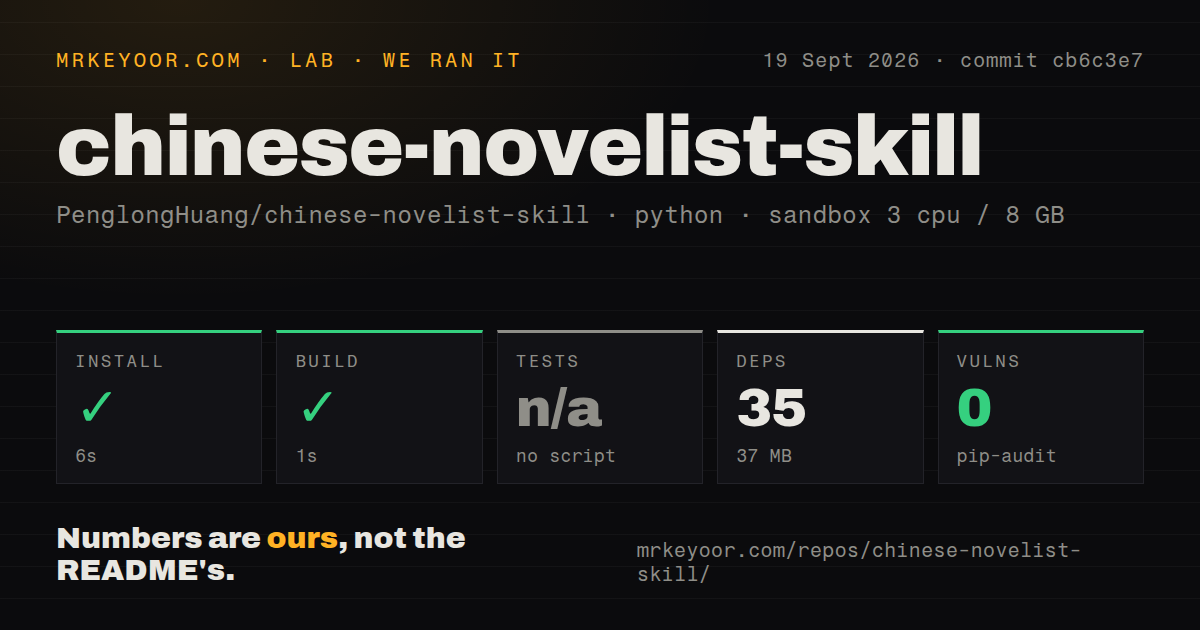
Our sandbox installed 35 Python packages in 6 seconds and occupied 37 MB on disk. The build completed in 1 second. Pip-audit reported 0 known vulnerabilities in that installed environment. This is a small checkout: 28 files, around 179 lines of source, and 0.9 MB before its dependencies. The low footprint fits a skill made mostly of Markdown instructions and reference material.
There was no test script or target, so tests were skipped. Our scan also found 0 CI workflow files, no tests directory, and no Dockerfile. A Docker image would add little to a set of local agent instructions, but the missing automated coverage matters. Changes to phase routing, continuation state, or plan-file handling have no visible regression suite in the measured commit.
The successful build only establishes that the supplied Python can be processed in our fresh Python 3.12 container. It does not score a generated story, run a 50-chapter session, or prove that an interrupted draft resumes correctly. We measured installation and repository mechanics. Claims about prose quality still need a manuscript, a model choice, and a human reader.
Length checks catch short chapters, not dull ones
The skill asks for 3,000 to 5,000 Chinese characters per chapter and can rewrite chapters that fail its checks, up to 3 rounds. Its guidance covers hooks, dialogue, character building, plot structures, and expansion. It also instructs the agent to polish away obvious machine-written phrasing. These rules provide a useful checklist, but word count and a second model pass cannot determine whether a scene earns its length.
Open issue 31 reports heavy repetition in a 10-chapter short novel. Issue 32 shows an agent repeating its own Layer 1 summary instead of advancing to Layer 2. Issue 30 describes later chapters drifting into slow, list-like prose despite extra prompting. The merged style-baseline work may help with one part of that complaint, yet the issues remain open. They are reasons to review output, not proof that every current run fails.
Phase 3 also tells the agent to stop asking the user for confirmation until the manuscript is complete. That choice reduces interruptions during a long run. It also removes natural editorial checkpoints. For serious work, inspect chapters in batches even if the skill prefers full automation, especially before parallel agents multiply a mistaken plot decision.
Chinese-only documentation matches a Chinese-only job
The README, SKILL.md, workflow files, and writing guides are written in Chinese. The root contains 7 top-level entries and no English README. That focus is appropriate for rules about Chinese web-fiction pacing and character counts, but it makes setup and modification harder for an English-only maintainer. The occasional English term such as serial or agent-teams is configuration syntax, not translated documentation.
Installation is otherwise light. The README offers an npx skills add command, while manual Claude Code setup copies the directory under ~/.claude/skills/chinese-novelist/. There is no hosted account or application server to maintain. The agent writes directly into the working directory, so users should choose that directory deliberately and keep drafts under version control if recovery matters.
September activity has no matching GitHub release
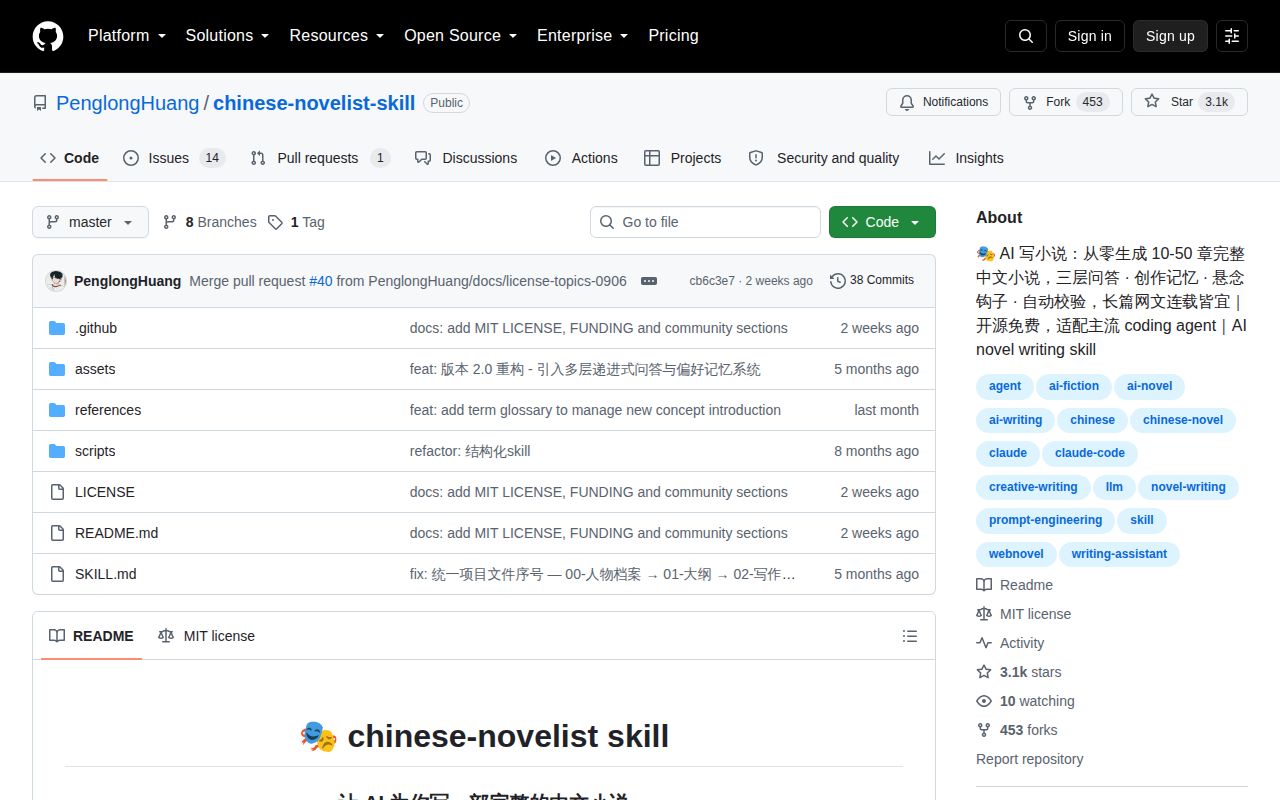
GitHub showed 3,106 stars, 15 open issues and pull requests combined, and a last push on September 6, 2026. A documentation pull request was still active on September 16. That combination shows recent work and user interest. GitHub's latest-release endpoint returned no release, even though the README displays a v2.0 badge and describes a v2.0 restructuring.
The repository is easy to try because our 6-second install and 1-second build both passed. Keep the promise narrow: it is a structured Chinese drafting process with persistent files. The missing test target and open repetition reports leave authors responsible for the harder check, reading the whole manuscript and deciding whether its characters still sound like themselves.