Four research agents cover papers, code, and verification
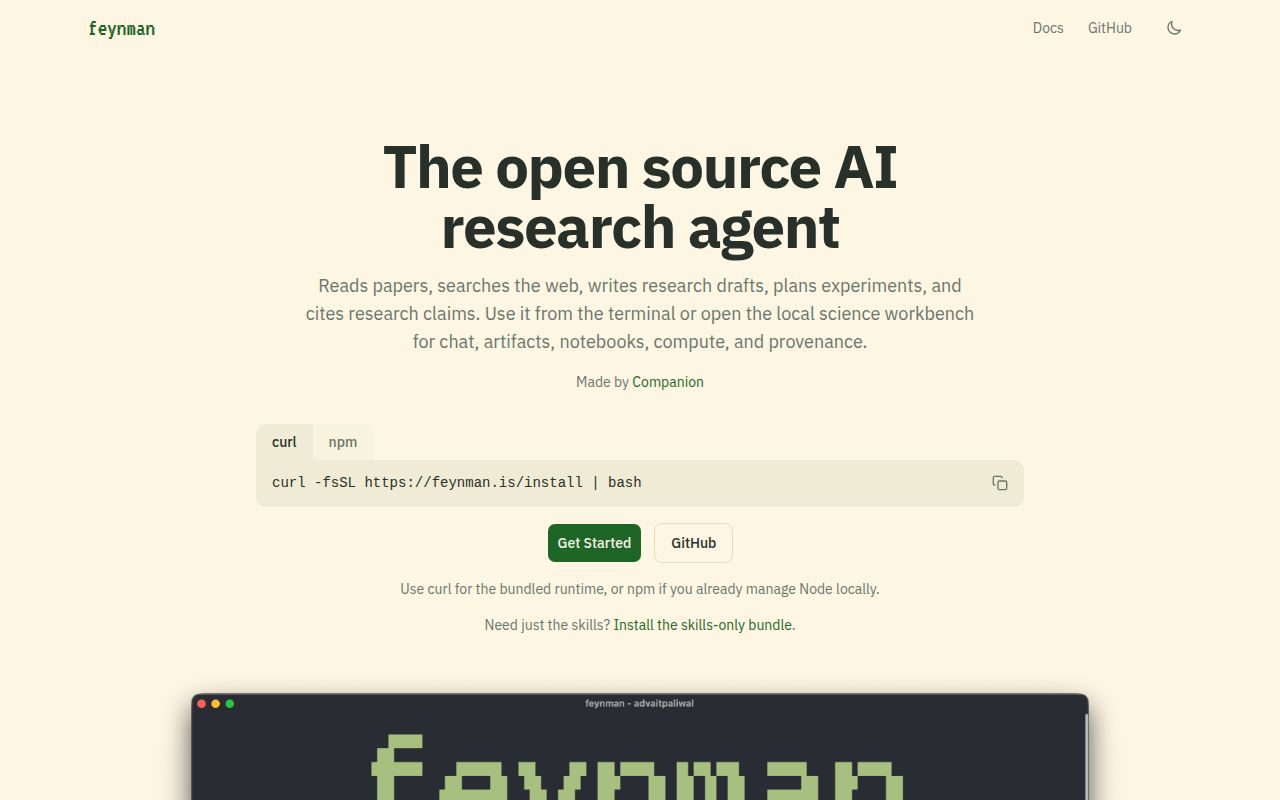
Feynman v0.3.48 bundles four named agent roles: Researcher, Reviewer, Writer, and Verifier. The terminal can search papers and the web, rank literature, compare sources, audit a paper against its public code, prepare a replication plan, and draft from collected evidence. A separate serve command opens a local science workbench for projects, chat, artifacts, notebooks, compute, and provenance. This is much closer to a research cockpit than a chatbot with a paper-search prompt.
The choice of interface is unusually flexible. A native installer brings its own pinned Node.js runtime and verifies a SHA-256 before replacing an installation. The npm package uses the local runtime instead. People who only want the prompts and skills can install those into Codex, a repository agent folder, or OpenCode without taking the terminal, authentication store, and bundled runtime. That split gives teams a sensible way to test the research method before adopting the full application.
Sixteen named workflows make scope the main buying decision
The 29.8 MB checkout documents 16 commands and slash workflows, including rank, paper, lit, audit, replicate, recipe, and watch. PaperRank can expand citation graphs, fetch full text for selected papers, add critique, and record the model used for synthesis. The paper resolver accepts DOI, arXiv, OpenAlex, PMID, PMCID, or a title. Those are concrete research jobs, and they reduce the glue code otherwise needed between search services, PDFs, citation graphs, and an agent session.
That breadth carries a tax. The workbench also handles spreadsheets, media, LaTeX, chemistry files, biological sequences, structures, trees, and tensors. Its science connector catalog reaches literature indexes, clinical trials, drug records, molecular databases, genomics services, cancer resources, and omics archives. A lab using several of those sources may appreciate one stateful interface. A software team that only wants cited web research will spend time understanding features it never needs.
What happened when we ran it
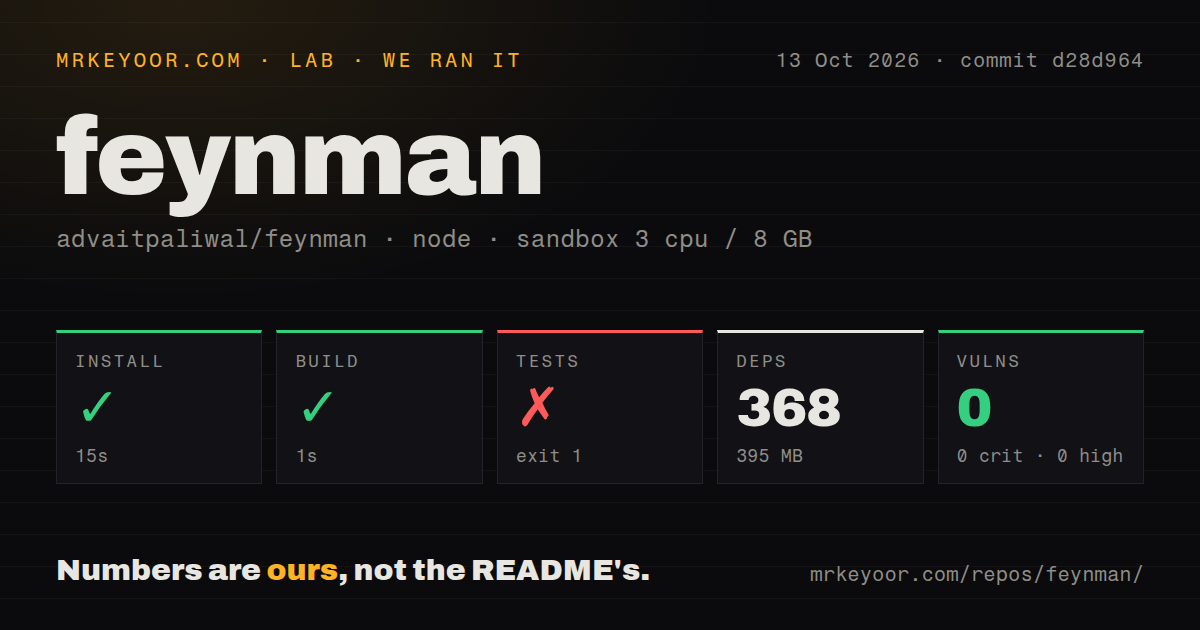
Our sandbox cloned commit dfdcb7c, a 29.8 MB repository with 1,013 files and about 191,766 source lines. On 3 CPUs with 8 GB of RAM, npm installed 985 packages in 76 seconds and occupied 1,329 MB. The build succeeded in 27 seconds. The checkout had 3 CI workflow files and a tests directory, but no Dockerfile.
The test command ran for 699 seconds and exited with code 1. The final assertion shown in the log had an actual value of error and an expected value of complete; the tail did not identify a cause, so we will not supply one. A provider-retry subtest printed as passing immediately before the failing-tests summary. Npm audit reported 0 known vulnerabilities across critical, high, moderate, and low severities for the dependencies in our run.
Local models trade provider accounts for local services
Feynman documents 2 local endpoints: LM Studio on port 1234 and LiteLLM on port 4000. Ollama and vLLM can be connected as custom OpenAI-compatible providers. Hosted routes use feynman model login, an API key, or an OAuth flow depending on the provider. OpenRouter even documents a headless SSH path where the user pastes the final redirect URL or authorization code back into the prompt.
A local endpoint removes the need to send research prompts to a hosted model, but it does not make the whole workflow offline. Paper search, web retrieval, full-text access, code fetching, and specialist science sources still depend on network services. Some use public endpoints, while others accept tokens such as HF_TOKEN. Teams should map which sources receive a query, what gets cached, and which credentials are present before using confidential research questions.
Version v0.3.46 proves that release pinning matters
The release page tells users not to install v0.3.46 because it included a shutdown failure, exposed proxy or provider credentials in child-process arguments, and carried stale npm metadata. The next published version shown by GitHub is v0.3.48, dated September 6, 2026, which moved the canonical repository and npm package to the current owner and updated affected URL and query dependencies. That history shows maintainers documenting mistakes plainly, but it also makes blind auto-updates a bad policy.
GitHub showed 8,917 stars and 6 open issues and pull requests, with the last push on September 6, 2026. Issue 273 was opened the next day and already had a matching pull request to remove a duplicate /thinking command that causes a startup warning under Pi 0.85.1. The repository is active by both push date and issue work. It is also young, created in March 2026, and its quick succession of 0.3.x releases signals ongoing interface and packaging changes.
A 1,013-file agent needs a local acceptance set
Feynman is worth trying when research spans papers, the open web, public code, and specialist scientific records. Start with the skills-only install or one pinned native release, then run a few questions for which your team already knows the literature. Check citation destinations, claim support, source licensing, provider routing, and saved artifacts. The failed 699-second suite means our exact commit did not earn a clean bill of health, even though installation, build, and audit all completed successfully.
For a narrower problem, PaperQA or GPT Researcher will be easier to explain and contain. Feynman earns its larger 1,329 MB dependency footprint only when the workbench, research memory, artifact handling, and several workflow types are used together. Its strongest audience is a technical researcher who wants one configurable workspace and already treats model output as a draft that must survive source review.