Type hints define both the handler contract and its documentation
A FastAPI route looks like an ordinary Python function. Its path parameters, query values, headers, cookies, and request body are declared through function arguments and Pydantic models. FastAPI converts incoming data, rejects invalid values, serializes the response, and generates an OpenAPI schema from those declarations. Swagger UI and ReDoc then provide interactive documentation without a second hand-maintained specification.
That shared source of truth is the main reason to choose it. Editor completion and static type checks help while writing code, while runtime validation protects the HTTP boundary. Changing a body model updates the generated schema and documentation. The convenience has a cost: Pydantic and Starlette behavior become part of your application's public contract, so dependency upgrades deserve API regression tests rather than an automatic version bump.
A 41-package install is small, while production remains your design
The README's current quick start uses uv add "fastapi[standard]", then uv run fastapi dev. The standard extra includes the command-line tooling and a Uvicorn server. A tiny application can be running with one Python file and two routes, with interactive docs at /docs and an alternative view at /redoc. No vendor account or hosted control plane is required.
FastAPI does not choose the rest of the stack. Database access, migrations, user storage, authorization policy, queues, and deployment topology come from your application or other packages. The public roadmap describes additional authentication helpers and updated database tutorials as tentative work, not shipped promises. Django is a better fit when an integrated ORM, admin interface, and account foundation are requirements from day one.
What happened when we ran it
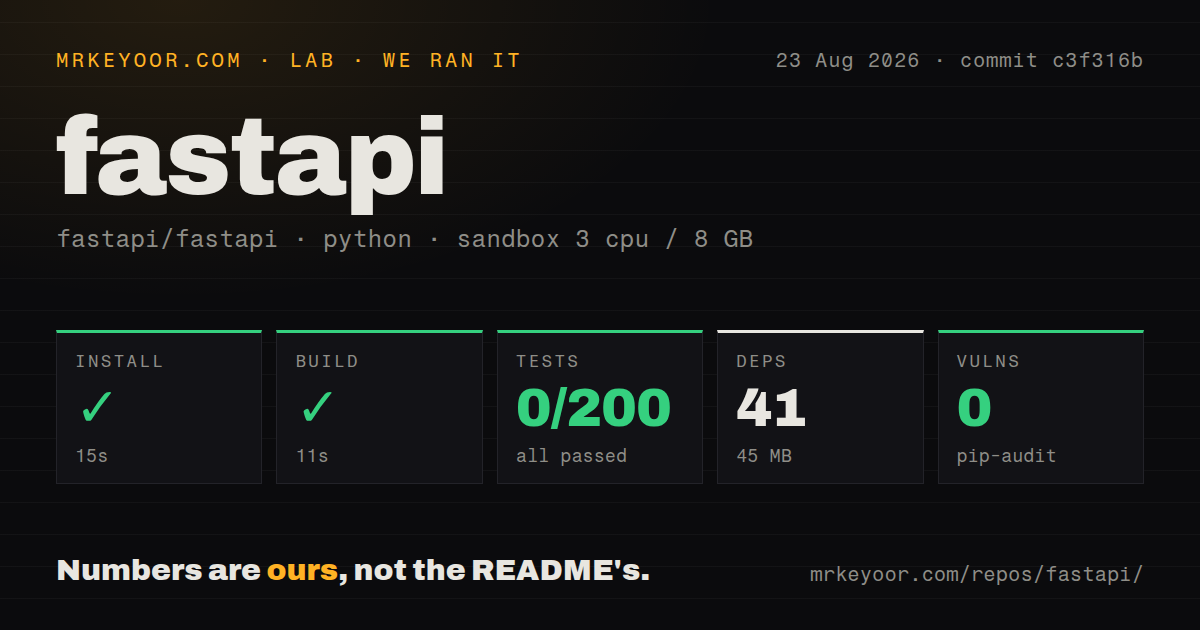
Our sandbox installed commit c3f316b in 15 seconds, adding 41 packages and consuming 45 MB on disk. The build passed in 11 seconds. The checkout was 34.4 MB with 3,139 files and about 114,759 lines of source. It had 20 CI workflow files, a tests directory, and no Dockerfile. Pip-audit found zero known vulnerabilities in the installed dependency set.
Pytest exited with code 1 after 13 seconds without executing a test. It reported five skips and stopped after 200 collection or setup errors. The repeated message said the starlette.testclient module required httpx2 and printed pip install httpx2. Several named failures were stringified-annotation test modules, but the same missing-package message prevented the suite from reaching assertions.
This is a dependency setup finding, rather than evidence that 200 FastAPI behaviors failed. It is still important: the install and build path we ran did not produce a runnable contributor test environment in a fresh Python 3.12 Debian container. Before changing the framework, install the repository's complete test extras, confirm the intended Starlette test-client generation, and rerun collection. Our 13-second result says nothing about request throughput because we did not benchmark an API server.
Generated docs create a browser-facing security surface
Interactive documentation is useful during development and can be useful for trusted API consumers. It is also HTML and JavaScript served by the application. Open issue 16253, filed August 26, 2026 by an automated security reporter, includes reproductions in which an attacker-controlled mounted path reaches the Swagger UI or ReDoc output without suitable escaping. It also reports unsafe title and asset URL interpolation when those values come from untrusted configuration.
The issue was still open when researched, so we will not present a maintainer verdict or fixed version that does not exist. The practical response is clear enough: do not derive documentation titles, asset URLs, or mount paths from untrusted tenant data, and restrict or disable docs routes where users do not need them. Pip-audit's zero known advisories covers installed package records. It cannot disprove an application-level report filed against current source.
Debug mode returns details that production clients should never see
A second open report demonstrates a response model returning the wrong type under debug=True. The resulting 500 response contains the source path, line number, function name, endpoint template, and rejected value. With debug disabled, the report's control run returned a generic internal server error. This fits the established rule that framework debug pages belong only on a developer machine.
Response validation itself is worth keeping. It catches a handler that promises an integer and returns an incompatible string before that bad shape reaches an API client unnoticed. Production should log enough context for operators while returning a plain failure to callers. Add a regression case for response-model errors, ensure debug=False in deployed configuration, and keep traces inside the service's protected logs.
July's v0.141.1 fixed the newer frontend path
FastAPI 0.141.1 was released on July 29, 2026. Its short notes fix background tasks and headers from dependencies when using app.frontend(), and document the FASTAPI_ENV setting in the CLI guide. GitHub recorded the last push on August 26. The repository had 101,868 stars and 81 combined issues and pull requests when fetched, with new reports receiving activity on August 27.
The low combined queue is notable for a repository of this size, although it is not a count of confirmed bugs. FastAPI also depends heavily on work in Starlette, Pydantic, and Uvicorn, a relationship its roadmap states directly. That makes its documentation unusually important because version compatibility and behavior span several projects. Pin a tested set, read each release note, and treat generated OpenAPI output as a contract checked in CI.
FastAPI remains an efficient way to build a typed Python API. The framework removes repetitive parsing and schema work without forcing a hosted platform. Its 15-second install and 45 MB footprint make a trial cheap, while our blocked test collection warns contributors to verify all development extras. For a production decision, the stronger questions are whether Python and Pydantic suit the team, and whether the team will own the database, authentication, deployment, and documentation exposure FastAPI deliberately leaves configurable.