It is a Chinese toolkit shelf, not one proxy application
Fanqiang collects circumvention material for many devices and several layers of a connection. The main index links Android and iOS clients, Windows and macOS instructions, Linux and router guides, browser bundles, server setup, and game-console routing. Its primary language is Chinese. An English reader gets a short licensing note in the FQNews page, not a parallel set of English instructions. That language boundary matters because setup advice changes by client and operating system.
The 1,885-file checkout also contains more than documentation. FQNews is an Android RSS reader that imports SS, VMess, VLESS, or Trojan node strings, fetches outside news through them, and caches the result on the device. ChromeGo packages several tools and free servers behind a Chrome-oriented launcher. Those are different products with different setup and trust questions, held together by one repository rather than one common installer.
The README expects users to rotate through several methods
The ChromeGo instructions tell users to extract the download fully, avoid a path containing Chinese characters or spaces, install Chrome separately, and try the numbered methods in sequence. That is practical advice for the audience, but it also defines the product honestly: there is no single route promised to work everywhere. The README says results vary with region, carrier, and local blocking conditions.
That variability shows up in support traffic. Open issue 1028 says sing-box and Xray stopped connecting after an IP update. Issue 1024 reports that the Linux Firefox bundle could not find ./firefox/firefox, even though its proxy configuration continued loading. Issue 975 says a manual geosite download URL in the Linux instructions no longer worked. These reports cover different components, so they do not prove one shared defect. They do show the maintenance cost of a repository spanning browsers, proxy cores, feeds, and third-party download links.
What happened when we ran it
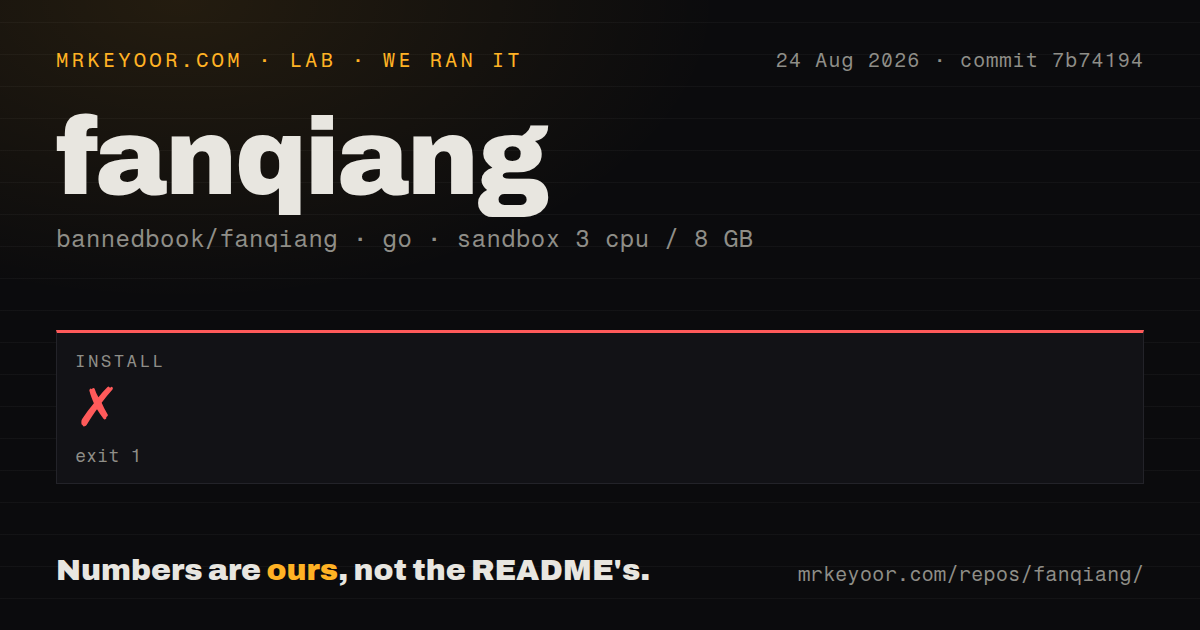
Our sandbox cloned commit 7b74194 and attempted the Go project in fqnews2/libcore. Installation failed with exit code 1 after 11 seconds. The checkout was 97.9 MB, with 1,885 files and roughly 100,360 lines of source. Go reported that github.com/matsuridayo/libneko@v1.0.0 had been replaced by ../../libneko, then failed to open /work/repo/libneko/go.mod because the file did not exist.
The log establishes a missing local module at that path. It does not establish why the expected directory was absent, so we will not assign a cause. Since installation stopped, our run produced no build result and no test result. The repository scan found 0 CI workflow files, no Dockerfile, and no tests directory. A developer evaluating FQNews should resolve the local replacement layout before judging application behavior.
FQNews needs nodes before it can fetch outside feeds
The Android reader is the most coherent application in the repository. Its 724-byte README says users can add outside RSS or Feed sources and cache stories locally, but the app needs a working proxy node. Imports accept 4 named formats: SS, VMess, VLESS, and Trojan, with one node per line and no stated quantity limit. That keeps credentials out of the source checkout, while leaving node acquisition and trust to the user.
FQNews says it is based on bannedbook/v2ray.vpn and spacecowboy/Feeder and is licensed under GPLv3. GitHub does not detect a license for the repository as a whole, even though fqnews2/LICENSE exists and the subproject states its terms. An organization planning redistribution should map the boundaries of the browser bundles, included binaries, instructions, and FQNews code rather than applying the subproject statement to every file.
Recent pushes coexist with an older app release
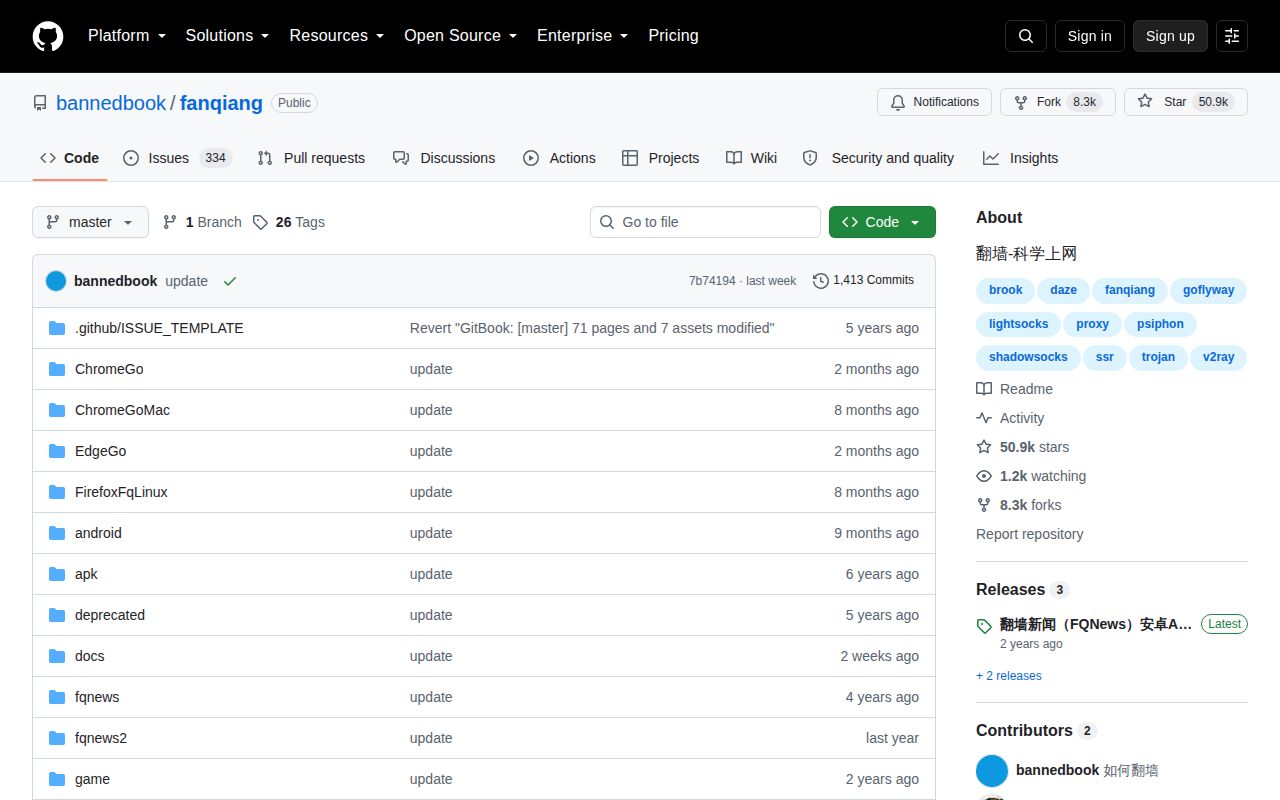
GitHub recorded the last repository push on August 21, 2026, and current issues were updated on August 24. The repository had 50,898 stars and 334 open issues and pull requests when fetched. That combined count includes pull requests, so it is not a defect total. The dates show ongoing repository and user activity, which is more useful than treating the release list alone as the health signal.
The latest GitHub release is FQNews v1.3.8, published August 18, 2024. A two-year-old app tag does not mean the entire collection is abandoned, because the default branch moved in 2026. It does mean Android users should separate app-release freshness from edits to guides or bundled configurations. Check the artifact, its source boundary, and current node compatibility before installing it on a primary device.
A focused client is easier to own
Fanqiang earns its place as a broad Chinese starting point. Someone facing an unreliable route can compare browser packages, mobile clients, self-hosted servers, and router options without assembling the vocabulary first. The 97.9 MB repository also preserves instructions and code that would otherwise be scattered across wikis and separate projects. That breadth is the reason to consult it.
It is also the reason many developers should walk away. Our 11-second install failure blocks a clean source evaluation, support issues span unrelated packages, and the top-level licensing signal is unclear. Use Fanqiang as a map when the Chinese documentation matches your needs. Use v2rayA, Hiddify App, or v2rayN when you need one product with a narrower operating and update surface.