Patterns make repeated prompts inspectable
Fabric stores each task as a named Markdown pattern rather than hiding the instruction inside an application. A user can pipe text into fabric --pattern summarize, apply another pattern to a URL, or retrieve a YouTube transcript before sending it to a model. Custom patterns live separately from the built-in collection and take precedence when names collide. That file-based design is the best reason to use Fabric: a team can read, edit, diff, and pin the instruction behind a recurring AI task.
A pattern does not guarantee a good answer. Output still depends on its wording, the input, the chosen model, provider behavior, and sampling settings. Fabric also offers strategy files that modify system prompts with approaches such as chain of draft or self-refinement. Those can be useful experiments, but they add another instruction layer to review. Treat patterns and strategies as code-like inputs to an unreliable remote function, with examples and acceptance checks for any output that affects publishing or operations.
Go 1.26 narrows source installation
Release v1.4.470 was published on 2026-08-04 and updates Nixpkgs because the module requires Go 1.26.0. Most users can avoid that compiler requirement through the release installer, manual archives, Homebrew, AUR, Winget, Scoop, or a container image. The one-line Unix and PowerShell installers detect the platform, download the latest archive, extract the binary, and verify it. Reading the script first is still sensible whenever an installation command pipes network content directly into a shell.
Setup then asks for model providers and stores configuration under ~/.config/fabric. The README lists native connections for OpenAI, Anthropic, Gemini, Ollama, major clouds, and several others, followed by a long set of OpenAI-compatible vendors. Per-pattern environment variables can select a provider and model. This flexibility reduces CLI switching, but credentials, model names, context limits, pricing, and output behavior remain provider-specific. A local Ollama route avoids a hosted API key while adding local model and hardware administration.
What happened when we ran it
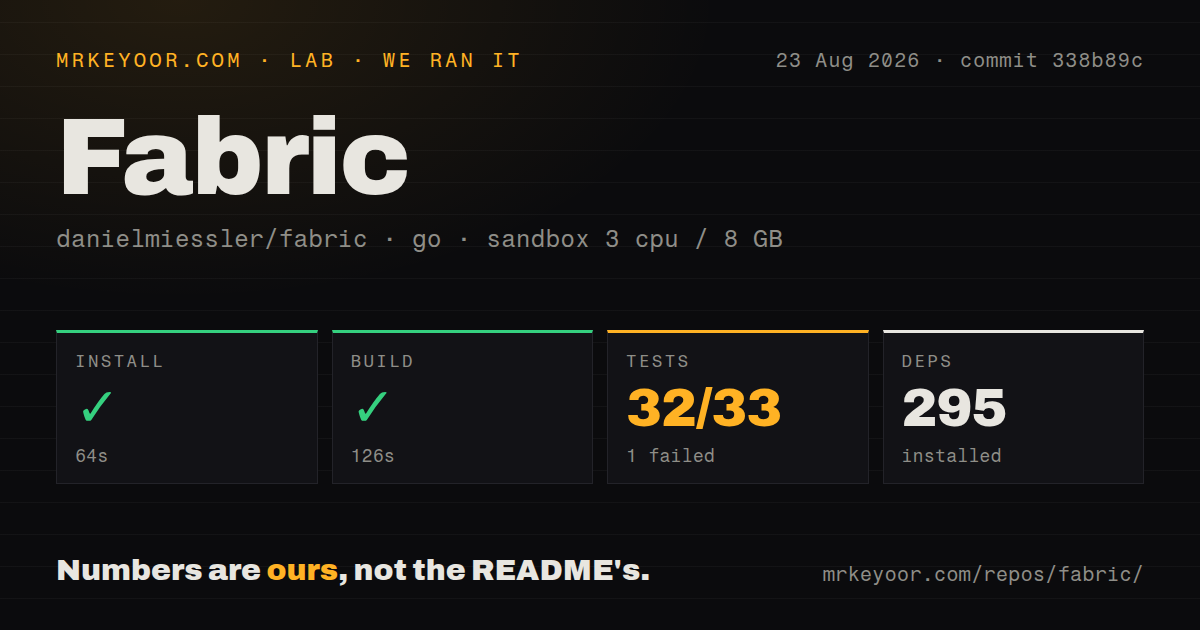
Our sandbox fetched 295 Go packages in 64 seconds at commit 338b89c. The source checkout contained 843 files, about 49,072 lines, and occupied 28 MB. Building the project succeeded in 126 seconds. The repository had 4 CI workflow files, no Dockerfile, and no directory named tests; Go tests are placed alongside packages instead. These measurements came from an unprivileged Debian container with 3 CPUs, 8 GB of RAM, and Go 1.24 as the named base image.
The test command ended after 26 seconds with exit 1. The harness counted 32 passing packages and 1 failed package out of 33. The supplied final lines show passes for server, converter, custom-pattern, notification, Spotify, and YouTube packages, plus several packages with no test files, followed by FAIL. They do not name the failing package or assertion. We therefore cannot tell whether configuration, Go version, a platform assumption, or a code defect produced the failure.
Port 8080 needs an API key before exposure
fabric --serve starts the REST API on port 8080. The API covers streamed chat, pattern and context management, sessions, provider model lists, YouTube transcripts, and configuration. Authentication is optional: supplying --api-key requires an X-API-Key header, while omitting it accepts all requests and logs a warning. The documentation also says Swagger remains public when API authentication is enabled. Bind and firewall the service deliberately instead of assuming a CLI defaults to local-only safety.
The configuration endpoints raise the stakes. GET /config returns provider keys and URLs, while POST /config/update writes values to Fabric's environment file. An unauthenticated server can therefore expose more than model output. Use a long API key, restrict network reachability, place TLS and request controls at a trusted proxy when remote access is needed, and avoid sharing one configuration directory across users with different privileges. The Docker example mounts that directory, so its volume belongs in backup and secret-handling policy.
Active releases do not make every integration equal
GitHub showed 65 open issues and pull requests combined, a latest push on 2026-08-09, and the v1.4.470 release 5 days earlier. August activity included Ollama cancellation, provider additions, prompt cleanup, completion behavior, and dependency updates. The project is plainly active. Its width is the maintenance risk: model SDKs, cloud authentication, YouTube extraction, web fetching, a REST API, prompt data, a web interface, and helper commands can age at different speeds.
Fabric fits best as a personal or team prompt runner whose configuration is versioned and whose outputs are checked. Unix pipes are a natural interface for feeding articles, transcripts, or code into one known instruction. The REST API can extend that model to applications, but it deserves server-grade authentication and isolation. If the main need is an open-ended chat history or agent loop, another client will feel more direct; Fabric earns its place when the reusable pattern is the product.