Short answer: use Exact when you can own a changing framework
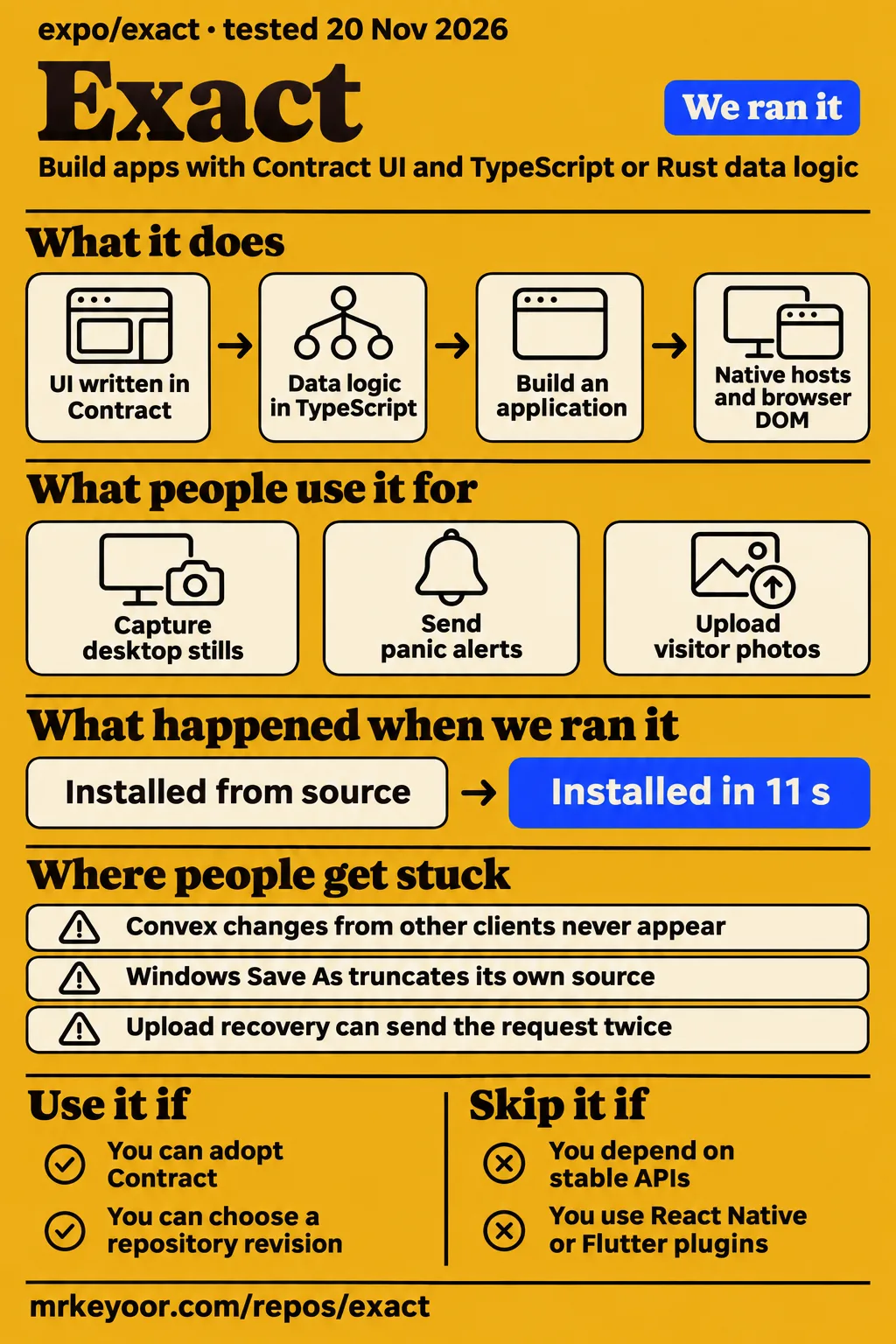
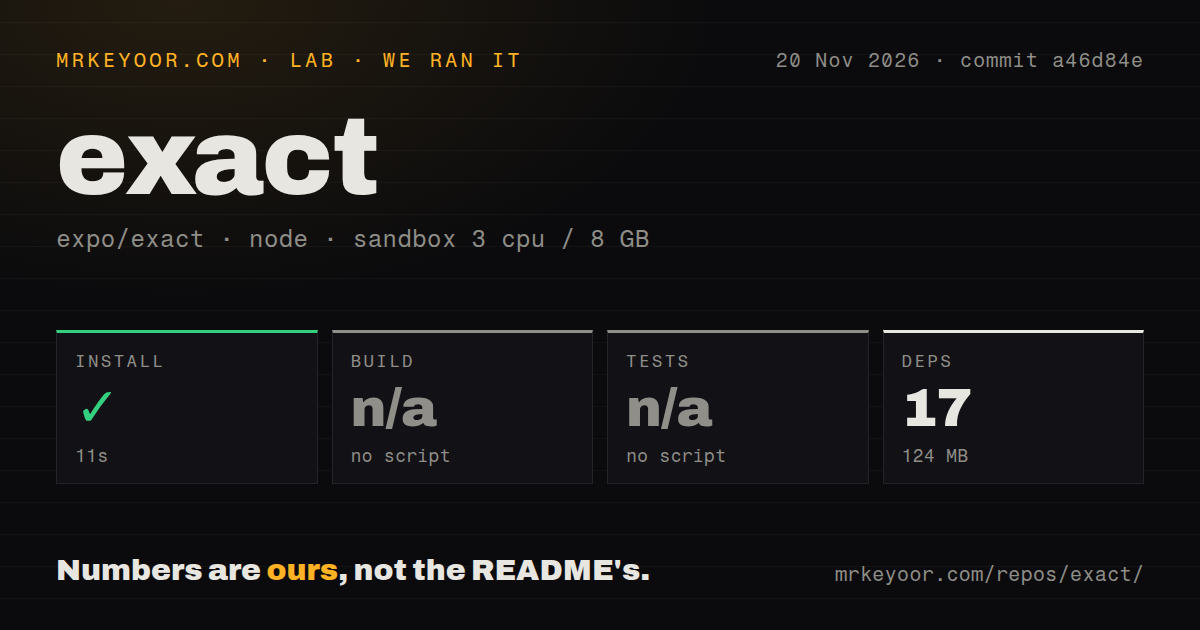
Exact is pre-1.0 and built from a repository checkout. Use it to evaluate Contract and agent-driven app development; skip it when your launch requires stable APIs or existing React Native or Flutter plugins. The Exact README explicitly describes the absence of API stability and backwards compatibility, and says those plugins do not work. Our dependency installation succeeded in 11 seconds at a46d84e.
Expo's Exact separates Contract UI from data logic written in TypeScript, Rust or declarative HTTP sources. Its README's agent-driver description lists 10 operations, including inspecting the tree, taking screenshots, entering text and advancing a seekable clock. For an experienced developer, that suggests a concrete evaluation: implement one important application interaction, then exercise it on each intended host. Contract is the UI language being adopted, while the data layer has several documented choices.
What people use exact for
Developers describe Convex applications, Windows screenshot tools and Android panic alerts in Exact's GitHub discussions. These reports connect framework capabilities to specific application requirements: receiving another client's changes, capturing the desktop before an overlay appears, or sounding an alert while a guard's phone is in a pocket. The model-viewer discussion adds a requested package direction for technical models in ordinary applications.
| Who used it | What they did | Reported outcome |
|---|---|---|
| san-devistan and their team | Connected a todo application to Convex | Reported live updates and Better Auth sign-in on web, macOS and the iOS simulator in Convex integration issue #54. |
| Anthonyy232 | Replaced custom Windows desktop capture | The maintainer's closing report names Windows 11 checks across display seams, menus, mixed scaling, hotplug and hidden launches in screen-capture issue #505. |
| juanclaudiopardo and their team | Built audible resident panic alerts for a gatehouse application | The closing discussion records phone delivery in front, background, locked and after am kill in Android push issue #537. |
| koolkao and their team | Requested a technical-model viewer for an ordinary application | The maintainer chose a first-party @exact/model-viewer GPU package rather than a built-in tag in model-viewer issue #724. |
The Convex application also exercised billing and storage. The team's integration report in issue #54 describes Stripe checkout updating the plan and paid invoice without a refresh, along with successful R2 uploads. Its email attempt reached Cloudflare but sending was refused by the account plan. That refusal belongs alongside the completed integrations because it identifies the operation that stopped and the reported reason.
What happened when we ran it
Our run installed dependencies in 11 seconds on November 20, 2026, at commit a46d84e. The repository measurement records 17 dependencies, 124 MB on disk, 3 CPUs, 8 GB RAM and image lab-node:22. The checkout occupied 365 MB and contained 18,130 files with approximately 2,597,251 source lines. Build and test steps were skipped because the harness found no matching script or target.
| Recorded repository step | Result | What you can conclude |
|---|---|---|
| Dependency install | Succeeded in 11 seconds; 17 dependencies; 124 MB on disk | The dependency step completed in our sandbox. |
| Build | No build script or target found; skipped | The harness recorded a skipped build. |
| Tests | No tests script or target found; skipped | The harness recorded skipped tests. |
| Checkout scan | 18,130 files; approximately 2,597,251 source lines; 365 MB | These are checkout measurements. |
| Repository signals | Four CI workflow files; monorepo workspaces; no Dockerfile or tests directory detected | These are file-discovery results. |
The separate November 20 deployment safety step failed with unsafe repo: none of compose.yaml, compose.yml, docker-compose.yaml, docker-compose.yml exists (rule: a compose file is required). The requirement came from the deployment harness. The run summary says deployment used its own Docker Compose with every port bound to 127.0.0.1, which conflicts with the failed safety step. The teardown record reports teardown: ok.
Where people get stuck: follow the operation, not the platform label
Exact's issue discussions identify failures in Convex live queries, Windows file handling and Android push configuration. Several received fixes or documented configuration changes. Keeping the original symptom beside the response helps distinguish a reported failure from the later implementation path. The linked discussions identify the application requirement behind each change, including external writes, retained folders and messages that must reach an application handler.
| Symptom and reporter | What changed or what to do | Status in the discussion |
|---|---|---|
| san-devistan: changes from other Convex clients never appear | Use @exact/convex's stream-based integration | External writes appeared without refresh in issue #54. |
| ConvexHttpClient encounters unavailable Math.random in a data source | Set logger: false | The maintainer calls that configuration the right answer in issue #54. |
| A retained Windows folder opens the last-used directory | Convert held paths into shell-compatible spelling | The discussion identifies the shell's refusal to parse the verbatim path form in issue #507. |
| Windows Save As truncates its own source or a hard link | Compare the destination with the opened source before copying | Later checks reported unchanged length and SHA-256 in issue #507. |
| Android pushes containing title/body do not raise the app's push event | Use the documented data-only delivery path for handler execution | Notification messages take a separate path in issue #537. |
| Android dependency verification rejects the push lock | Include kotlin-stdlib-common in lock generation | The next ordinary Android command built and installed without lock changes in issue #537. |
Convex integration also exposed generated-type and source-mount problems, including ENOENT and handling an external tsconfig extension. The issue #54 discussion records a fully typed api.todos.list and a passing web/macOS check after source-mount changes. It also says the web build reads the application's own configuration for mounted files. That detail is relevant when the backend sources live outside the application's directory.
Background upload recovery can send the request twice
A POCO X6 Pro completed a 314,572,800-byte upload with HTTP 201, including in the background, according to the closing report in issue #687. The recovery checks recorded separate outcomes for pressing Home, swiping the application out of Recents and explicitly force-stopping it. The distinction is useful for the gatehouse application's visitor photos and recorded videos because leaving an application can involve different process states.
After a Recents swipe killed the process, relaunch caused one retry and success in issue #687's recovery report. The reporter describes launching about 22 seconds after the server answered the dead process, followed by another POST. Pressing Home while the server held its reply for 30 seconds succeeded with one POST; explicit force-stop delivered an abort. An endpoint that creates records or charges for an operation should account for repeated requests: the reported recovery involved two POSTs.
Performance numbers belong to a workload and revision
jonathanfristedt reported a full application's launch script shrinking from 3,577,000 to 1,711,454 raw bytes between the endpoint revisions in web code-sharing issue #1110. Gzip size fell from 552,600 to 364,829 bytes. The same report says the full application at a50b2d6f8 built and passed its check on web, Mac and phone. These figures describe the reporting team's application and its Exact pins.
| Reported result | Full app launch script, raw bytes | Gzip bytes |
|---|---|---|
| Old pin 8952f385c | 3,577,000 | 552,600 |
| Newer pin a50b2d6f8 | 1,711,454 | 364,829 |
| Direction between these endpoints | Smaller | Smaller |
Windows painter selection produced another application-specific comparison. Anthonyy232's memory report in issue #508 describes the CPU painter peaking around 150 MB instead of around 600 MB. The initial fixture used a release build at 45f6e8a0, Windows 11 build 26300 and one 2560×1440 display at 125% scaling. Later discussion attributes additional allocation to pooled intermediate targets and reports lower, repeatable Ink readings.
On Raspberry Pi 4, smihica reported a dialog animation improving from about 6 fps to about 51 fps after local shader and presentation changes in rendering issue #145. The touchscreen kiosk drew directly through DRM/KMS. Separately, rbayuokt's Exact tuning post reports a grid of 2,000 text nodes improving from 12 fps to 60 fps with zero dropped frames after trying different drawing approaches.
Grants constrain storage, and account switches needed a fix
Known-folder writes on macOS and Linux create new files but refuse reads, replacements and removals, according to the storage discussion in issue #507. An existing filename returns EEXIST. Permission to create a new image in Pictures therefore differs from permission to inspect or replace the folder's contents. A screenshot application's save behavior needs to distinguish those operations even when they share a destination folder.
Convex account switching exposed cached answers belonging to the previous user. The maintainer's fix in issue #54 associates each answer with the token that computed it. The discussion reports passing checks for the absence of the previous person's answers after sign-in, account switching and sign-out. This is a separate authentication concern from obtaining a token: the displayed query result must also belong to the active account.
Exact vs React Native, Flutter and custom platform code
React Native lets you build native apps using React. Its README describes JavaScript, native rendering and Native Modules. Flutter's README describes Dart, Cupertino and Material widgets, and platform integration. Exact declares its UI in Contract. These language and integration choices give developers a practical first cut when their existing components or application architecture already favor one approach.
| Choice | Reason to choose it | Evidence behind the distinction |
|---|---|---|
| React Native | Use React components and its Native Modules workflow | Its README describes React UI and calling platform code from JavaScript. |
| Flutter | Adopt Dart and Flutter's widget workflow | Its README describes Dart, Cupertino and Material widgets. |
| @exact/convex vs a custom adapter | Use the integration the reporting team preferred for typed calls and shared connections | san-devistan reports replacing the custom adapter in issue #54. |
| captureScreens vs custom Win32 capture | Capture desktop stills through Exact's screen-capture package | The reporting application replaced its BitBlt path in issue #505. |
| @exact/model-viewer vs a custom wgpu surface or game engine | Follow the maintainer's package direction for ordinary technical-model applications | The request describes about 1,200 renderer lines; the maintainer chooses a GPU package in issue #724. |
| Ink vs Vello on Raspberry Pi 4 | Follow the kiosk team's faster painter on its setup | The team says it tried both and focused on Ink in issue #145. |
Flutter code is powered by the Dart programming language. Its README's compilation description names ARM machine code for iOS and Android, JavaScript and WebAssembly for the web, and Intel x64 and ARM for desktop devices. React Native's Native Modules description instead emphasizes calling platform code from JavaScript. Choose between these documented development models according to the application and the team's existing code.
Outdated claims, corrected
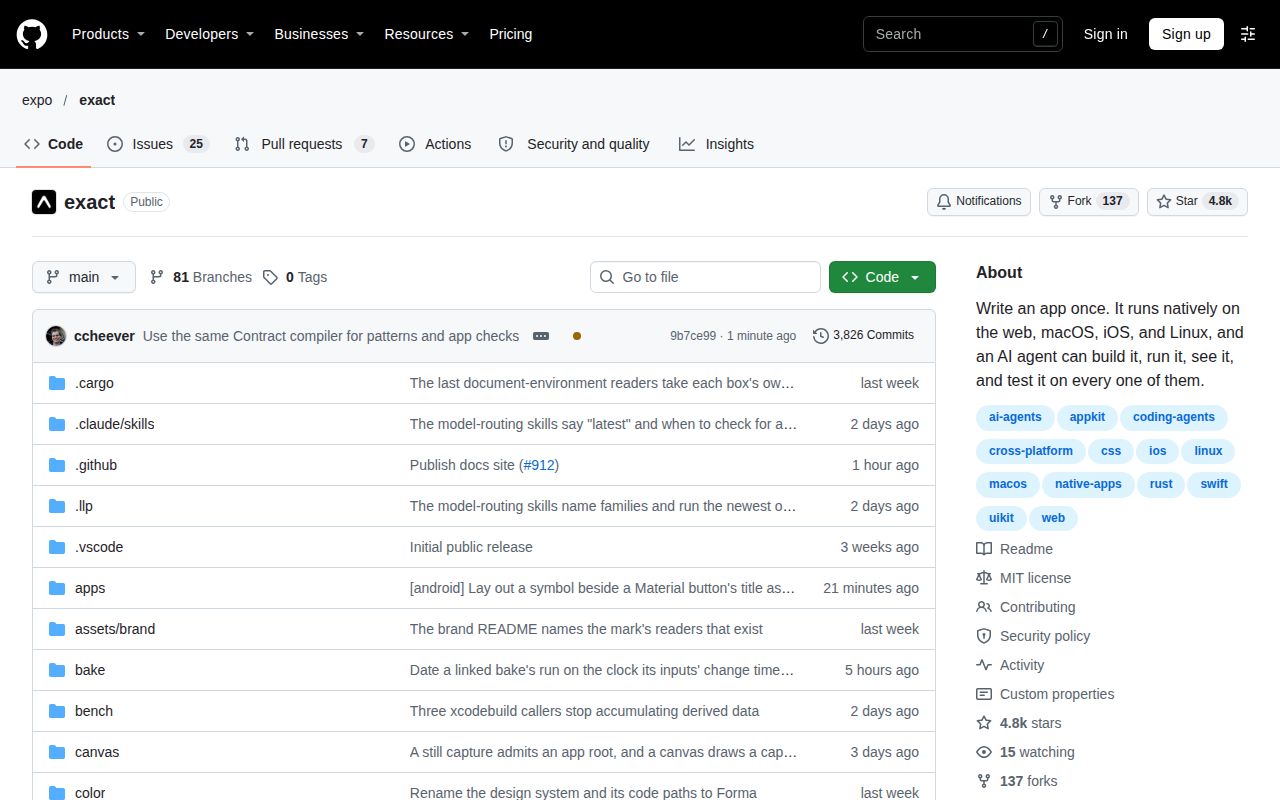
Expo's Exact is an app framework, rather than the React Native alarm-scheduling component described by the directory entry reproduced in the Exact search record. Charlie Cheever identifies it as an agent-native framework written in Rust, and Expo names Contract as its UI language. This review concerns expo/exact. Exact ERP is a separate product, so its ratings and customer counts do not describe this framework.
The Convex video's transcript calls the language "Contact," while Expo's announcement and the Exact README name it Contract. The announcement also uses "no compromises" as promotional language. The README's concrete platform descriptions are more useful for framework selection: Windows is early, Android Material 3 polish is in progress, and the project is pre-1.0 without an API stability guarantee.
FAQ
Convex live queries and Better Auth worked in san-devistan's reported application on web, macOS and the iOS simulator. The questions below come from the integration and platform discussions. They address separate operations: authentication, desktop capture, file storage, push delivery and upload recovery. The answers identify the implementation or result described in each thread so readers can connect it to the corresponding application requirement.
Does Exact work with Convex live queries, authentication and generated types?
san-devistan reported live updates, Better Auth and fully typed api.todos.list in Convex issue #54. A todo written from another client appeared without refresh on web, macOS and the iOS simulator. The type result followed source-mount and configuration fixes. The discussion therefore connects the @exact/convex integration with both live query behavior and the application's mounted backend configuration.
Can Exact use Better Auth or another Convex authentication provider?
Better Auth worked in the application reported in issue #54. The thread covers sign-up, sign-in and sign-out, with each person seeing their own todos. Later account-switch checks address cached answers from the previous person. For a developer evaluating authentication, those are two concrete requirements: establishing the session and ensuring query results follow the active account when that session changes.
Can Exact send WebSocket mutations after awaiting other work?
The maintainer reports that a send after await works on the web in issue #54. The original report had described source timing restrictions as one obstacle to using Convex's standard client. The later first-party @exact/convex integration uses a stream resource and received reports of external writes appearing without refresh. That integration is the documented route discussed for the application's live-query requirement.
Can an Exact Windows app save screenshots without showing a picker for every file?
The screenshot application in storage issue #507 used its own Rust/Win32 copying path outside Exact's storage grants. The maintainer separately describes create-only known-folder writes on macOS and Linux. Windows Save As dialogs are another operation, with reported checks for file selection, cancellation and source-file preservation. The application's custom export path and the framework's picker behavior answer different saving requirements.
Do Exact's Windows file pickers support an initial folder and retained directory handles?
The Windows storage discussion records a retained-folder problem and a subsequent confirmation that the picker opened folder A before navigation. The maintainer identifies verbatim Windows path spelling as the shell parsing problem and describes conversion to ordinary spelling. This distinguishes retaining a directory chosen earlier from merely opening the last-used folder, which was the behavior reported in the failure.
Why do large Exact canvases consume so much memory on Windows?
The canvas investigation in issue #508 attributes timing-dependent allocation to Ink's intermediate-target pool while GPU completion lagged. Reuse, bounding unused targets and retirement on hide changed that behavior. The initial comparison records roughly 150 MB with the CPU painter versus roughly 600 MB in the same session. Painter choice and canvas behavior therefore belong alongside the application revision in this report.
Can Exact capture every display before showing its window, without a picker each time?
The closing report in screen-capture issue #505 names Windows 11 checks across single and multiple displays, seams, menus, mixed scaling, hotplug and hidden launches. The reporting application replaced its own BitBlt capture with captureScreens. Its requirement was to freeze the desktop before showing the annotation overlay, preserving menus and tooltips that could disappear when focus moved to the application.
Does Exact support Android FCM push, custom notification channels and sounds?
The guard-application discussion records Android notification channels, sound and phone delivery in push issue #537. The closing exchange names front, background, locked and after-am-kill delivery checks. For application-handler execution, the documented data-only path puts title and body inside data. A notification message containing title/body follows a separate delivery path and does not raise that push event.
Can an existing Expo push-service backend reach an Exact Android app?
The Android push report records the Expo-service route and the guard application's phone delivery checks. Its backend already used Expo's push service, making that route a concrete migration requirement. The thread also records a dependency-lock failure involving kotlin-stdlib-common and a later ordinary Android command that built and installed without lock changes after the correction.
Can an app add its own Firebase Messaging module while Exact's Android push support is missing?
The later discussion in issue #537 records a first-party Android push route and the Expo-service helper. The question arose when Android push and local notifications were marked unsupported. For the gatehouse application's requirement, the reported outcome points to that first-party integration, its channel configuration and its message format. The original absence of Android support is the starting condition of the thread.
Can Exact upload large Android videos after the user leaves the app?
The POCO X6 Pro received HTTP 201 after sending all 314,572,800 bytes, including in the background, in upload issue #687. Pressing Home succeeded with one POST while the server delayed its response for 30 seconds. Recovery after a Recents swipe retried once on relaunch, whereas explicit force-stop delivered an abort. Those are three separate outcomes from the phone report.
Can an Exact model viewer save named camera views and animate a reset?
Named views, reading camera values after a drag and animated changes are requested capabilities in model-viewer issue #724. The maintainer chose a first-party @exact/model-viewer GPU package rather than a built-in tag. The requester describes an existing custom wgpu renderer of about 1,200 lines and wants technical-model interaction in an ordinary application instead of adopting the game engine's world/tick model.
What we have not tested yet
Our 11-second dependency installation is the successful executable setup result behind this review. We have not run an Exact application, host build, custom verification command, device workload or security audit. The Compose procedure produced no application screenshots or known-answer task results. The image label gives neither the actual runtime nor operating-system version, and file discovery reporting no tests directory does not mean Exact has no tests.
Apple push has a specific outstanding check: the maintainer's issue #127 comment says delivery through APNs on a phone was not run. Android delivery on the reported POCO device does not establish behavior across other manufacturers. The readable model-viewer discussion documents the request and package decision rather than successful package execution, saved-view behavior, animated reset or a completed macOS agent-clock correction.
Windows picker-free known-folder writes were still being built in issue #507, with redirected-folder probes requested. The retained-folder confirmation excludes UNC paths, long or reserved paths and jump lists. Pi issue #145 remains open for direct VK_KHR_display presentation, while capture issue #505 assigns filename/file-lock contention and HDR work to separate follow-ups. These are operation-specific boundaries to the platform descriptions.
The web payload, Windows memory and Pi frame-rate results belong to their reporters' workloads and revisions. Our run includes no reproduction or comparison against React Native or Flutter. The Windows memory excerpt ends before a complete final analysis and supplies no universal memory ceiling. GitHub activity and detailed issue exchanges measure neither production reliability nor adoption or support capacity. Rendered page layout, accessibility, related links and recommendation modules also fall outside this text review. A useful next evaluation is one complete application task on the intended devices at a chosen revision.