HeyPuter/everything's src/3d/ project passed our installation, build and test checks at commit 71e76b3 on 2026-11-15. A separate deployment attempt failed because its required Compose file was absent. The useful decision is therefore app-specific: developers can start with a measured source project and concrete user reports, while contributors have identifiable import, layout and packaging work to investigate.
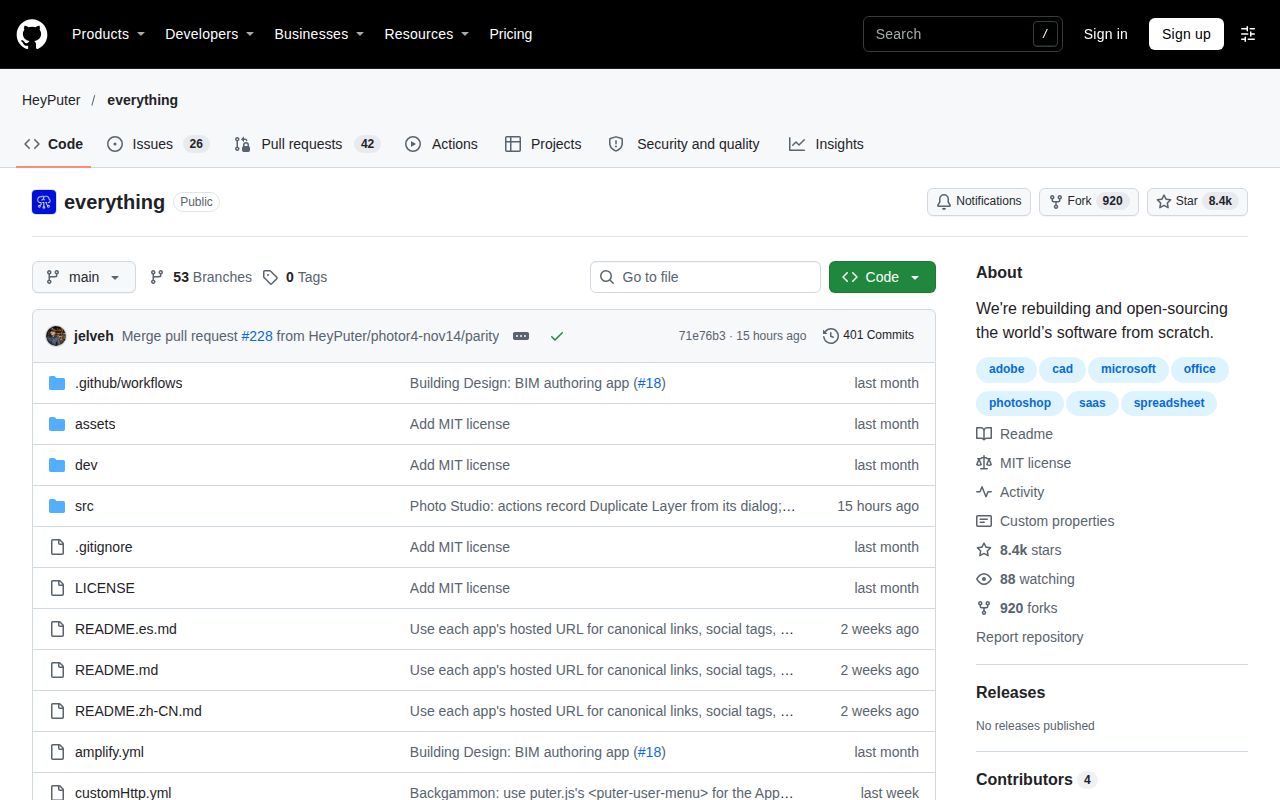
The HeyPuter/everything README describes a repository of apps intended as open-source alternatives to proprietary software. Documents, Spreadsheet, Music Studio, Circuits and 3D Studio have separate source entry points. This review concerns that repository. The similarly named voidtools search utility and David OReilly game are separate products, as the supplied PCMag product record and Guardian product record show.
What people use everything for
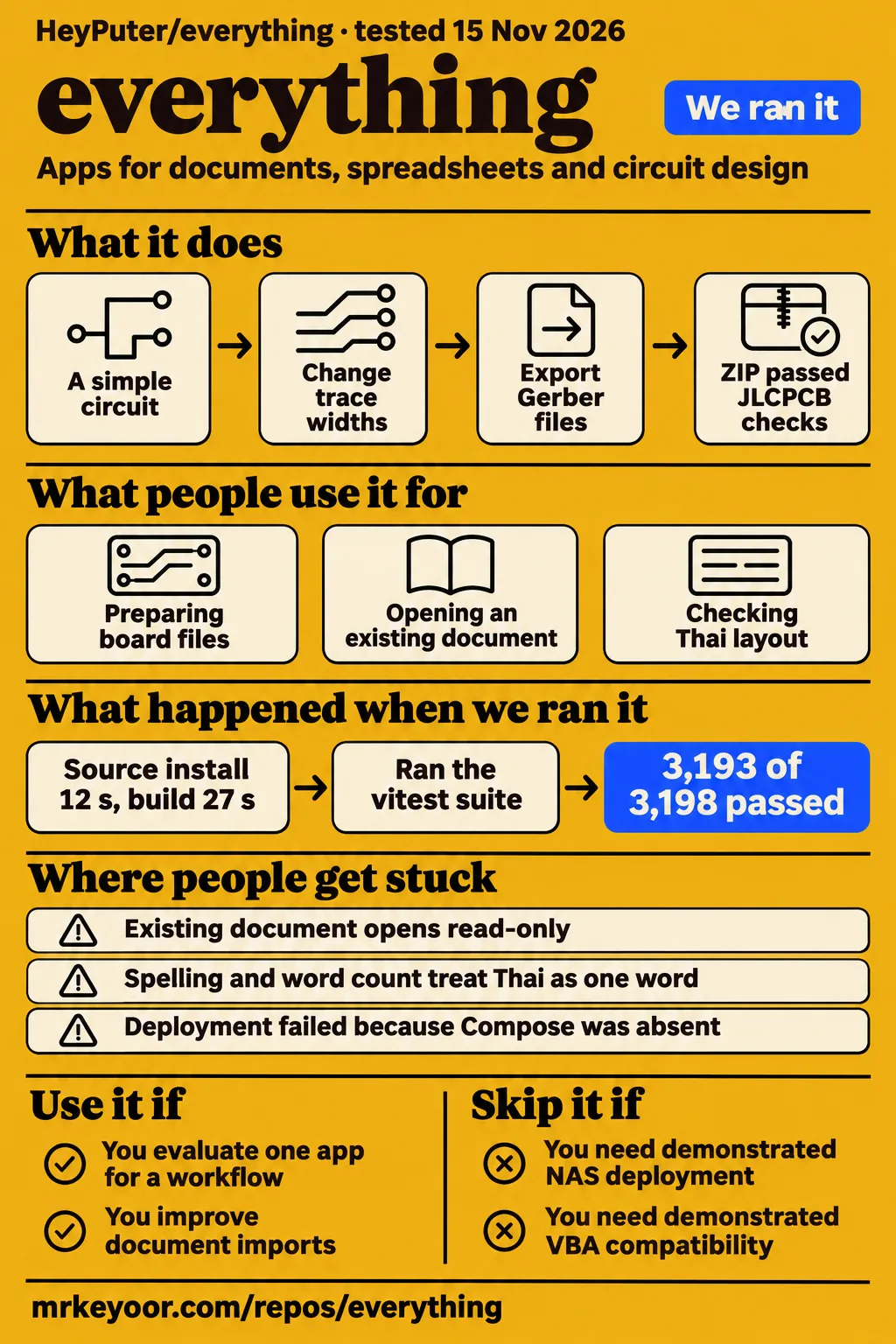
A Circuits user reported a Gerber export accepted by JLCPCB, while Documents users reported import warnings and a successful ordinary Thai-wrapping retest. These are three distinct uses of the collection: preparing board files, opening an existing document and checking multilingual document layout. Each report concerns a particular app and task, giving a more useful account of practical use than the repository's broad alternative-to labels.
| Person and task | Reported outcome | Source |
|---|---|---|
| Issue #88 reporter designed a simple Bazz Fuss circuit, created a PCB and exported Gerbers as a ZIP | The ZIP passed JLCPCB's checks | Circuits export report |
| GitHub user reynaldichernando opened an existing file in Documents | The file opened with unsupported-feature warnings and read-only mode; a spacing warning followed the first fix, and a later commit references spacing support | Documents import report |
| GitHub user kamthorn retested Thai layout after commit 1c19d727 in Chrome 153 on Linux | Ordinary breaks fell between words; the reporter also identified an overlong-word edge case | Thai layout report |
The README groups applications into office, collaboration, creative, engineering and other categories. Its Documents entry names Microsoft Word, Google Docs and Apple Pages as intended alternatives; Music Studio names FL Studio, Ableton Live and Logic Pro. Those are project positioning statements. The issue reports above add concrete inputs and outcomes: an existing document, a circuit exported for an external service and Thai text laid out at specified widths.
What happened when we ran it
Our deployment attempt on 2026-11-15 failed its safety step because no Compose file existed. The failed safety-step record lists compose.yaml, compose.yml, docker-compose.yaml and docker-compose.yml as absent. The run summary nevertheless says the repository was deployed with its own Docker Compose and every port bound to 127.0.0.1. The teardown record says teardown: ok.
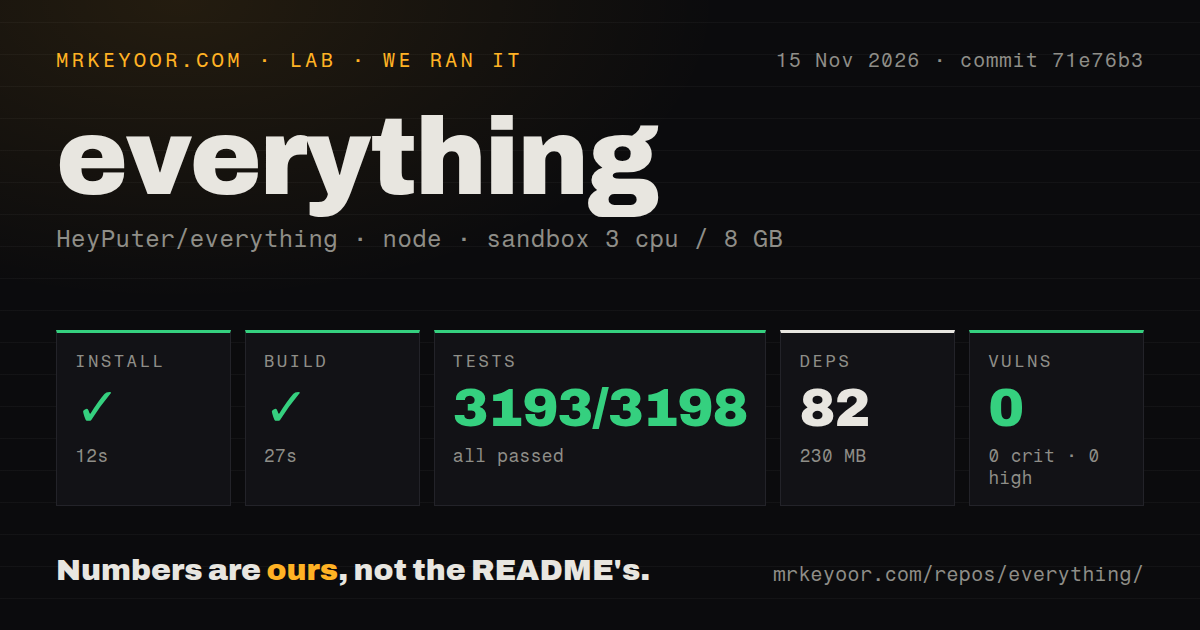
The separate source harness succeeded for src/3d/. We measured installation, build and tests at commit 71e76b3 in a sandbox configured with 3 CPUs, 8 GB RAM and image lab-node:22. The command outcomes belong to that npm project. Checkout size and repository signals have a wider scope: they describe the repository rather than the application commands. Keeping those scopes separate prevents the test count from becoming a collection-wide result.
| Source-harness check | Recorded result |
|---|---|
| Install | Succeeded in 12 seconds; 82 dependencies recorded, 230 MB on disk |
| Build | Succeeded in 27 seconds |
| Tests | Succeeded in 246 seconds; Vitest reported 3,193 passed, 0 failed and 5 skipped out of 3,198 |
| npm audit | 0 known vulnerabilities: 0 critical, 0 high, 0 moderate and 0 low |
| Checkout | 37,382 files, approximately 7,431,844 source lines, 1,387.1 MB |
| Repository signals | 3 CI workflow files, a tests directory and no Dockerfile detected |
The README's getting-started instructions require Node.js 22.12 or newer. They direct developers to clone the repository, enter everything/src/[app-name], install dependencies and start development with npm. That app-folder structure matches the scope of the source harness: the recorded successful commands ran in src/3d/. It also gives contributors a specific entry point rather than a single installation procedure for the entire catalog.
Where people get stuck: imports and trace editing
The Documents reporter encountered another spacing warning after the first fix. The issue #69 thread begins with a read-only message and warnings about a numbering paragraph property, picture metadata and a hyperlink target. A maintainer then asked the reporter to try the file again. The next response reported the spacing warning. A later commit references spacing support, preserving a more complete chronology than the issue's closed status alone.
| Reported obstacle | Response recorded in the thread | Relevant next action |
|---|---|---|
| Existing document opens read-only | Maintainer pushed a fix; reporter then saw an unsupported spacing property; a later commit references spacing support | Keep the original file and assess a copy through import, editing and download |
| PCB trace widths take too long to change individually | Maintainer says #89 adds bulk Track width editing and a preferred design-rule width | Use the selection-wide control described in the response |
| Reporter found no container deployment path | Issue #36 points to implementation in progress in PR #112 | Start with the packaging discussion and its application-header requirements |
In issue #88, the reporter wanted to change traces from the current default of 0.25 mm to 0.5 mm. The maintainer says #89 adds two controls: select all with Ctrl+A and change Track width in Properties, or change Track width (preferred) in Design rules and accept the offer to update existing tracks. The reply also says setting the preferred width before routing applies it to new tracks and the autorouter.
These reports identify different kinds of work. Documents needs attention to the imported file and its property warnings; Circuits received a specific editing control for an operation the reporter found repetitive. For an app-level adoption decision, use one disposable real project and follow it through input, the required editing operation and the receiving tool or service. That is the review's central acceptance task, rather than a separate checklist for every app mentioned below.
Static hosting must preserve the app's headers
Issue #36 identifies cache rules and WebAssembly MIME types as behavior a replacement server must preserve. Its author describes stale service workers returning old builds and incorrect MIME types breaking WebAssembly engines. The self-hosting discussion describes an Amplify configuration based on amplify.yml and customHttp.yml, then proposes container packaging that carries the application-specific serving rules into another hosting arrangement.
| Path or asset | Behavior described by the issue author |
|---|---|
/ and HTML |
no-cache, max-age=0, s-maxage=0, must-revalidate |
Hashed assets under /assets/ |
public, max-age=31536000, immutable |
| WebAssembly assets | Also send Content-Type: application/wasm |
/sw.js, /worker/*, /manifest.json |
Preserve the documented no-cache treatment |
The discussion says chess, backgammon and checkers also ship Content Security Policy and other security headers. A contributor proposes one parameterized Dockerfile in a shared deployment directory and nginx configuration generated from customHttp.yml. The final supplied update describes PR #112 as implementation in progress. The thread separately discusses multi-app Compose packaging, Cloudflare worker components and connections to self-hosted Puter, rather than presenting those as one completed deployment arrangement.
Hosted demos can ask for identity checks
The maintainer says some live demos require login, with phone or credit-card checks depending on the backend's risk assessment. The explanation appears in the supplied issue #48 account discussion, after a user complained about unexpected contact-information prompts. The same reply says the apps use Puter and that many need no backend. Those statements describe app-dependent service and access arrangements within the collection.
The issue #36 hosting discussion raises related configuration questions about Cloudflare workers, the Puter SDK origin and connecting apps to self-hosted Puter. These concerns distinguish three decisions: using a hosted demo, serving an app's frontend and controlling its service connections. A frontend build and an account prompt describe different parts of that arrangement; neither substitutes for the selected app's service map.
Thai wrapping and language-aware editing have separate outcomes
Kamthorn reported corrected ordinary Thai wrapping after commit 1c19d727 in Chrome 153 on Linux. The supplied issue #82 retest specifies Arial 16 and line widths of 300, 400 and 500. The reporter said breaks fell between words and no line started or ended with a stray vowel. This is a particular user retest with a revision, browser, platform and layout setup.
The maintainer separately says Ctrl+Arrow navigation, word count and spelling still treat Thai as one long word. Kamthorn also reports an isolated repetition mark when a word exceeds the available width: cutting ใหม่ๆ at three graphemes per line leaves ๆ at the start of a line. In the supplied issue #135 translation discussion, a maintainer links a Simplified Chinese Spreadsheet interface and a contributor offers Thai translations for Spreadsheet and Documents. Interface translation, paragraph wrapping and language-aware editing are separate tasks in these records.
everything vs FL Studio, word/deck/gridcraft and focused apps
LibreOffice and KiCad are comparison candidates for office and PCB work, respectively. LibreOffice offers Writer, Calc and Impress for documents, spreadsheets and presentations. KiCad handles schematic capture and PCB layout with Gerber output. Their official office-suite overview and official EDA overview establish those application categories. For readers choosing a project around those jobs, they provide focused candidates alongside the relevant HeyPuter app.
| Comparison candidate | Supported reason to include it | What the supplied record says |
|---|---|---|
| LibreOffice | Documents, spreadsheets and presentations are the required work | Its official overview describes Writer, Calc and Impress |
| KiCad | Schematic capture, PCB layout and board-file output are the required work | Its official overview describes schematic capture, PCB layout and Gerber output |
| FL Studio | A requester wanted an FL Studio clone | The maintainer linked a first music app and called it very early and potentially buggy |
| Equivalent word/deck/gridcraft projects | The VBA requester said macro support was out of scope there | The thread links VBA Studio v0 work in PR #115 |
The supplied music-app request records the motivation for the first music app and the maintainer's early-version warning. The supplied VBA discussion records the requester's comparison with word/deck/gridcraft and an implementation link for VBA Studio v0. These are development discussions: one describes an early response to a music-production request, and the other identifies macro support as a desired differentiator.
What the other reviews get wrong
The documented historical error is blanket MIT wording in the project's README, challenged and corrected in issue #90. The supplied license clarification records a user identifying AGPL licensing in many subprojects and the maintainer acknowledging the mismatch. The maintainer discusses AGPL for areas such as the office suite, retaining MIT for SaaS work, and then reports changing the text. The correction concerns the project's earlier wording.
The current README says MIT applies unless explicitly stated otherwise and notes that included third-party libraries may have their own licenses. The current license section therefore contains an exception that matters when reusing an individual app. Read that app's license alongside the collection-level statement before incorporating its source or distributing changes. The supplied evidence supports this specific licensing correction rather than an accusation that unrelated product reviews misdescribed HeyPuter/everything.
FAQ
The recorded Docker Compose attempt failed at the missing-file safety step. That answers the deployment question raised in the supplied VPS and NAS discussion, while the other questions concern particular app behaviors or maintainer responses. The answers below keep those source distinctions: a maintainer's explanation describes intended behavior, a user's report describes that user's outcome, and a linked implementation identifies development work.
Can I self-host everything with Docker Compose on my VPS or NAS?
The supplied attempt stopped at a required Compose-file check. Its safety record names all four absent filenames. In issue #36, the final supplied update calls PR #112 implementation in progress. The earlier discussion proposes shared packaging and generated nginx headers, with worker components and self-hosted Puter treated as separate parts of the hosting work.
Which cache and WebAssembly headers must I preserve when self-hosting the apps?
Issue #36 specifies no-cache HTML and worker files, immutable hashed assets and application/wasm for WebAssembly assets. The header discussion also names security headers for chess, backgammon and checkers. Its proposed configuration generator would read customHttp.yml, preserving per-app differences instead of maintaining a separate handwritten copy of each application's serving rules.
Why do some everything demos require phone or credit-card verification?
The maintainer attributes those checks to the hosted backend's risk assessment during login. The supplied issue #48 reply says some apps may require login for their live demo and explains the possible phone or credit-card checks. It also says the apps use Puter and that many need no backend, making the selected demo the relevant account-access context.
Do the apps need a cloud backend, or can their backends run locally?
The maintainer says many apps need no backend and that the apps use Puter. That answer appears in the supplied backend discussion. The separate hosting thread raises Cloudflare worker components and connections to self-hosted Puter. Those records describe different service arrangements rather than one backend requirement shared by every application in the repository.
Which apps are MIT-licensed and which are AGPL-licensed?
The README states an MIT default with explicit exceptions and a separate qualification for third-party libraries. The supplied issue #90 discussion records the historical AGPL clarification and the maintainer's distinction between office and SaaS work. The current collection-level wording and the chosen app's license are the relevant documents for a reuse decision; the thread explains why that distinction arose.
Why does Documents open my existing file as read-only with unsupported-feature warnings?
The file in issue #69 triggered warnings about unsupported features and a read-only message. The import thread records a maintainer fix, a subsequent unsupported spacing warning and a later commit referencing spacing support. Its original message also said downloads keep the original file. That sequence describes the reported file and the responses recorded in the thread.
Does Documents wrap Thai text correctly, including vowels and very narrow table cells?
Kamthorn reported corrected ordinary wrapping after 1c19d727 in Chrome 153 on Linux, then identified a repetition-mark problem for a word wider than the line. The supplied Thai retest separates those outcomes. The maintainer's reply also distinguishes wrapping from Ctrl+Arrow navigation, word count and spelling, which it says still treat Thai as one long word.
Which languages are supported, and can community contributors translate Spreadsheet and Documents?
Issue #135 links a Simplified Chinese Spreadsheet interface and records an offer to translate Spreadsheet and Documents into Thai. The supplied translation discussion is a coordination exchange about that contribution. The main README also links Chinese and Spanish versions. README translations, application-interface translations and document-language behavior appear as different kinds of language work in these sources.
How can I change the width of all PCB traces at once?
The maintainer says select all with Ctrl+A, then change Track width in Properties. The issue #88 response also describes changing Track width (preferred) in Design rules, which offers to update existing tracks. Setting that preferred width before routing applies it to new tracks and the autorouter, according to the same response to the reporter's editing request.
Will VBA be supported in the office apps?
Issue #25 links PR #115 for VBA Studio v0. The supplied VBA discussion begins with a request for office-app support and includes the requester's statement that VBA is out of scope for word/deck/gridcraft. The implementation link is the concrete development lead in that exchange, while the proposed advantage over those projects is the requester's reason for asking.
Can everything provide a music production app comparable to FL Studio?
The maintainer linked a first music app and described it as very early and potentially buggy. The supplied issue #17 exchange contains that response to a request for an FL Studio clone. The README separately positions Music Studio alongside FL Studio, Ableton Live and Logic Pro, identifying the intended category of work for the app.
Can the 3D modeling apps use local models, and how can I help?
The maintainer says local support should be possible through Puter's Ollama discovery, and a later comment links PR #117 for procedural modeling and OBJ. The supplied issue #33 discussion contains both leads. Local-model service integration and procedural geometry are distinct contribution subjects in that exchange, even though both arose in the requested 3D-modeling discussion.
What we have not tested yet
Our successful source checks cover src/3d/ at 71e76b3, rather than every app or a completed end-user workflow. The deployment summary conflicts with the failed prerequisite, so it supplies no reliable successful-deployment result; teardown success records cleanup only. No screenshot record or known-answer application task accompanies that attempt. The lab-node:22 image label identifies neither the actual runtime version nor the operating-system version.
The supplied Documents thread contains no subsequent user retest confirming editability after the later spacing-support commit. Our run excludes a representative document collection, reproduction of the reported Gerber export and a fabricated, functioning board. It also excludes browser-performance measurements, concurrent-user tests, large-project tests and a complete app-by-app license account. The zero-advisory npm audit describes dependencies in the measured project, rather than a comprehensive application-security assessment.
Hosted-demo data handling, account isolation, backend traffic, service independence and deployed header behavior fall outside the completed source checks. The records also lack completed validation of VBA compatibility, working local-model integration, Thai translation delivery and resolution of the remaining Thai editing cases. They establish neither FL Studio replacement capability nor a VBA advantage over word/deck/gridcraft. LibreOffice and KiCad supplied category comparisons, without comparative compatibility testing in our run.
The supplied social and video extracts contain no identifiable independent review of this repository, and search demand and ranking are unknown. The available related-page record concerns a different repository, Everything Claude Code. These boundaries keep the recommendation specific: use HeyPuter/everything for app-level evaluation and contribution; readers requiring demonstrated NAS deployment or completed office-migration compatibility should choose on evidence that answers those requirements.