Agent Router keeps the old deployment names
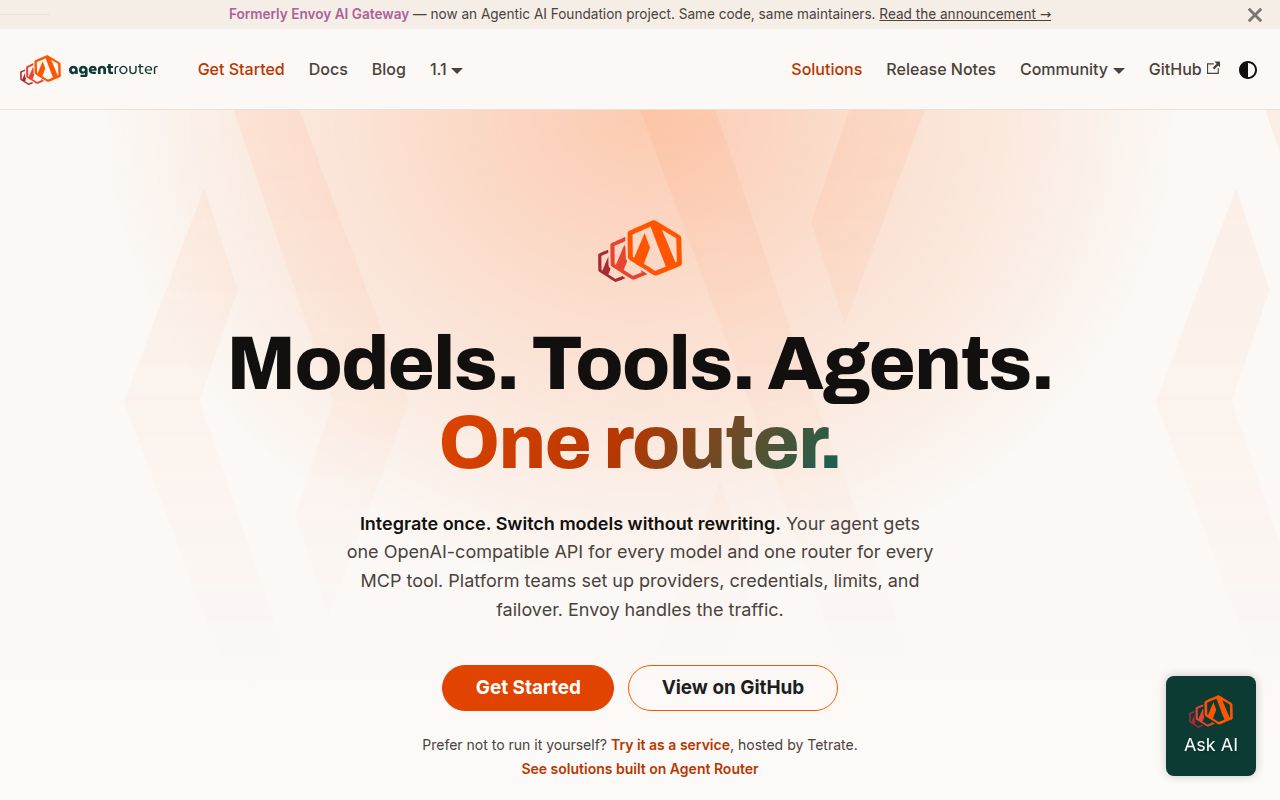
The repository called Envoy AI Gateway now presents itself as Agent Router. The move is organizational and editorial, not a manifest migration: AIGatewayRoute, AIServiceBackend, BackendSecurityPolicy, the aigateway.envoyproxy.io API group, aigw, and the envoy-ai-gateway-system namespace keep their names. Container images and the Go module also retain their existing paths. That protects installed clusters, but a new evaluator has to translate between the current product name and old identifiers throughout the stack.
The product gives applications one OpenAI-compatible endpoint for hosted providers, self-hosted inference, and MCP servers. Envoy carries requests while the control plane applies credentials, routing, quotas, failover, and usage attribution. The README describes a 2-tier model: a central gateway handles authentication and global policy, while a second gateway controls traffic entering a model-serving cluster. This is infrastructure for a platform team, not a convenience wrapper around one API.
The local command hides a much larger production job
A developer can set a provider credential and run aigw run, then aim an OpenAI-compatible client at port 1975. The current guide says this local mode needs neither Docker nor Kubernetes on Linux and macOS. It can also front Ollama, vLLM, and MCP servers, which makes it useful for proving a route and configuration before a cluster rollout.
Production is where the choice gets expensive. The documented path installs Agent Router as a control plane on Kubernetes with Envoy Gateway, then asks operators to manage credentials, gateway resources, routing policies, quotas, and telemetry. Version 1.1.0 adds per-request credentials, stream idle timeouts with failover, HTTP CONNECT egress, GenAI tracing, and MCP hostname selection. Those are serious platform controls, but each one creates configuration and failure modes that a direct provider SDK never introduces.
What happened when we ran it
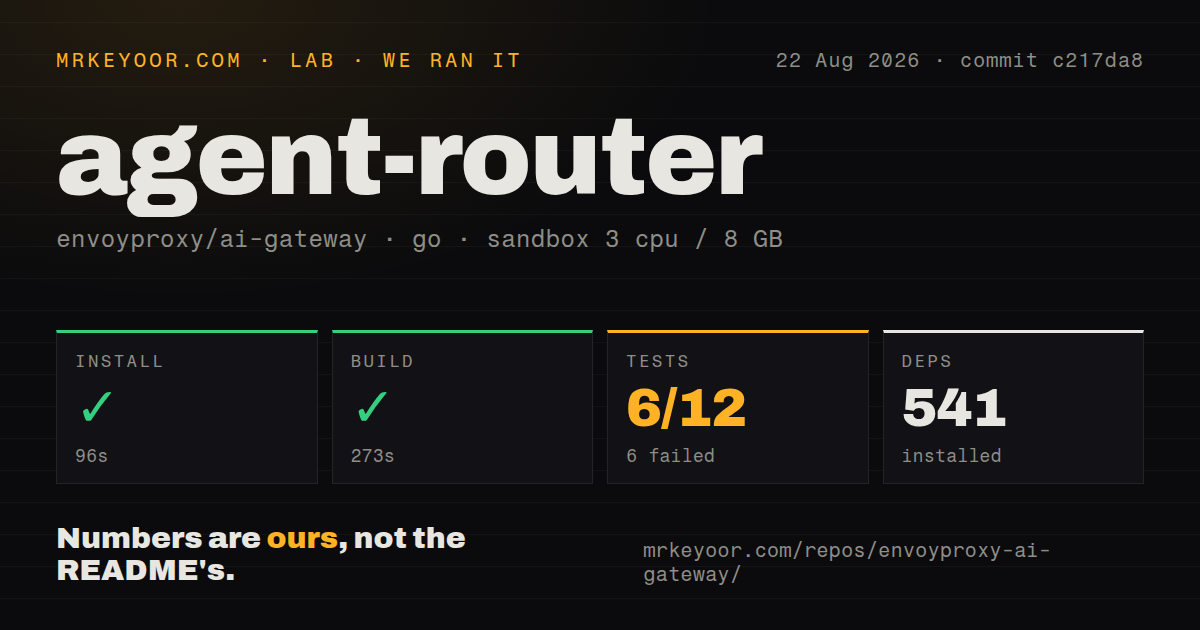
Our sandbox installed 541 Go packages in 96 seconds and built commit c217da8 successfully in 273 seconds. The checkout itself was 35.2 MB, with 1,558 files and about 221,489 lines of source. We found 7 CI workflow files, a Dockerfile, and a tests directory. This is a substantial Go control plane, although the clean build shows its compilation path worked in the stated Debian container.
Tests were a different result. The Go test command ran for 668 seconds and finished with exit code 1: 6 package results passed and 6 failed out of 12. The supplied tail shows successful packages such as the OpenAI, OpenInference, MCP test server, and upstream test helpers, then ends with a bare FAIL. It contains no failed assertion or setup error. We can report the split, but the log does not support blaming credentials, missing services, or a particular package.
MCP aggregation still has namespace and response gaps
Agent Router can combine MCP backends and advertise merged capabilities through one route. Version 1.1.0 added hostname scoping and CEL-based backend selection, with a default deny action. This belongs at the gateway when several teams publish tools and one platform group must decide which client may see which backend. The same release also records MCP resource URIs in access-log metadata.
Two open reports matter before that design reaches a strict production client. Issue 2385 says an MCPRoute can currently reference Services only in its own Kubernetes namespace, making cross-team aggregation awkward without proxy Services or a shared namespace. Issue 2665 reports that merge functions can drop cache metadata and emit an empty cacheScope, which strict clients reject. These are specific limits, not reasons to dismiss the entire LLM routing path, but MCP buyers should reproduce both cases.
Version 1.1 improves control without making billing exact
The August 21, 2026 release supports token-counting routes across several provider formats, provider credentials supplied per request, forward-proxy egress, and retry behavior when a stream stalls before its first token. It also accepts Responses API tool-search inputs and exposes JSON log options. Upgrading from 1.0 requires no CRD migration, according to the release notes, though the Helm chart now applies a restricted controller security context by default.
Cost attribution still has a documented edge. Issue 2694 says the gateway combines Anthropic 5-minute and 1-hour prompt-cache writes under one cost type even though their rates differ. A team charging usage back to users or departments cannot recover that split from the current per-request signal. External billing exports can fill part of that gap, but they lose the request identity that makes gateway accounting useful.
September activity is high, and so is the surface area
GitHub showed 2,105 stars, 292 combined issues and pull requests, and a last push on September 15, 2026. The open queue was active again on September 16, including work on quota windows, MCP protocol handling, provider authentication, and controller readiness. The combined count is not a defect total. It does show how many providers, protocols, and Kubernetes behaviors this project is trying to hold together.
Agent Router makes sense when that breadth matches a problem you already own. Existing Envoy teams get familiar data-plane machinery, a stable 1.x API, and policy that stays outside application repositories. The failed 668-second suite is the immediate caution: reproduce it before making this gateway a release dependency. If your architecture has one model provider and no shared cluster policy, keep the direct connection and avoid creating another control plane to operate.