Entire records the conversation behind each Git commit
Entire CLI attaches coding-agent history to ordinary Git work. It captures prompts, responses, touched files, tool calls, timestamps, and token information, then associates that material with the commit created after the session. The code commit stays on the developer's branch while the session metadata goes to entire/checkpoints/v1. That split is the product's useful idea: reviewers can inspect the reason for a change without stuffing generated transcripts into the application tree.
The README lists 7 agent choices for entire enable --agent: Claude Code, Codex, Gemini, OpenCode, Cursor, Factory AI Droid, and Copilot CLI. Pi also has a preview integration. Teams using several agents can install more than one hook set, and Entire detects each integration by its hook files. Experimental blame and why commands connect current lines back to the recorded prompt and session, while session resume restores checkpoint metadata and prints commands for continuing.
Checkpoints live on a separate branch that can still leave the machine
A checkpoint is created when the developer or agent commits. Entire says it never creates commits on the active code branch, but its metadata is permanent on entire/checkpoints/v1. By default, the checkpoint branch can be pushed to the same remote as the code. A project can turn off automatic session pushes or point them at a separate private repository, which is the safer arrangement when the application repository is public.
This storage choice deserves a policy before the first of the 224 Go packages is installed. The README states plainly that transcripts in a public repository are visible to anyone. Detected API keys, tokens, and credentials are redacted when checkpoint data is written, but that process is best effort. Temporary shadow branches can contain unredacted material and should not be pushed. A team that handles customer data or production credentials should test the redactor against its own prompts and tools, then restrict access to the checkpoint remote.
What happened when we ran it
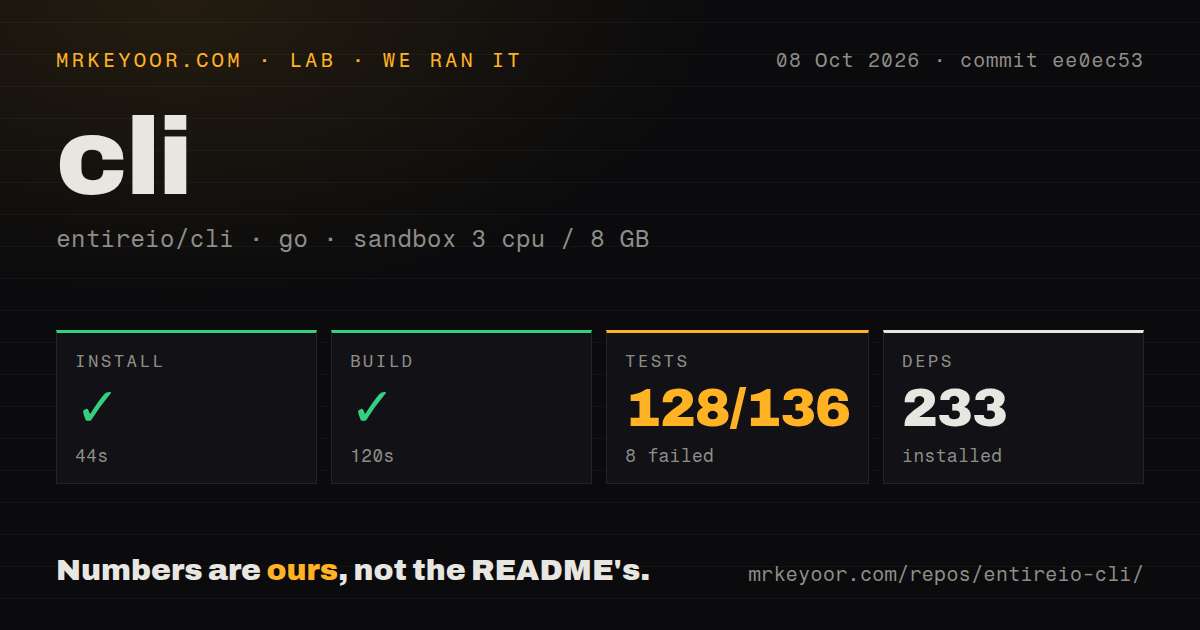
Our sandbox installed Entire CLI in 79 seconds, fetching 224 packages. Building commit b1e0862 succeeded in 84 seconds inside an unprivileged Debian container with 3 CPUs and 8 GB of RAM. The checkout contained 1,474 files, about 474,837 lines of source, and occupied 19.7 MB before dependencies. None of those figures measures hook latency or the size of real session archives.
Tests ended with exit code 1 after 192 seconds. Go reported 82 package results passing and 3 failing out of 85. The supplied tail shows internal/procsignal, several internal/remotehelper packages, perf, and redact passing immediately before the final FAIL. It does not include the three failing package names or assertions, so we cannot attribute the result to Git, a keyring, network access, or any other missing service. The finding is simply that the full command did not pass in our fresh container.
The repository has 13 CI workflow files, which is substantial automation for a Go CLI. Our scan found no Dockerfile and no top-level tests directory, although Go tests commonly live beside source files. A dev-container path is documented for contributors and includes Git, tmux, a keyring, mise, linting tools, and test helpers. That environment may be closer to the maintainers' intended setup than bare golang:1.24-bookworm, but it does not change our 3 failed package results.
Headless setup needs an explicit token-storage choice
Desktop login uses the operating system keyring. Containers, minimal servers, and CI runners can instead set ENTIRE_TOKEN_STORE=file, which writes a token file with 0600 permissions, or inject ENTIRE_TOKEN for one command without storing it. The latter is a sensible CI path. Teams can also supply ENTIRE_CHECKPOINT_TOKEN specifically for checkpoint fetches and pushes rather than modifying the credentials used for the code remote.
The initial setup is more invasive than installing one binary. entire enable writes settings, installs a Git hook, and adds configuration under the selected agent's directory. Auto-summarization adds another dependency: the README says it currently calls an installed and authenticated Claude CLI. Summary failure does not block commits. On Linux, keyring failures have their own documented file-store workaround, and the development container includes a helper for commands that touch the keyring.
Seven agent integrations do not mean identical coverage
Agent support has named boundaries. Copilot works through Copilot CLI, not VS Code, other IDEs, or github.com. Pi is marked preview and does not capture subagents. An open report filed on August 26 says OpenCode Desktop produced no activity with Entire 0.10.2 while OpenCode CLI worked. That report lacks reproduction details, so it establishes a user-visible gap rather than a confirmed root cause.
Release v0.10.2 is equally direct about Codex subagents. Entire consumes SubagentStart and SubagentStop hooks, but committed checkpoints carry no per-subagent data for any agent. Codex subagent token use is not aggregated, and only thread-spawned Codex subagents fire those hooks. Anyone buying the tool for a complete agent audit trail should test the exact client, version, and spawning mode used by their team.
August activity is strong, while privacy remains the adoption test
GitHub showed 5,011 stars, 209 combined issues and pull requests, and a last push on August 26, 2026. The latest release, v0.10.2, was published August 19 and includes both subagent work and a security fix for an executable privacy-filter setting. Those dates and the busy queue indicate active development. The combined GitHub count should not be read as 209 bugs.
Entire earns a trial when code review needs the session behind the diff, especially across more than one coding agent. The failed 192-second test run calls for a local reproduction before rollout. More important, the checkpoint branch contains sensitive working context by design. Put it on a controlled remote, decide whether automatic pushing is acceptable, and treat redaction as a fallback rather than the boundary protecting secrets.