The diff sandbox is Plandex's strongest reason to exist
Plandex plans coding work, gathers context, writes changes, runs commands, and keeps the proposed edits separate from the working tree until you apply them. That cumulative diff is more useful than a stream of model messages on a change touching dozens of files. You can revise the plan, compare branches, and keep control over when generated code reaches the project. Git integration can produce commit messages or automatic commits, although cautious teams should leave the final commit to their normal review process.
The context system targets work larger than one prompt. The README claims a 2 million-token effective window with its default model pack, about 100,000 tokens per file, and directory indexing beyond 20 million tokens through tree-sitter project maps. Those are project claims, not numbers from our sandbox. The practical idea is still clear: Plandex selects relevant context instead of stuffing a whole repository into every request, then caches supported provider context to reduce repeated model work.
New users must self-host because Plandex Cloud closed signup
The hosting table says Plandex Cloud began winding down on October 3, 2025 and no longer accepts new users. A fresh adopter therefore needs local mode or a self-hosted server. The README points to a Docker quick start and asks for an OpenRouter key or credentials for another supported model provider. It can also connect a Claude Pro or Max subscription when first started. This is a different commitment from installing one terminal binary and signing into a maintained service.
The CLI has a one-line installer, a REPL, and a shorter pdx command. Windows support is narrower than the headline platform list: Plandex must run in WSL and does not work correctly in Command Prompt or PowerShell. A project does not have to use git, but the review and version-control features make more sense inside a repository. Browser debugging also depends on Chrome being installed where the agent can use it.
What happened when we ran it
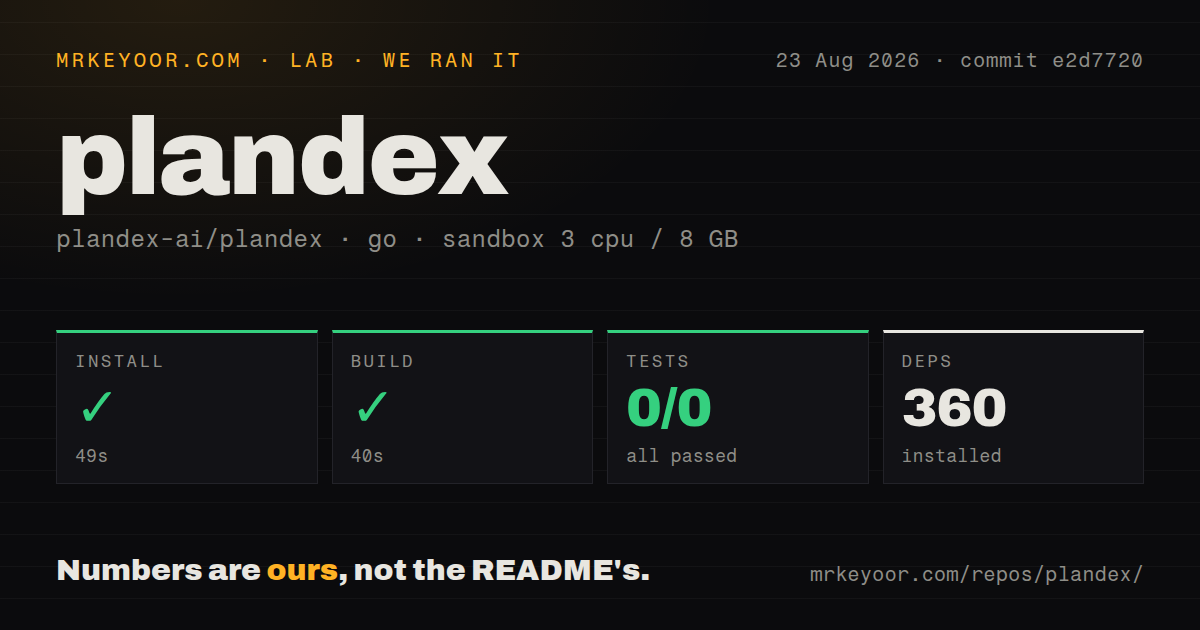
Our sandbox checked out commit e2d7720 and worked inside app/cli. Installing 360 Go packages took 49 seconds, and the CLI build completed in 40 seconds. The test command exited successfully after 13 seconds, but go test reported 0 passed and 0 failed out of 0. The correct reading is that the measured command did not fail; it did not exercise a discovered test case either.
The checkout contained 696 files, about 81,449 lines of source, and occupied 32.2 MB. Our scan found one CI workflow, a tests directory, and no Dockerfile. That last result describes the measured checkout scan, while the README separately documents Dockerized local mode. We did not start the server, connect a provider, pay for model calls, or ask Plandex to modify a real project in this run.
A clean build lowers the cost of inspecting the CLI, but 0 executed tests gives little assurance about file application, retries, or long-running plans. Anyone adopting Plandex should add a disposable-project trial that covers plan creation, command approval, diff review, apply, rollback, and provider failure. Keep those trials away from credentials and writable paths outside the test repository until containment behavior is confirmed.
An open path traversal report changes the auto-apply decision
Open issue 352 reports that version 2.2.1 accepts a model-supplied parent path and can write outside the project directory when changes are applied. The report says the confirmation displays a file count without constraining the resolved destinations, and automatic apply removes the prompt. Pull request 358 proposes a path-containment check. Both were still open when fetched, so we cannot claim the published CLI contains that fix.
This finding is directly relevant to an AI coding agent because repository text and other context can influence model output. Run Plandex under an account with limited filesystem permissions, inspect destination paths, and avoid automatic apply until your exact commit rejects absolute paths and parent traversal. Open issue 350 also asks maintainers to enable private vulnerability reporting or provide a disclosure channel, which is a process concern for teams evaluating how security reports are handled.
Provider failures and large replacements have open crash reports
Issue 339 records a nil-pointer panic after an Anthropic 529 overloaded response, instead of a clean retry outcome. Issue 349 describes another nil-pointer failure during the build and merge stage for a replacement above roughly 10,000 tokens. These are individual reports rather than our lab results, but both concern the long tasks Plandex is designed to handle. Test provider overload, cancellation, and large-file edits using your chosen server version.
Audit integration is also unfinished for some buyers. Issue 319 asks for before-and-after hooks around tool calls, filesystem operations, and command execution because the author could not find such an interface in the documentation. If your policy requires an external audit collector to observe every agent action, confirm the available events before migration. Plandex's own history is useful, but it may not satisfy a separate security system.
Contributor activity continues after the last maintainer push
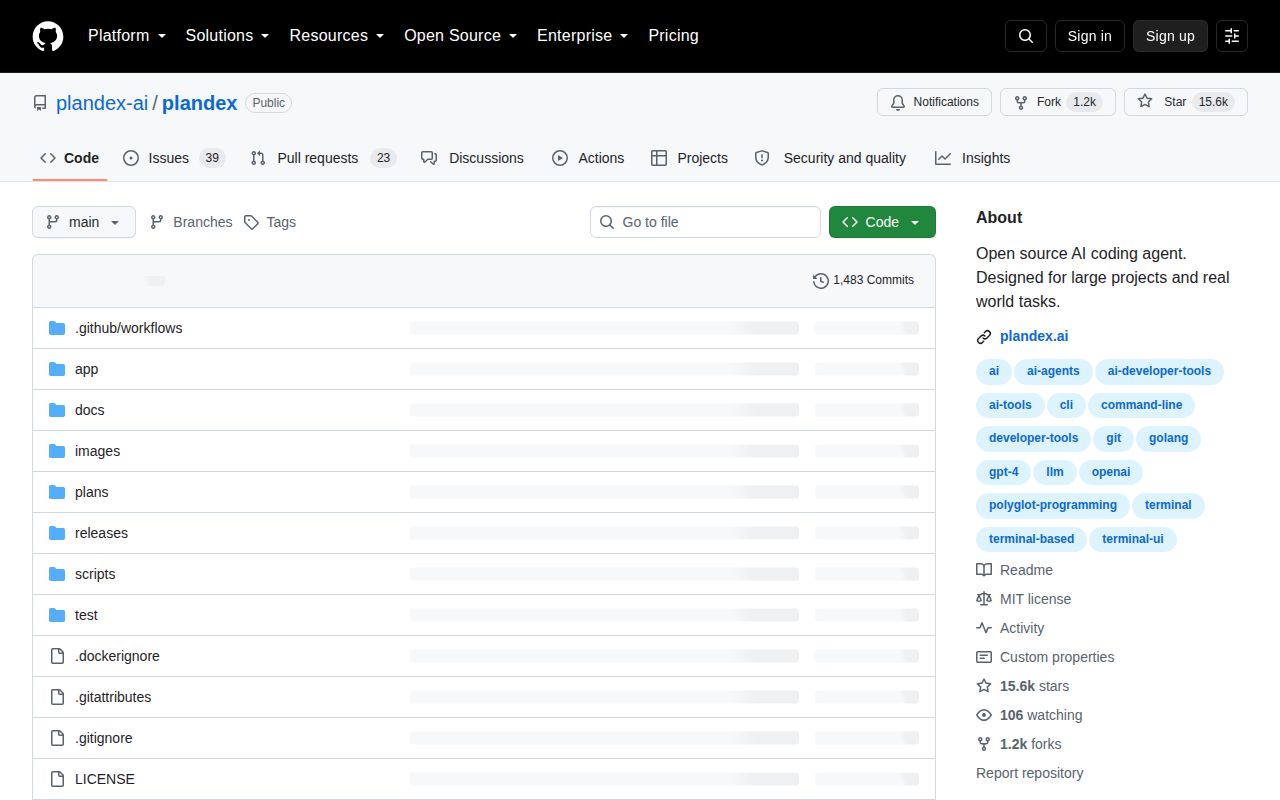
GitHub listed 15,596 stars and 62 combined issues and pull requests. The repository's last push was October 3, 2025, and cli/v2.2.1 was released on July 16, 2025. Open pull requests were still being updated in August 2026, including the proposed path fix, WSL configuration work, provider additions, and remote-agent pairing. That is community activity without a recent merged push.
Plandex remains interesting because the planning and diff model solves a real review problem. The 49-second install and 40-second build make the CLI approachable, yet cloud closure, 0 discovered tests, and unresolved safety reports raise the operating burden. Trial it only if the separate server and deliberate approval workflow are features you want, then pin the verified commit rather than following an unexamined latest tag.