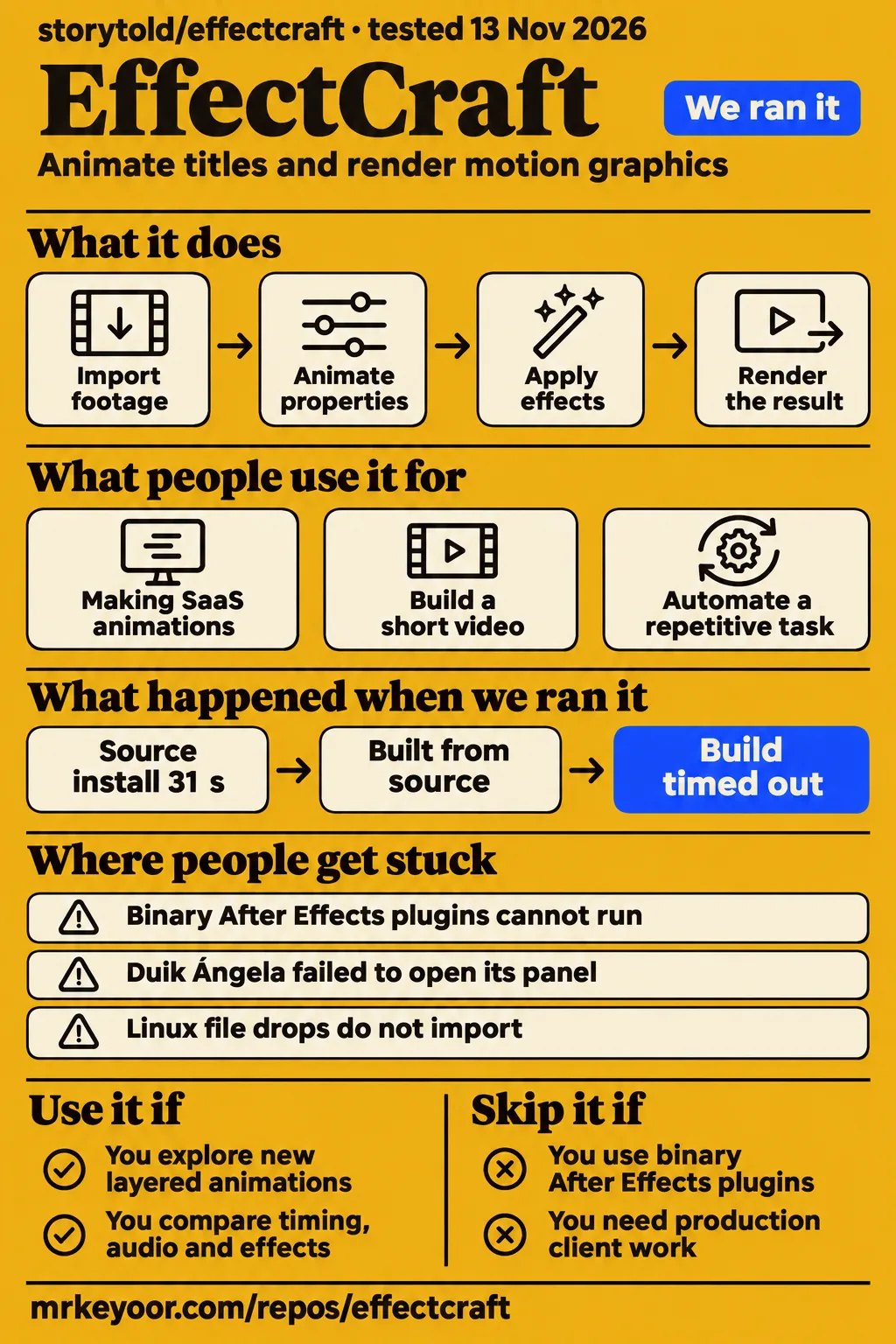
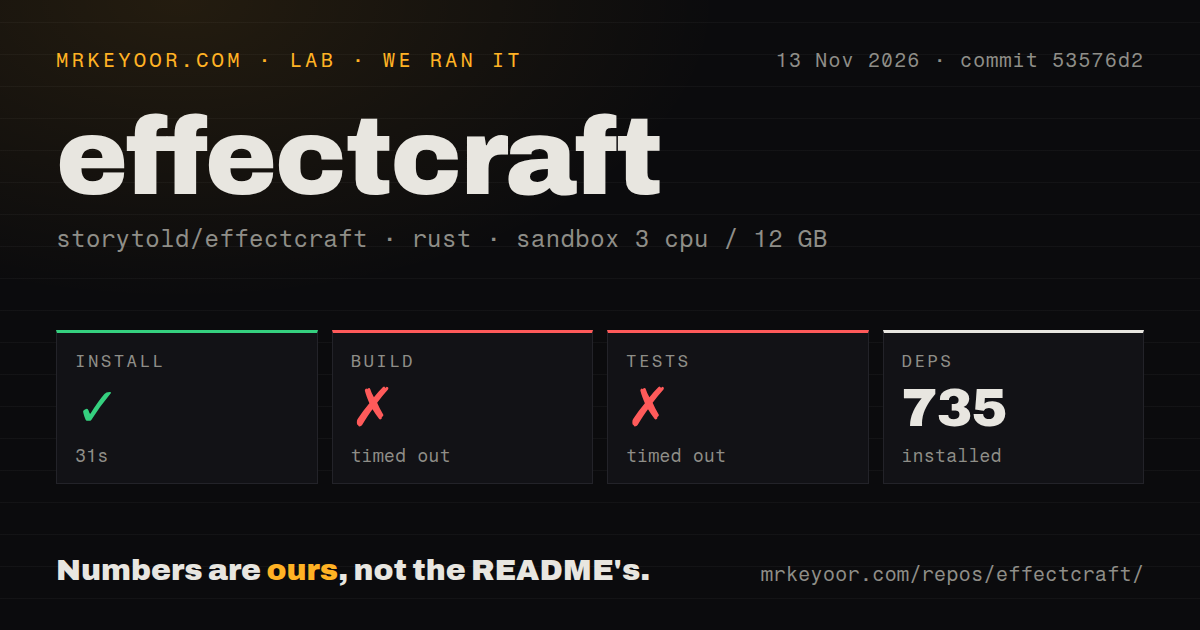
EffectCraft is a free, open-source motion graphics editor worth considering for experimental compositions. Our source installation succeeded in 31 seconds, but both build and test commands reached the 900-second limit. Upstream advises against production client work and excludes binary After Effects plugins. For a designer evaluating a new tool, the useful decision is whether a small composition can preserve the timing, audio and effects that the intended project needs.
What people use effectcraft for
Creators report making SaaS animations, agent-assisted videos and reusable scripts with EffectCraft. These examples suggest practical starting projects: animate a product explanation, build a short video through an agent connection, or automate a repetitive editing task. The reports describe work their authors made, while the repository explains the editor's underlying composition model. Together they help identify a first project without treating a social video's appearance as a performance measurement.
| Who | Reported use | Source |
|---|---|---|
| AB Animation Studios | Created a SaaS animation while exploring animation tools, 3D effects and presets | AB Animation Studios' animation post |
| EggplantParticular27 on r/ArtCraftAI | Posted a video described as made with Claude and EffectCraft | Claude and EffectCraft video thread |
| NotJustShaking on X | Tried making YouTube Shorts through Codex and EffectCraft's MCP connection | NotJustShaking's first-attempt report |
| SouthCentralMenace on r/ArtCraftAI | Built personal versions of Overlord, Grid Builder and Ease Stash | Community scripting discussion |
The EffectCraft repository describes compositions made from solids, shapes, text, footage and other compositions. Users animate properties with keyframes, apply effects and render the result. Projects use versioned JSON files with the .ecproj extension. This gives technical creators a readable project format alongside the visual editor. Within the same family, the README identifies FilmCraft as the application for video editing, color and sound; EffectCraft focuses on motion graphics and compositing.
What happened when we ran it
Our November 14 hands-on attempt failed its safety check because the repository had no accepted Compose file. The hands-on safety record lists compose.yaml, compose.yml, docker-compose.yaml and docker-compose.yml as the accepted names. The deployment summary nevertheless says the repository deployed through its own Docker Compose, with every port bound to 127.0.0.1. Those records conflict. The teardown record records successful cleanup.
Our separate November 13 source run used commit 53576d2, with a recorded configuration of 3 CPUs, 12 GB RAM and image label lab-rust:1. We measured installation at 31 seconds, with 735 dependencies recorded. Build and tests each reached the 900-second cap. Dependency installation, compilation and test completion are different outcomes, so the table keeps each command's result separate and describes only what the recorded outcome shows.
| Recorded step | Result | Practical meaning |
|---|---|---|
| Install | Succeeded in 31 seconds; 735 dependencies recorded | Dependency installation completed. |
| Build | Timed out in 900 seconds | The build command reached the time cap. |
| Tests | Timed out in 900 seconds | The test command reached the time cap. |
The supplied test-log tail shows compilation of rustls, httparse, wl-clipboard-rs, url, accesskit_unix, rustls-webpki and effectcraft-host v0.24.1, followed by dependencies including bytes and subtle. That tail contains no compiler error or failed assertion. The checkout scan recorded 1,661 files, approximately 568,156 source lines and 40.5 MB on disk. It also found nine CI workflow files, a tests directory and no Dockerfile. These observations describe the checkout and commands, rather than passing CI results.
Where people get stuck: plugins and project migration
Upstream EffectCraft cannot run binary After Effects plugins, according to maintainer bflatastic in issue #322. The same comment describes EffectCraft's own plugin API and scripts or ScriptUI panels. Before moving a composition, identify whether each dependency is an Adobe binary, a script panel, a native EffectCraft plugin or a separate executable. That distinction matters more than a tutorial's broad use of the word plugin.
| Problem | Supplied report or documentation | Next step |
|---|---|---|
| Flow, Deep Glow, Sapphire or Twixtor dependency | Issue #322 excludes binary After Effects plugins | Identify the required product's plugin format and host. |
| Duik Ángela panel does nothing | Issue #625 reports that the panel did not open and direct execution produced no visible response | Make the exact extension a requirement in the evaluation project. |
| Linux file drops do not import | The README describes missing file-drop events on native Wayland | Use File > Import > File or the documented XWayland route. |
| GPU compositor starts but an effect uses CPU | Issue #613 reports fxd_point fallback on v0.23.1 |
Check the backend and the affected effect kernel. |
SouthCentralMenace describes File > Script > Install Script for community .jsx tools in the scripting discussion. The author's Overlord-like tool requires an executable and is described as a work in progress. For project migration, current upstream After Effects import documentation describes .aep and .aepx import through File > Import > Adobe After Effects Project. The v0.24.1 release notes also list importer changes, providing newer implementation evidence than the draft proposals discussed in issue #190.
Footage reports distinguish rendering from correct timing
KNUFFIXX's supplied v0.24.1 comparison reports 82/82 imports and renders, with frame-rate and frame-count checks each at 79/82. The contributor's footage report describes importing footage, creating a composition from the clip, saving the project and rendering short video and audio samples through the CLI on CPU. The corpus includes phone recordings and variable-frame-rate footage, making the timing checks particularly relevant to creators working with those sources.
Earlier channel checks passed 74 of 83, while later reports show 73 of 73 after ten source files were removed. The contributor says those files were removed on the test PC and that this was not an EffectCraft change. A later report also attributes two frame-rate fixes and one frame-count fix to an updated harness acceptance rule. The totals therefore need their accompanying explanations: the files included and the rules used to judge them changed during the series.
For a small evaluation project, choose footage from the cameras and phones used in the intended work. Compare duration and frame count with the source, then listen for every expected audio channel. The original report identifies silent E-AC-3, crackling AAC in Matroska and a 5.1 AC-3 case retaining only the front pair. Those reported failures explain why reaching Done in the render queue is only one part of an export check.
Cache and EXR reports include later implementation evidence
Issue #2551 records a maintainer-reported 20 GB disk-cache default and free-space reserve after #2553. The cache discussion identifies Settings > Disk > Disk Cache > Maximum Disk Cache as the adjustable setting. Its original reporter described cache growth and slow caching on Fedora. The follow-up supplies a setting and a reported repair that readers can use when configuring their own cache allocation.
The supplied issue #2551 extract records a November 8 commit, 8438248, referencing #3184. Its displayed title begins "Disk cache: entries keep the files they read, keys from memory (#3184)". This later observation updates the EXR discussion, where a comment described #3184 as planned work after an earlier closure associated with #3106. The later explanation concerns composition-view stalls while disk-cache keys stamp footage files on network storage.
The Cryptomatte report describes tested matte selections agreeing with the specification on CPU and GPU, alongside selection and performance problems. The maintainer reports that #645 adds the missing editable text field. Other comments discuss viewer picking, metadata popups, quoted names and performance work. For a selected name containing a comma, the reporter describes a hexadecimal ID as a workaround because the name parser split the selection incorrectly.
Local editing and agent control use different interfaces
The upstream README exposes engine commands through the CLI, JSON control channel and MCP, while UI-only commands use the running application's frontend dispatcher. The control channel or an attached MCP bridge reaches that dispatcher. This gives an automation project a concrete first choice: use the engine interface for supported headless operations, or connect to the running application when the intended task needs its frontend commands and widgets.
The README documents effectcraft-cli mcp as an MCP server over stdio, with tools for commands, project properties, keyframes and rendered frames. It also states that EffectCraft has no telemetry and makes no network access unless requested. These are upstream descriptions. A useful starting task is one small project operation with a copy of the media and project, selected according to the interface that exposes it. Community helper executables have their own installation route outside the upstream editor.
Interface typography has desktop and browser findings
Issue #1309 reports a mixed Latin/CJK interface baseline correction measured on main after #1395. The supplied discussion attributes remaining kana overshoot to the fallback font. This is an interface-text finding: it concerns how labels align within the application. Readers evaluating a Japanese, Chinese or Korean interface can use representative labels to examine baseline alignment separately from whether the selected fonts contain the required characters.
The same discussion reports empty-box glyphs in a Japanese browser interface when font coverage is missing. Baseline adjustment and glyph availability require different remedies because moving a glyph cannot supply a character absent from the font. Keeping those findings separate makes the report useful: one concerns alignment after a correction, while the other concerns browser font coverage. Neither needs an unsupported numerical acceptance bound to explain the practical difference.
EffectCraft vs After Effects, the OpenFX fork and EasyRunCraft
Keep After Effects for Adobe binary-plugin dependencies; consider upstream EffectCraft for experimental compositions, the fork for advertised OpenFX hosting, and EasyRunCraft for hosted editing. These choices address different requirements. The upstream editor's plugin boundary comes from its maintainer, the fork describes its own additions, and EasyRunCraft describes a service based on ArtCraft projects. Choose according to the required host and service arrangement before comparing familiar interface features.
| Option | Reason to choose it | Source-backed condition |
|---|---|---|
| Adobe After Effects | Retain an existing Adobe-dependent workflow | Upstream EffectCraft excludes binary After Effects plugins in issue #322. |
| Upstream EffectCraft | Explore new layered animations and documented CLI/MCP control | Upstream calls it alpha and advises against production client work. |
| glumbis/effectcraft | Explore the fork's advertised OpenFX hosting | The fork explicitly disclaims upstream and plugin-vendor support. |
| EasyRunCraft | Use hosted editors with free manual editing | Its AI Agent and MCP processing are paid services using account credits. |
The upstream README offers a WebAssembly static-site download, while EasyRunCraft describes hosted editors based on ArtCraft's open-source projects. These are different ways to reach browser editing. For linked compositions, FilmCraft issue #388 requests a workflow comparable to Adobe's Dynamic Link, with changes to an EffectCraft composition updating its FilmCraft instance. Its discussion proposes a full-render cache approach; the issue describes rendered media and timeline interchange as the documented workflow.
What the other reviews get wrong
The supplied EffectCraft.org download extract labels 0.8.0 current, while the supplied release page identifies v0.24.1. The download extract therefore carries an older version label. Effect counts also differ: the product extract says 259, the AIidelist review says 306, and the supplied current README says 308. These are source-specific catalog descriptions; the count alone says nothing about whether a particular effect meets a project's needs.
The TikTok tutorial extract calls EffectCraft literally After Effects. Issue #322 supplies a practical correction: Adobe binary plugins cannot run upstream. The AIidelist extract also says .aep and .aepx projects cannot open, whereas current upstream import documentation describes both formats and loss reporting. Familiar panels and shortcuts can help explain the editor, but current documentation gives the more useful answer to a specific migration question.
The Facebook review describes smooth operation on low-spec PCs. The Fedora cache report describes slow caching and excessive growth, followed by a maintainer-reported repair. Those are accounts from different sources, rather than a shared benchmark. The supplied GitHub metadata records a November 14, 2026 push, and the discussions contain fixes and follow-up reports. Repository activity shows development work without supplying a numerical adoption, support or performance rating.
Questions people ask
Community scripts have a reported installation route, Adobe binary plugins cannot run upstream, and current documentation describes .aep/.aepx import with loss reporting. These answers turn on the specific dependency: a script, an Adobe binary and a project file use different routes. The questions below come from the supplied search and community records and connect those routes to the installation, migration and automation decisions a reader needs to make.
Can I install third-party plugins in EffectCraft, and how?
SouthCentralMenace reports using File > Script > Install Script for community .jsx tools. The author also describes an Overlord-like tool that requires an executable. Separately, maintainer bflatastic describes EffectCraft's own plugin API in issue #322. Start with the particular tool's host requirements and installation instructions so a community script's installation account does not become a general instruction for every extension format.
Can EffectCraft run After Effects plugins such as Flow, Deep Glow, Sapphire or Twixtor?
Upstream EffectCraft cannot run binary After Effects plugins, according to issue #322. The glumbis fork separately advertises OpenFX hosting and names tested OpenFX products. Match the required product's actual format to its host: a product name shared across formats does not make an Adobe binary an OpenFX plugin. Keep an existing Adobe-dependent workflow in its current host when that binary is a requirement.
Can I open existing .aep or .aepx projects in EffectCraft?
Current upstream documentation describes .aep and .aepx import through File > Import > Adobe After Effects Project. It describes reporting losses and bringing effects without counterparts across as placeholders. Use that import report to identify which parts of a composition need attention, then compare the migrated result with its source. This is a more precise answer than the older overview's blanket statement that neither format can open.
What workflow do people use with Claude and EffectCraft?
The supplied Claude video thread contains requests for the author's workflow, while upstream documents an MCP integration starting point. The README describes effectcraft-cli mcp and an attached bridge for the running application's frontend dispatcher. Those interfaces provide a route for building an automation task. The posted video remains its author's reported result, and the repository documentation describes the editor's interfaces rather than that person's prompts.
What kind of software is EffectCraft?
EffectCraft is a motion graphics and compositing editor for animated titles, layered animation and effects work. Its README describes desktop and browser builds, keyframe animation and a render queue, with scripting, CLI and MCP control. Within the ArtCraft family, FilmCraft is listed for video editing, color and sound. That distinction helps a reader choose an application according to the work rather than the similarity of their names.
Can Duik Ángela and other ScriptUI extensions run in EffectCraft?
Duik Ángela failed to open its panel in the supplied issue #625 report, and direct execution produced no visible response. The discussion includes proposed compatibility work and requests for clearer extension information. For a character-animation workflow, include the exact extension and a representative rig in the evaluation. The maintainer's broader statement about ScriptUI panels and the reported behavior of this Duik package describe different levels of compatibility.
Can I set how much disk space EffectCraft's cache uses?
Issue #2551 identifies Settings > Disk > Disk Cache > Maximum Disk Cache as the adjustable setting. The maintainer reports a 20 GB default and a free-space reserve after #2553 on main. Choose a capacity for the disk holding the cache. The network-storage EXR discussion concerns a different operation: the work performed while calculating cache keys, rather than just the amount of cached data retained.
Can FilmCraft link an EffectCraft composition without repeated manual exports?
The supplied FilmCraft issue #388 requests an editable composition link that updates after changes in EffectCraft. Its discussion proposes a full-render cache as an initial approach. The requested behavior is specific: changes to text, animation or easing would refresh the FilmCraft instance while preserving its timeline placement and trims. That request gives readers a concrete requirement to compare with the documented rendered-media workflow.
What we have not tested yet
Our evidence contains no completed source build, completed test-suite result or successful interactive hands-on session. The run used commit 53576d2; the effectcraft-host v0.24.1 compilation label does not identify it as a run of the v0.24.1 release tag. Preview responsiveness, export fidelity, GPU memory, long render queues, browser stability and desktop-download installation were not measured. The image label supplies no actual runtime versions, and the conflicting Compose records supply no successful deployment finding, task answers or screenshots.
The November 8 commit referencing #3184 updates the earlier planned-fix account, but its effect on the network-storage stall in a particular release is unresolved here. The contributor's private footage corpus was not reproduced, and its historical discrepancies were not independently reconciled. Browser freezes reported on Intel Gen 9 integrated GPUs on Windows and macOS, remaining Cryptomatte work and interface typography also lack sandbox reproduction. The typography discussion supplies no direct finding about composition-text rendering.
The unofficial OpenFX fork, unchanged Duik, community helper executables and EasyRunCraft's account or credit behavior were not tested here. Social examples supply neither measured export quality nor a reproducible Claude workflow. This review includes no network inspection, permission audit, malicious-project exercise, measured support response or representative adoption assessment. All four score cards are N/A. The next useful evaluation is a small composition using your own footage, compared with its sources for timing, audio channels and required effects.