Effect turns failures and dependencies into part of the program
Effect asks you to stop treating exceptions, retries, cancellation, and cleanup as separate concerns. An Effect value records what it can produce, how it can fail, and which services it needs. The runtime then coordinates that work. For a service that calls a database, a remote API, and a queue, this can make control flow easier to inspect than nested try blocks and hand-built retry loops. It also changes how your team writes TypeScript.
The repository covers much more than its core package. Its synchronized 4.0.0 release includes platform adapters for Node, Bun, Deno, and browsers, plus SQL clients, AI providers, OpenTelemetry, testing helpers, and schema tooling. That shared model is the appeal: a PostgreSQL layer and an Anthropic layer can use the same service, error, scope, and tracing concepts. It is also the commitment. Effect is closer to an application foundation than a utility you sprinkle into two files.
Version 4.0.0 has an LTS promise and strict entry requirements
Effect 4.0.0 was released on October 1, 2026. The README calls the 4.x line LTS and promises at least 3 years of support, followed by defined bug-fix and security-fix windows around the next major release. Stable APIs reserve breaking changes for majors. Unstable APIs may change in a minor release, while experimental ones may change in a patch, so package choice matters as much as the headline LTS label.
The compiler requirements are equally direct. You need TypeScript 5.9 or newer and must enable strict. Node 18 is the general minimum, although integrations can set a higher floor. The documented example is @effect/sql-sqlite-node, which needs Node 22.16 or newer. A team can trial the core with npm install effect, but a real adoption should begin by checking every intended package against the runtimes already deployed.
What happened when we ran it
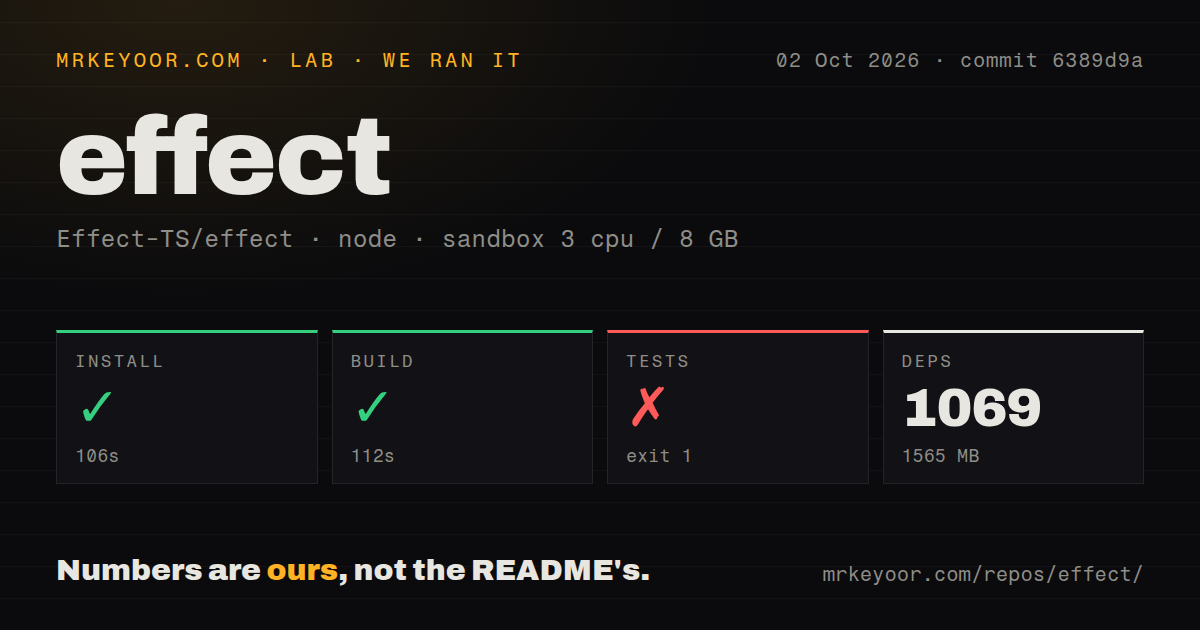
Our sandbox installed commit 6389d9a in 106 seconds, adding 1,069 packages and using 1,565 MB on disk. The checkout itself contained 2,591 files, roughly 834,039 lines of source, and occupied 43.9 MB. The build completed successfully in 112 seconds. We used a fresh unprivileged Debian container with 3 CPUs, 8 GB of RAM, Node 22, and no secrets.
The test step failed after 500 seconds. Vitest reported 452 passing files, 5 failed files, and 1 skipped file. At test level, 13,213 passed, 33 failed, 10 were expected to fail, and 60 were skipped out of 13,316. The log tail repeatedly reports Test timed out in 5000ms, then exits with code 1. It does not identify a cause in the supplied lines, so blaming the container, the tests, or a missing service would be speculation.
Those numbers give a mixed but useful result. A 112-second successful build across this monorepo is meaningful, and 13,213 passing tests show broad exercised behavior. The 33 failures still block a clean release gate. A team evaluating Effect should rerun the failing files on its own CI hardware and inspect the full logs before deciding whether the 5-second limits expose slow infrastructure, nondeterministic tests, or product defects. Our log tail cannot make that distinction.
The 1,565 MB install belongs in the adoption budget
The application dependency may be smaller than the development monorepo we measured, but contributing to Effect or validating the repository means carrying 1,069 installed packages. Seven CI workflow files show that upstream automation exists. There is no Dockerfile, so the repository does not hand contributors a canonical container matching our Debian setup. Tests are distributed through the monorepo rather than collected in a root tests directory.
Learning cost will usually exceed install cost. Typed error channels, service layers, scopes, fibers, schedules, and schemas reinforce one another, which is why adopting a single concept rarely captures the whole benefit. That cohesion pays off in services where cancellation and cleanup are everyday problems. In a small request handler with one database call, the same vocabulary can obscure code for coworkers who know ordinary promises but have never used Effect.
October activity shows fast maintenance and live edge cases
GitHub recorded 16,418 stars, a push on October 2, 2026, and 301 open issues and pull requests combined. A separate issue search found 177 open issues. The dates matter more than the size of the queue: maintainers and contributors were updating reports and pull requests on the day of this review, one day after the 4.0.0 release. This is active software with a busy public workbench.
Fresh 4.0.0 reports also show where careful upgrades matter. Issue 8673 documents an uncaught Node socket error during re-entrant reader teardown. Issue 8635 reports a Bun worker finalizer calling a missing close() method. Both include reproductions, and issue 8673 already had a linked fix pull request when checked. They do not make Effect unsafe as a whole. They do argue for testing the exact runtime adapters and shutdown paths your service uses.
Adopt the model deliberately, or choose a smaller tool
Effect earns its place when a team repeatedly solves typed failure, dependency wiring, cancellation, resource lifetime, and observability in the same TypeScript services. The package family then gives those problems a common grammar. The active October 2026 maintenance and stated LTS terms support a serious evaluation, while the failed sandbox suite says your own CI trial should remain a release condition.
If the immediate problem is only typed errors, neverthrow asks far less of the codebase. fp-ts fits teams that want functional abstractions without Effect's runtime, and RxJS remains the more direct choice for observable event streams. Effect is the pick when those narrower boundaries have already started leaking into one another. Budget for training, pin the stability tier you can tolerate, and make the 33 failures we saw a question to resolve before rollout.