mrkeyoor.com_
Wed 07 Oct 06:43 UTC
AI Toolsevaluationupdated 07 Oct 2026

editaplot2026 review

EditaPlot's main README is written in Simplified Chinese, and the repository also provides a full English README. It is a Codex skill that inspects scientific tables, asks the user to confirm what each column means, then drives Origin 2026 to produce an editable OPJU project plus PNG, PDF, and TIF exports.

Verdict

Our EditaPlot run installed 35 packages and built successfully, but the 291-test run ended with 19 failures and 34 collection/setup errors, so this is a promising specialist tool that is not ready for a blind rollout. Try it if you already have a physical Windows machine, OriginPro 2026, and a review step for every scientific figure. Choose a script-based plotting library if you need cross-platform execution or a green suite as an adoption gate.

We ran it

Lab card: what happened when we ran editaplot2026Screenshot of editaplot2026 (github.com/liushunqi8-hash/editaplot2026)
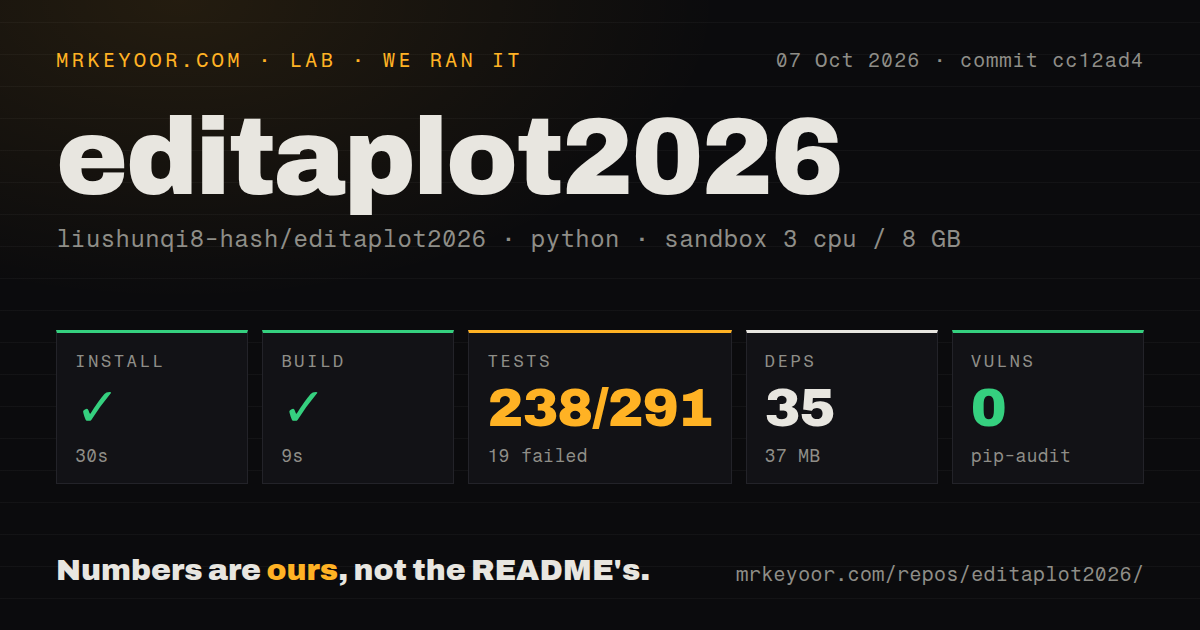
Install✓ · 30s35 packages · 37 MB
Build✓ · 9s
Tests✗ · 20s238 passed · 19 failed · 34 errors of 291 (pytest)
Known vulns0(pip-audit)
Repo677 files~68,740 lines of source · 10.5 MB · 0 CI workflows · tests dir

Answers from our run

Does editaplot2026 build from source?

Dependencies installed in 30 seconds (35 packages), and the build succeeded in 9 seconds. We cloned commit cc12ad4 into a clean Debian container with 3 CPUs and no project-specific setup.

Do editaplot2026's tests pass?

Not all of them: 238 of 291 passed and 19 failed when we ran the project's own test command (pytest), with 34 collection errors. Some failures need services or credentials a bare container does not have.

Does editaplot2026 have known vulnerabilities in its dependencies?

pip-audit found none in the dependency tree at the time of our run.

Who should not use editaplot2026?

Mac, Linux, WSL, Wine, Parallels, or virtual-machine users: the README says the full Origin path is supported only on physical Windows 10/11 x64 computers.

What are the alternatives to editaplot2026?

Matplotlib, Plotly.py, OriginLab Python Samples. Our EditaPlot run installed 35 packages and built successfully, but the 291-test run ended with 19 failures and 34 collection/setup errors, so this is a promising specialist tool that is not ready for a blind rollout.

Setup2/530-second install, but Windows and Origin 2026 are mandatory
Docs4/5Detailed bilingual setup, safety boundaries, and chart coverage
Community2/5124 stars, a recent push, and no open issue or PR queue
Maturity2/5v0.1.3 is recent, but our 291-test run did not pass

Who it’s for

Windows researchers who already use OriginPro 2026 and want an agent-guided route from CSV or Excel data to an editable project.
Labs that value explicit confirmation of column roles, plotted elements, fits, and transformations before a figure is rendered.
Codex users who can give a local process narrowly scoped permission to start Origin Automation.
Materials, spectroscopy, medical, or statistics teams whose chart type appears in the documented 41-route catalog.

Who it’s NOT for

Mac, Linux, WSL, Wine, Parallels, or virtual-machine users: the README says the full Origin path is supported only on physical Windows 10/11 x64 computers.
Researchers without a licensed local copy of Origin or OriginPro 2026 (10.30): EditaPlot does not install Origin, and other releases are outside this fork's verified range.
Teams that need a clean test suite before adoption: our run ended with 19 failures and 34 collection/setup errors.
Anyone expecting automatic fitting or scientific interpretation: the README says it will not invent columns, smooth data, remove outliers, assign phases, or calculate results such as SHAP values.
Workflows that cannot grant Codex a narrowly approved local Origin command: the documented sandbox check stops before COM when that execution context is unavailable.

Setup reality

Our sandbox installed commit cc12ad4 in 30 seconds, adding 35 packages and 37 MB. The build passed in 9 seconds. Pytest failed in 20 seconds: 238 tests passed, 19 failed, and 34 hit collection/setup errors out of 291. Pip-audit found 0 known vulnerabilities.

A real render needs physical Windows 10/11 x64, 64-bit Python 3.10 through 3.12, Codex, and an existing Origin or OriginPro 2026 (10.30) installation. The README names no hosted API credential for the local plotting path, but setup may need GitHub and Python package access.

Origin Automation must run in the signed-in Windows session. EditaPlot requests approval for the exact smoke or render command when Codex is sandboxed, writes a new output folder beside the source data, and does not claim success until OPJU, PNG, PDF, TIF, object readback, and visual checks complete.

The useful idea is confirmation before drawing

EditaPlot covers 41 documented Origin plotting routes, but its best idea is smaller than that catalog: an agent should not guess what a scientific column means. The skill sorts columns into evidence, visible support, calculation or validation data, retained data, and unresolved data. A changed source file or mapping invalidates the confirmation. For XRD refinement data, that means Observed can become points while weight or axis-control columns stay out of the plot unless the user says otherwise.

That restraint makes EditaPlot more credible than a prompt that says "make this publication ready." The README explicitly refuses to calculate fits, remove outliers, assign phases, or infer conclusions. Reference images are treated as visual briefs rather than data sources. A PNG cannot smuggle its labels or fitted values into the result, and an unsupported style request is rejected or left at the template default. Scientists still have to own the scientific claim.

Origin 2026 is a hard dependency, not an export option

The complete path supports physical Windows 10/11 x64 and Origin or OriginPro 2026 product number 10.30. EditaPlot starts a dedicated Origin instance, runs a smoke check, renders, exports OPJU, PNG, PDF, and TIF, then reads objects back and calls for a human visual check. Python previews do not count as completed Origin work. That is a sensible acceptance rule for editable figures, but it makes Origin the center of the system.

Mac, Linux, WSL, Wine, CrossOver, Parallels, and other virtual machines are outside the V1 support boundary. Python must be 64-bit version 3.10, 3.11, or 3.12. The launcher can create a project environment, yet it will not install or modify Origin. A team without the exact commercial desktop application cannot use the main result path, regardless of how easily the Python portion installs.

What happened when we ran it

Our run at commit cc12ad4 installed 35 packages in 30 seconds and occupied 37 MB. The build completed in 9 seconds. Our sandbox was an unprivileged Debian container with 3 CPUs, 8 GB of RAM, Python 3.12, and no secrets. The checkout held 677 files, about 68,740 lines of source, and used 10.5 MB. Pip-audit reported 0 known vulnerabilities.

Pytest failed in 20 seconds. Of 291 tests, 238 passed, 19 failed, and 34 ended in collection or setup errors. The log tail showed a missing page.width mapping, README release-gate assertions, and a missing star-trend workflow file. Several semantic workflow cases could not import modules named nu or matplotlib. Those messages establish what failed. They do not establish why those modules or files were absent.

Our test method exercises repository mechanics in a fresh Debian container, not the advertised Origin render on physical Windows. We did not produce an OPJU file or judge image quality. The Linux suite result still matters because the repository includes those tests and 53 cases did not reach a pass. A buyer should reproduce the suite on the intended Windows host and require a real smoke, render, export, and object-readback cycle before trusting the workflow.

The permission model is narrow but still operational work

EditaPlot documents one exact escalation point: a sandboxed Codex process must receive approval to run the chosen origin-smoke or render command in the signed-in Windows session. The project says normal use does not need administrator rights, whole-drive access, DCOM edits, registry changes, or firewall changes. If approval is denied, the process stops before Origin COM and must not describe the figure as complete.

Outputs go into a new timestamped folder beside the CSV, TXT, XLS, or XLSX input rather than overwriting the source. Network access is mainly for the initial clone, updates, and locked Python packages. Medical data supplied to Codex remains subject to the account and organization's retention policy, and the README says EditaPlot does not promise automatic PHI detection. That boundary deserves a written lab procedure before anyone attaches patient material.

Recent code does not cancel the failed suite

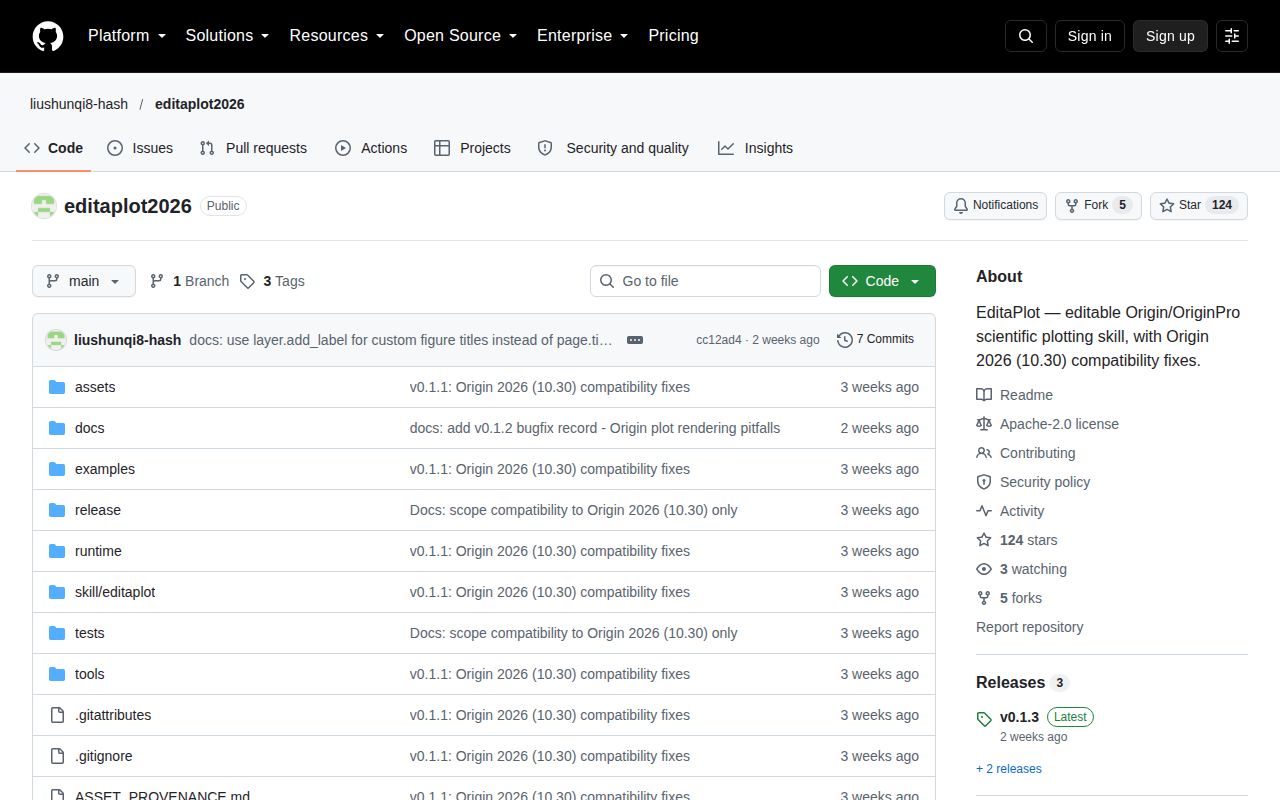
GitHub showed 124 stars, 0 open issues and pull requests, and a last push on September 20, 2026. Release v0.1.3 was published the same day. Those dates show recent maintenance, while an empty queue says little about field use or response quality. The release notes are also unusually rough: their body ends with an instruction to click the Publish release button, which reads like authoring residue in a public artifact.

EditaPlot earns a controlled trial for a lab already standardized on OriginPro 2026. The confirmation contract is careful, the bilingual documentation is detailed, and 238 tests passed in our container. The failed 291-test run blocks a broader recommendation. Put one representative dataset through the full Windows path, inspect every exported artifact, and keep the scientist who owns the claim in the approval loop.

Alternatives

ProjectWhat it isPick it when
Matplotlib gh↗A script-first Python plotting library with broad scientific use and cross-platform output.pick this instead when reproducible Python code and platform independence matter more than an editable Origin project.
Plotly.pyA Python graphing library for interactive browser charts and static exports.pick this instead when interactive HTML figures or web delivery matter more than Origin automation.
OriginLab Python SamplesOfficial sample code for controlling Origin from Python without an agent workflow layered on top.pick this instead when you want to write and own the Origin automation code yourself.

What people are saying

  1. [velocity-scout] liushunqi8-hash/editaplot2026

Sources

  1. EditaPlot repository and primary README
  2. EditaPlot English README
  3. EditaPlot installation guide
  4. Origin 2026 compatibility notes
  5. EditaPlot v0.1.3 release

More ai tools reviews

embodied-jev · underclass · minecraft-agent · laya-coreml · CometixCode · openJev-verdict-2.0 · the whole board →