DSPy turns prompts into programs that can be optimized
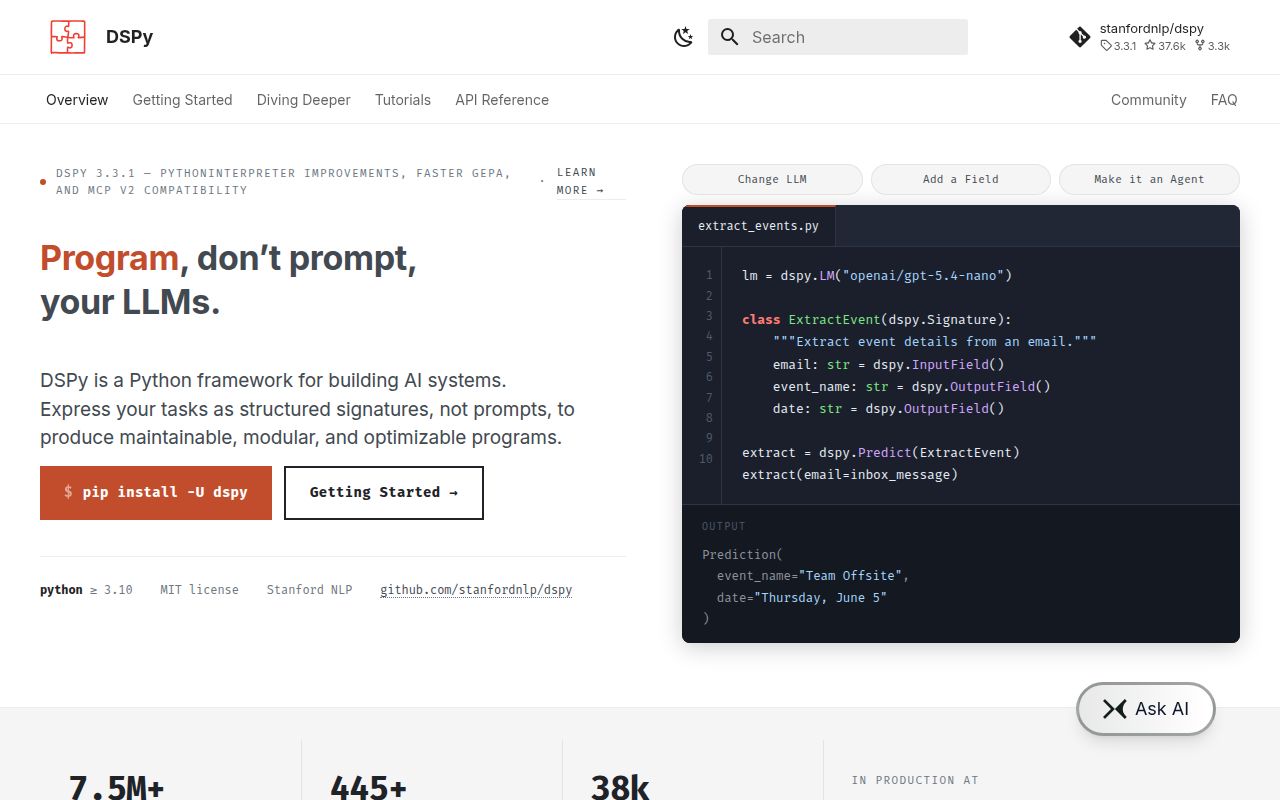
DSPy asks developers to describe an input-output contract as a signature, compose predictors into Python modules, and evaluate the result with a metric. An optimizer can then search instructions, demonstrations, or other program choices. That is a different abstraction from putting a formatted string around each model call. It suits classifiers, retrieval pipelines, extraction, and agents when quality can be measured over a set of examples. The promise is less manual prompt editing, but the work moves into signatures, datasets, metrics, and evaluation.
A small application can start with dspy.Predict or ChainOfThought, then configure a language model once. Larger programs combine modules and retrieval, while optimizers compile the program against training examples. DSPy does not make an unclear task precise by itself. If the metric rewards the wrong thing or the examples miss production cases, optimization can improve the score you wrote while leaving the actual user problem untouched. The framework is most useful to teams already willing to maintain an evaluation set.
Version 3.3.1 is active, while ReActV2 remains experimental
The latest release is 3.3.1, published on 2026-08-21, and the last repository push was 2026-08-25. That combination indicates active maintenance. GitHub listed 637 open issues and PRs, a large queue that also reflects the project's usage and pace. Current work includes adapters, usage tracking, evaluation timeouts, GEPA optimization, and code-interpreter boundaries. This is a living research-backed framework rather than a frozen utility library.
Agent users should note that ReActV2 arrived as an experimental feature in 3.3.0. The maintainers are asking for feedback on prompt caching, native tool calling, and regressions before it replaces the earlier ReAct module. That wording matters: it is an experiment, not a completed migration. Teams shipping an agent should pin DSPy, choose the ReAct implementation deliberately, and cover tool-call behavior with their own evaluations instead of assuming the newest class is the stable default.
What happened when we ran it
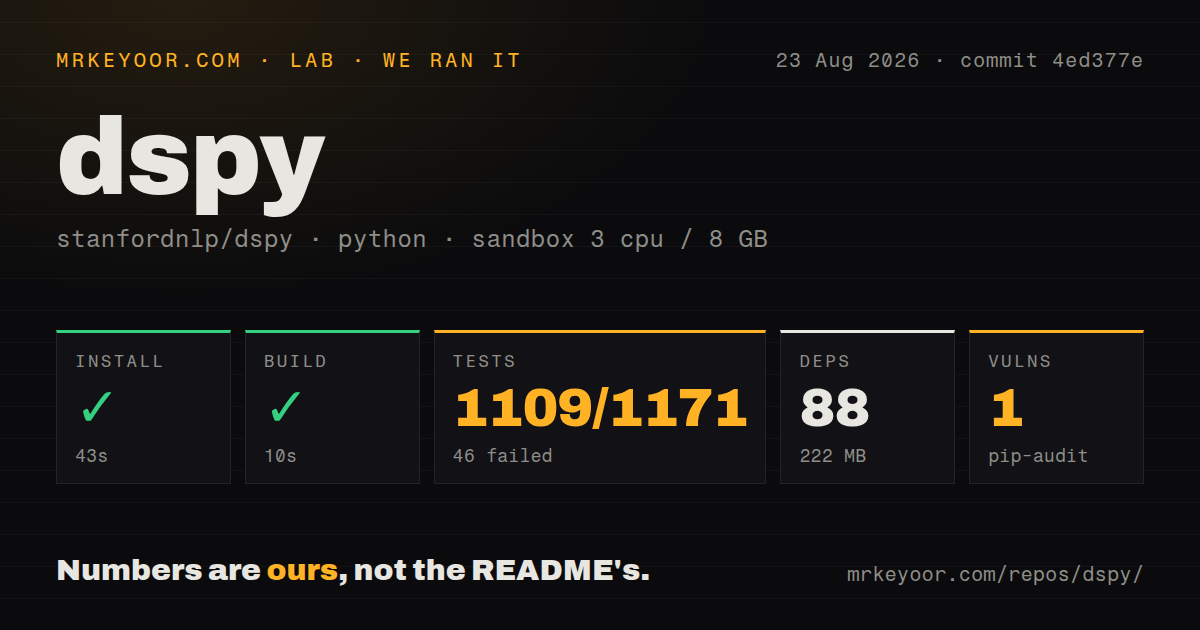
Our sandbox cloned commit 4ed377e into an unprivileged Debian container with 3 CPUs and 8 GB of RAM. Installation took 43 seconds, pulled 88 Python packages, and occupied 222 MB on disk. The repository contained 567 files, about 73,695 lines of source, and used 23.6 MB when checked out. The package build then completed successfully in 10 seconds. pip-audit reported 1 known vulnerability.
Pytest ran for 569 seconds and exited 1. Of 1,171 tested cases, 1,109 passed, 46 failed, and 16 ended in collection or setup errors; another 360 were skipped. The log tail shows several client and streaming tests timing out because a server process exited before port 48455 became ready. It also shows the KNN few-shot test raising an ImportError because NumPy was missing and recommends dspy[numpy] or a direct NumPy install. The tail does not say why the server process exited.
Optional extras affect what the base install can verify
The public installation line is simply pip install dspy, and that is honest for core imports. Our 88-package base environment built correctly. The test result shows that the whole source tree expects more in at least one path: KNN few-shot refuses to run without NumPy. A developer who chooses features by reading examples can discover those optional requirements later, so install the matching extras and run the tests for the modules you use.
Model access is the larger configuration step. A real DSPy program needs credentials for a hosted model or a reachable local endpoint. Compiling a program may call the model many times across examples and candidates, which turns evaluation design into a cost and rate-limit decision. DSPy tracks usage, but an open pull request reports nested tracker totals and nonnumeric fields being combined incorrectly. If cost ceilings are contractual, verify totals outside the framework as well.
Current adapter issues can change typed output behavior
DSPy's adapters translate typed signatures into provider messages and parse responses back into Python values. That layer carries real correctness risk. Issue #10269 documented XML output containing ]]> failing to parse and empty optional containers returning None; a linked pull request supplies fixes and tests. Issue #10273 reports an lru_cache retaining up to 32 image objects, which can hold large base64 payloads in a long-running process.
These reports are specific enough to guide adoption. Teams using XMLAdapter should test code-like strings and empty containers. Image workloads should watch memory over repeated, distinct inputs. Neither concern disqualifies DSPy, and active fixes are a good sign, but typed signatures do not guarantee faithful round trips through every adapter. Pin the release, test the chosen provider adapter, and keep representative multimodal or structured examples in the same evaluation set used during optimization.
DSPy pays off only when the metric is worth trusting
DSPy's strongest idea is that prompts and demonstrations can be treated as parameters of a program. On a task with labeled examples and a defensible metric, that gives engineers a repeatable way to compare changes instead of polishing one prompt by feel. The 1,109 passing tests in our run and the published research show serious engineering behind the approach, even though the full suite was not green in our container.
For an internal extraction system, support classifier, or RAG pipeline with reviewable answers, the added concepts can pay for themselves. For a chatbot whose quality is subjective and changes by conversation, compilation may add expense without a trustworthy target. LangChain and Haystack are easier choices when the main job is wiring tools and data sources. Pick DSPy when evaluation already belongs in your development loop and you want the program, not a person, to search the prompt space.