What this project actually is
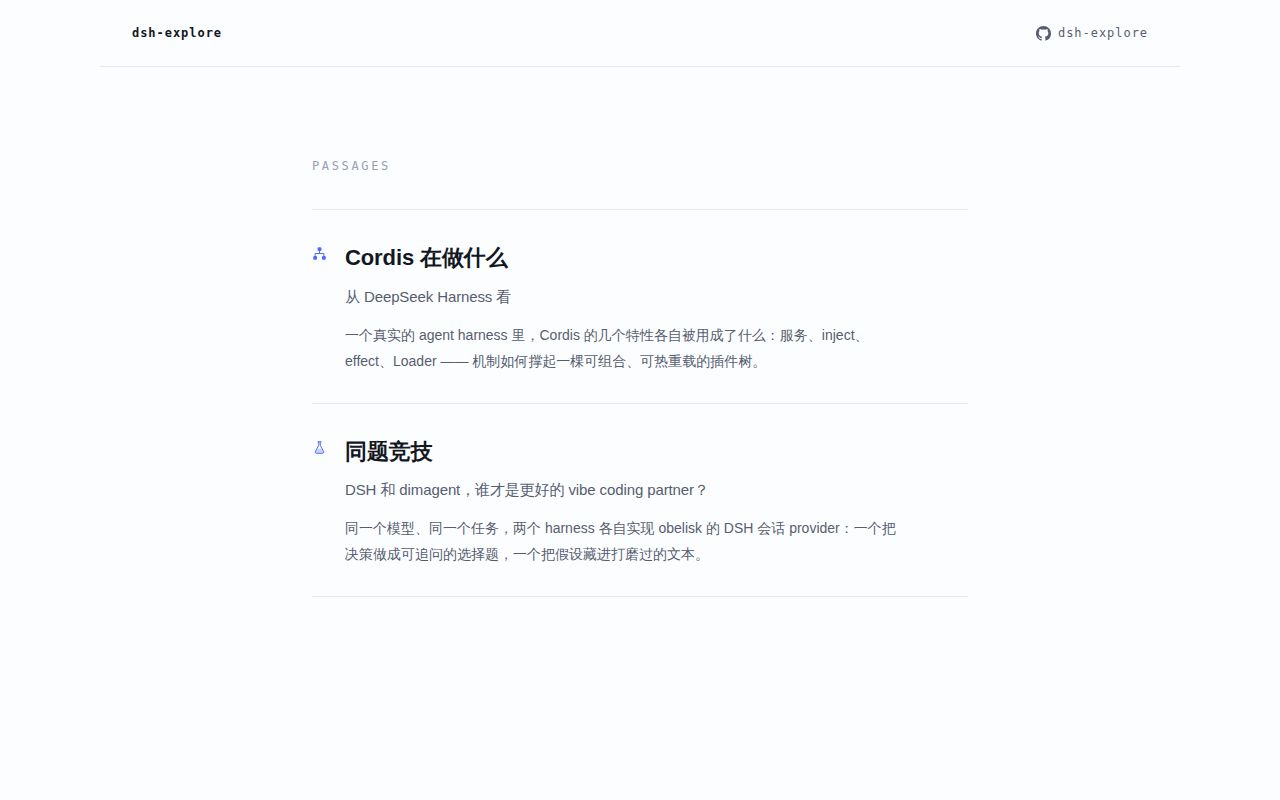
Deepseek Harness Explore is best understood as a technical publication with a web reader, not as another agent framework you install into an application. The repository gathers interpretation and, eventually, practical exploration of Cordis and Deepseek Harness. Its central subject is a harness design that separates parts of an agent system through plugin trees with what the authors describe as spatial and temporal independence. That is architecture material: it is meant to help readers reason about composition, lifecycle, packaging, and configuration.
Language is a meaningful consideration. The listed article is written in Chinese, while chapter names and code identifiers retain their original English. The repository links an English README, which helps readers understand the project and navigate it, but the supplied description does not claim an English translation of the articles. English-only readers should therefore expect translation friction precisely where the material becomes most detailed.
The repository also includes a Vite and Vue reading site with syntax-highlighted article rendering. The public homepage makes the work easier to browse without cloning anything. If you do clone it, the documented local path is short: move into site, install dependencies, and start the development server. That setup serves the publication, not a runnable Deepseek Harness environment.
What it does well
The strongest signal is its approach to evidence. The README says code references use file and line numbers, include original excerpts, and were checked against declared source baselines. It identifies Cordis at commit 8cc9e33, corresponding to the stated 4.0.0 release-candidate baseline, and Deepseek Harness at commit 47f943859b, with the vendored Cordis package pinned at 4.0.1. For an architecture explainer, this specificity matters. Readers can distinguish an observed implementation detail from a vague summary and can investigate how later code has changed.
The first listed article also chooses useful, concrete seams rather than discussing agents in generalities. Its scope includes the three-part package convention, plugin lifecycle, cordis.yml, layered patches, presets, declarative composition, and the broader meta-harness perspective. Those topics are where framework designs become operationally understandable. A reader evaluating extensibility can inspect how plugins are grouped, when they exist, and how configurations combine, rather than relying on a promotional diagram.
The source bundle is another practical strength for serious study. The project names an 88-page paper, A Programming Paradigm for Spatiotemporal Composability, and includes both the PDF and a plain-text conversion. It also states exactly which source revisions informed the writing. That creates a compact research trail: paper, implementation, interpretation, and a readable site live together.
Finally, the repository is active right now. Its last push was August 19, one day before this review, and its star count is 174. The community item records 119 stars when the repository was created on August 15, suggesting quick initial attention. That does not prove durable adoption, but it does show that the subject has found an audience unusually quickly for such a young, specialized publication.
Weaknesses and rough edges
The largest limitation is scope. The visible table of contents lists one article, while practical Deepseek Harness exploration is described as future work. The current repository may explain one important slice exceptionally well, but it is not yet a broad handbook, tutorial series, or implementation cookbook. Readers looking for end-to-end examples, migration guidance, or operating advice should not assume those exist.
There is also almost no maturity history to judge. No releases are listed. Zero open issues can mean a clean project, but in a repository only days old it can just as easily mean that issue traffic has not developed. There is no evidence here about response times, contributor breadth, maintenance across breaking upstream changes, or whether fixed line references will be refreshed. The recent push is a positive health signal, yet it cannot substitute for months of maintenance.
The unknown license is a concrete concern. Reading the public material is one thing; copying, redistributing, translating, or incorporating site code into organizational documentation is another. Until the repository declares terms, teams should avoid assuming permission beyond ordinary viewing. The README excerpt also omits runtime prerequisites, tested package-manager versions, a production deployment path, and troubleshooting. The local site probably is straightforward for a Vue developer, but the documentation shown only proves the development command.
Where it fits in a real stack
Place this beside design documents and source-reading notes, not in the runtime dependency graph. An agent-platform team could use the article during an architecture review, compare its plugin lifecycle and declarative layering with an existing extension system, then validate attractive ideas against the pinned Cordis and Deepseek Harness sources. It can also help framework maintainers build a shared vocabulary before prototyping a meta-harness abstraction.
It does not replace an implementation framework, orchestration layer, deployment platform, evaluation suite, or observability system. LangGraph, AutoGen, and CrewAI are alternatives only in the broader sense that they provide concrete frameworks when the actual need is to build. Deepseek Harness Explore serves a different stage: learning and evaluating a design before choosing or creating runtime machinery.
For now, the sensible approach is to read the hosted article first. Clone the Vue site only if you want local access, intend to contribute, or need to inspect how the publication is assembled. Watch future commits for the promised practical explorations, English article coverage, licensing, and signs of community discussion. The project is already specific enough to be useful, but much too young to carry production expectations.