Two skins share one manager and cannot stay active together
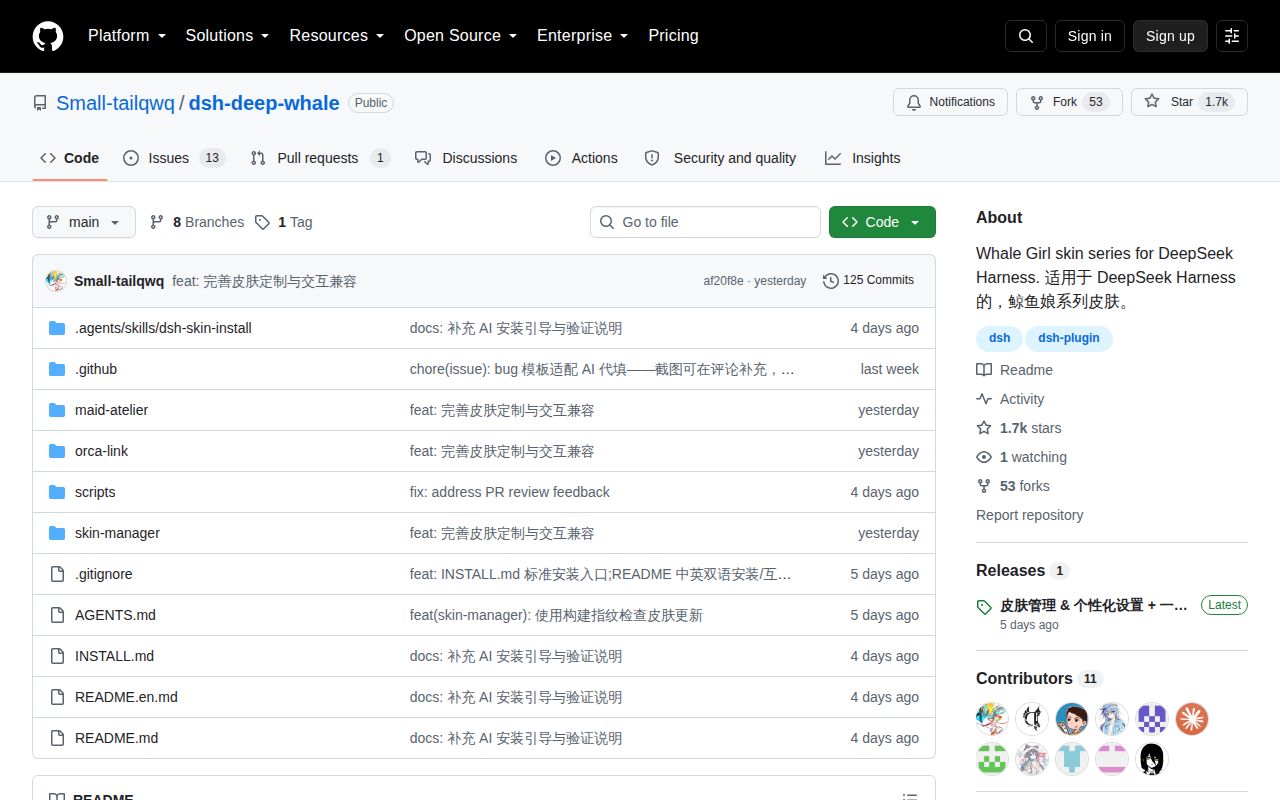
The repository contains Maid Atelier, Orca Link, and a skin manager. Maid Atelier uses deep-sea blue lace, character backgrounds, and a styled sidebar. Orca Link uses a white mechanical cabin, electric-blue signals, and another whale character. Both have light and dark previews. The manager discovers installed skins, switches between them, and exposes their configuration cards inside DSH settings.
Mutual exclusion is essential. Without explicit disabled entries, DSH treats a skin as enabled. Installing both can therefore stack decoration layers, disturb sidebar widths, and even hide the settings control. The manager detects 2 simultaneously active skins on first restart and atomically falls back to the official appearance. After that, a user chooses exactly one skin and refreshes the browser.
Chinese documentation is primary and English is complete
The default README is Simplified Chinese, and it links to an English edition at the top. Both explain the 3-package installation, PowerShell quoting, mutual-exclusion files, local development, browser verification, and recovery from a broken layout. That English coverage makes the project usable outside its main community, although release notes and most issue discussion remain Chinese.
The project was created on August 13, 2026 and had 1,743 stars by the time we fetched it. GitHub listed 14 combined open issues and pull requests, with the last push on August 25. Release v0.1.0 arrived August 21. This is a very young extension moving alongside release-candidate versions of its host, so compatibility work is expected rather than exceptional.
What happened when we ran it
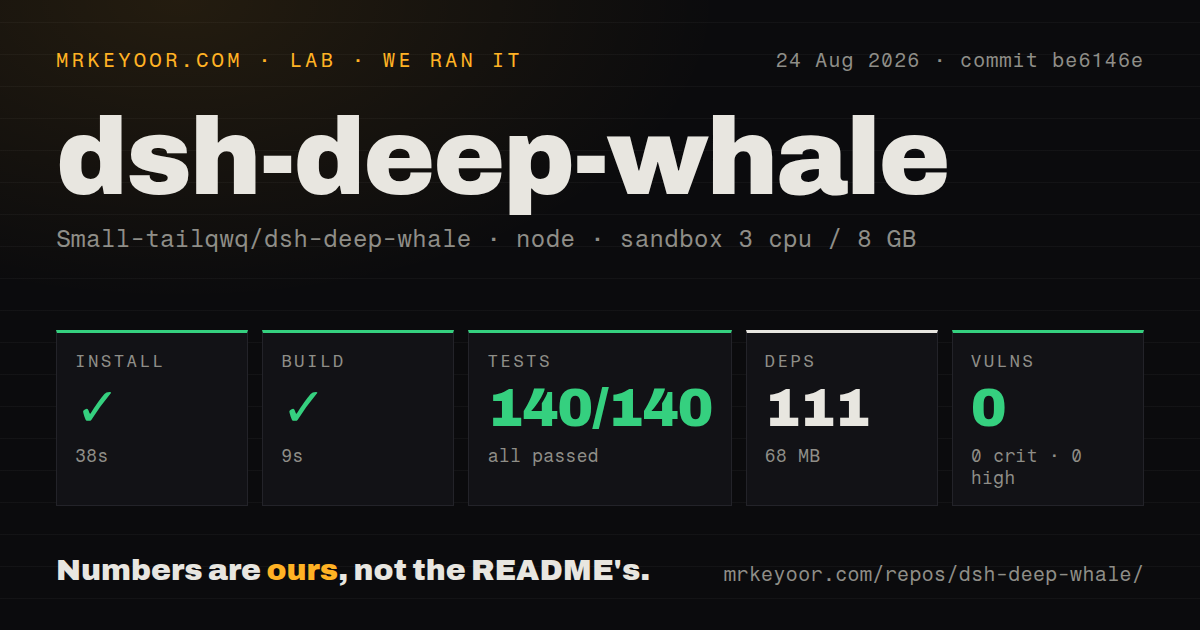
Our sandbox cloned commit be6146e into an unprivileged Node 22 container with 3 CPUs and 8 GB of RAM. The measured project was maid-atelier/, not the manager or Orca Link. npm installed 111 packages in 38 seconds and used 68 MB on disk.
The Maid Atelier build completed in 9 seconds. Vitest then passed 140 of 140 tests in 12 seconds, with 0 failures. npm audit found 0 known vulnerabilities across critical, high, moderate, and low severities. These are clean repository mechanics for the tested skin, but they do not prove every DSH release, browser, resolution, or third-party plugin combination.
The full checkout held 145 files, about 18,294 source lines, and 18.6 MB before dependencies. Our scan found 1 CI workflow file, a tests directory, and no Dockerfile. We did not start DeepSeek Harness, install all 3 subpackages into a real profile, or visually compare the 2 themes across Safari, Chrome, high-density screens, and mobile widths.
pnpm 9 and two patch layers are the setup traps
The recommended command installs the manager and both skins directly from GitHub subdirectories, so cloning is unnecessary. That #path: syntax requires pnpm 9 or newer. The README says pnpm 8 interprets the path as a commit reference and fails. PowerShell also requires quoted specifications because # starts a comment and uses semicolons in the shown command.
DSH stores skin state in both the profile patch and the home patch. The home layer has priority, so editing only one can produce a switch that appears to do nothing. A patch file containing its original [] plus appended list entries is invalid YAML. The manager normally writes both layers; manual recovery should use its staging script or replace the empty array rather than append below it.
Safari and plugin overlays remain the main visual risks
Issue 53 reports that Orca Link on Safari can show the settings mask while leaving the panel invisible when the sidebar is expanded. The report ties the behavior to WebKit stacking contexts and notes that Chrome and Edge did not reproduce it. Maid Atelier had a related issue and fix, while Orca Link was still named as unfixed in this report.
Other extensions can collide with the skins' decoration layers. Issue 77 asks for background-opacity control because plugin interfaces can become hard to read. Pull request 84 describes fixed popups from cost and session plugins being covered by Maid Atelier's top and bottom trim. Its proposed z-index change includes targeted verification, but users should still test the exact plugins they run rather than infer compatibility from 140 unit tests.
The art license rules out commercial use
The skin manager uses MIT, but the artwork-based skins use CC BY-NC-SA 4.0 with an attribution chain recorded in their NOTICE files. The README calls them derivative works and explicitly prohibits commercial use. Redistributed adaptations must retain attribution and use the same license terms. GitHub's repository fact endpoint does not identify one repository-wide license because the packages differ.
For a personal DSH profile, the choice is simple: the skins are distinctive, reversible, and the tested package passed in 12 seconds. A company product should stay with the official interface or obtain separate permission. Users wanting more theme choices and a workshop model should compare dsh-web-ui, which the README credits as the source of the skin scaffolding.