Background
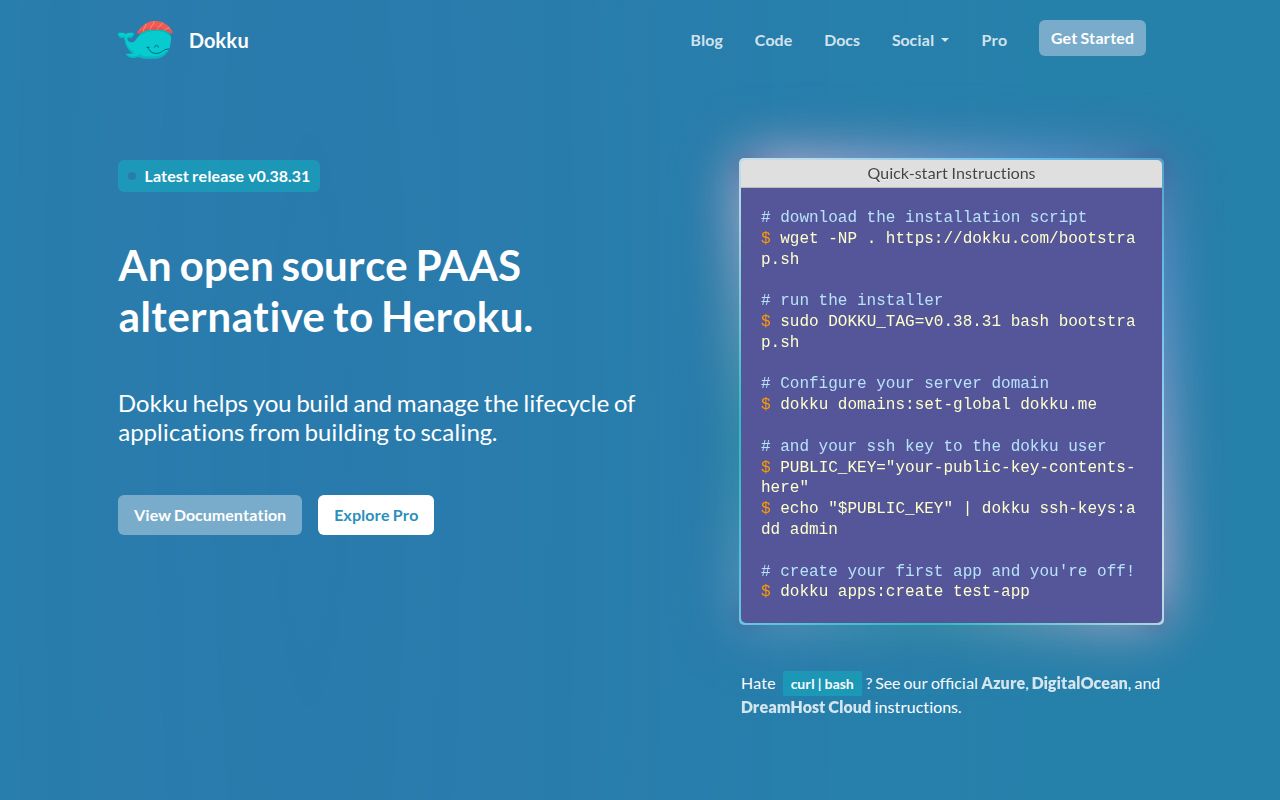
Dokku has been around since 2013, created as an open-source clone of Heroku's deploy workflow. It is a collection of shell scripts and plugins that turn a single Linux server into a mini platform-as-a-service. You install it, add your SSH key, create an app, and then git push dokku main to deploy. Under the hood it builds a Docker image from a Heroku-compatible buildpack or a Dockerfile, runs the container, and configures an Nginx proxy to route traffic. The project claims to be 'the smallest PaaS implementation you've ever seen', and at roughly 58,695 lines of source in 1,622 files, it is compact compared to Kubernetes or Cloud Foundry. The README lists sponsors and backers, indicating an active donation model.
Dokku solves a real problem: small projects and solo developers often want the convenience of git push deploys without paying for Heroku or managing an entire orchestrator. One virtual private server with 2GB RAM can host a handful of small apps, each with its own domain, SSL certificate, and zero-downtime deploys. The project has 32,127 GitHub stars and only 45 open issues at the time of writing.
What happened when we ran it
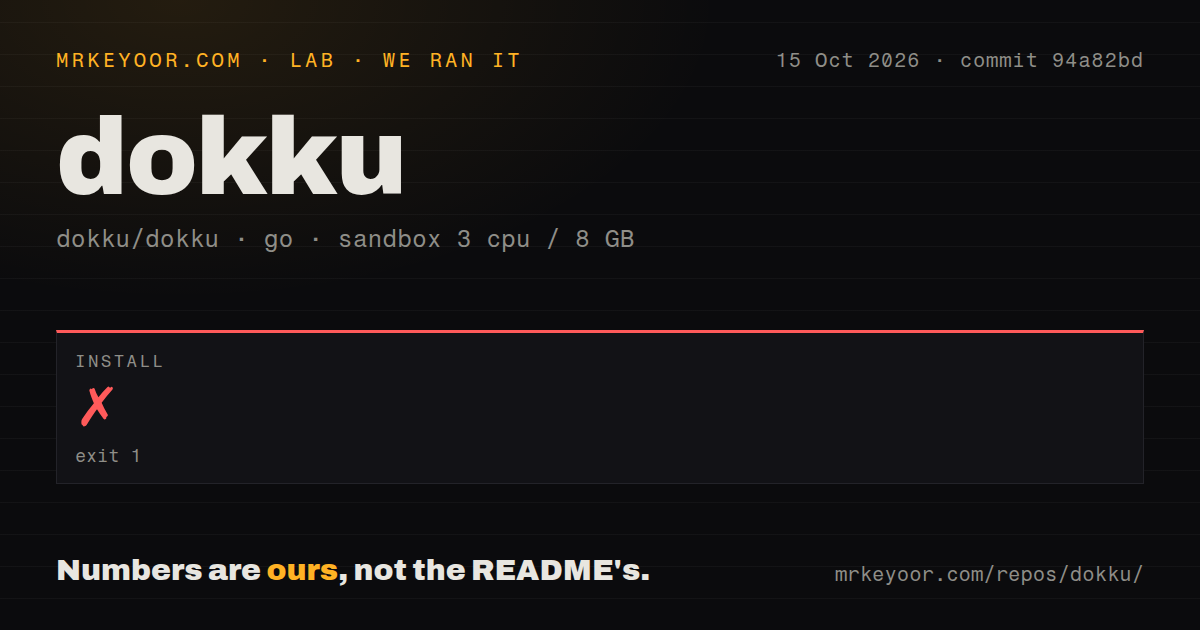
We cloned the repo at commit b29bf2e and attempted to install it in a sandbox on 2026-09-07. The sandbox had 3 CPUs, 8GB of RAM, no secrets, and ran an unprivileged Debian container with the Go 1.24 toolchain. The install step failed after 227 seconds with exit code 1. Our run's log ends with a wall of Go errors: k8s.io/cri-streaming@v0.0.0: invalid version: unknown revision v0.0.0, and the same for csi-translation-lib, kubelet, mount-utils, and several other Kubernetes modules. The repository includes a Go component, the app-json plugin, which appears to depend on a Kubernetes module set that no longer resolves the pseudo-version v0.0.0. The main Dokku project is mostly shell, but this Go plugin broke the install on our box.
That failure does not mean Dokku is broken everywhere. The official install path is a bootstrap.sh script designed for recent Ubuntu releases, and our Debian sandbox with a stock Go image may be missing system packages or using an incompatible Go version. The README's installation instructions are brief and assume Ubuntu; they do not mention the Go toolchain or how to build the app-json plugin from source. So our measured failure is a finding about setup reality: if you drift from the supported Ubuntu bootstrap, expect to debug Go module resolution. The install took 227 seconds before failing, which is not a quick one-command setup on our environment.
What makes Dokku attractive
If you use the supported installation path, Dokku offers a lot for a single host. You get git push deploys, automatic Nginx configuration, Let's Encrypt SSL via a plugin, and a plugin system that extends the core. The README references plugins for Postgres, Redis, and other services. Multiple apps can coexist on one server, each with its own port and domain. There is also a scheduler for zero-downtime restarts and process scaling within the host.
The project has been stable for over a decade. The latest release, v0.38.27, was tagged on 2026-08-12, less than a month before our review. The last push to the repository was on 2026-09-07, the day before our run. With 32,127 stars and 45 open issues, the community is large and issues appear to be addressed quickly. The documentation site at dokku.com is extensive, with installation guides, deployment tutorials, and plugin references. The README contains a lengthy list of sponsors and backers, suggesting a healthy funding stream.
The rough edges
Dokku is not a multi-host orchestrator. It runs on one server, and if that server dies, all your apps die with it. There is no built-in high availability, autoscaling, or clustering. Backups are manual unless you script them. The plugin ecosystem is broad but uneven; some plugins are maintained, others stale. The Go plugin that broke our install illustrates a deeper issue: while the core shell scripts are well-tested, the newer Go-based components may drift and break in environments that are not exactly Ubuntu with a specific Go version.
The CLI is powerful but text-based. There is no official web dashboard, so if you or your team need a graphical interface to deploy, restart, or view logs, you will need a third-party tool or use the command line. The install experience, at least on our Debian box, was not smooth. We measured a 227-second failure, not a quick win. For users who are not comfortable debugging Go module errors or Nginx configs, that is a real barrier.
Community health and release cadence
Dokku's community is active. The repo has 6 CI workflow files and a tests directory, indicating continuous integration. The last push on 2026-09-07 shows ongoing development. Releases are cut regularly: v0.38.27 on 2026-08-12, roughly 4 weeks before our review date. The low open issue count of 45 for a project with 32k stars suggests responsive maintainers and a mature codebase. The Slack group and documentation site are linked from the README, and the OpenCollective sponsors indicate financial support. In short, this is not an abandoned project. Even if our sandbox install failed, that failure is likely a temporary dependency issue, not a sign of decay.
Where Dokku fits in a real stack
Dokku fits behind an existing gateway, not in front of one. It replaces Heroku for single-host deployments. If you have a $5 to $20 per month VPS and a few small apps, Dokku gives you deploy automation, SSL, and process management without the overhead of Kubernetes. It is not a replacement for a multi-node cluster, and if you need to scale beyond one server, you will outgrow it. In that sense, it is a stepping stone: start with Dokku, move to CapRover or Coolify when you need a UI, and only adopt Kubernetes when you have a team and multiple hosts.
For most self-hosters, the Ubuntu bootstrap script is likely to work, despite our Debian failure. But if you value a one-command install on any Linux distribution, CapRover or Piku may be easier. CapRover adds a web dashboard and one-click app templates. Coolify is a more modern UI-driven alternative with automated SSL. Piku is a minimal buildpack-only option with no Docker required. Each trades off some of Dokku's leanness for easier setup or a friendlier interface.
Bottom line
Dokku is a proven single-host PaaS with a decade of development and a large, active community. Our sandbox run failed after 227 seconds due to Go module resolution in the app-json plugin, which means setup can be tricky outside the recommended Ubuntu path. If you stick to Ubuntu and the official bootstrap script, you will likely get a reliable git push deploy platform. For most small projects, that tradeoff is acceptable. But if you need a graphical interface or multi-host scale from day one, look elsewhere.