Discord.js 14 gives Node bots a complete client
Discord.js 14.27.0 wraps Discord's gateway and HTTP APIs in a Node client with typed events, structures, permission helpers, interaction responses, and caches. The main package suits bots that must stay connected and react to commands, messages, member changes, or voice state. Its object model saves application code from decoding raw gateway payloads and maintaining every related entity by hand.
That convenience creates state. The v14 guide explains that intents decide which events arrive, and those events keep internal caches current. Omitting an intent can leave a message or interaction with only guild and channel IDs instead of full objects. The library works best when you want that managed client model. If a job sends one webhook or makes a few HTTP calls, a persistent gateway connection and object cache solve a problem you do not have.
Fourteen packages let you choose a narrower layer
The README lists 14 packages, including the assembled discord.js client and smaller pieces for REST, WebSocket, builders, collections, formatting, core structures, RPC, and voice. That split is useful architecture rather than catalog padding. A service that only registers commands can use @discordjs/rest; an infrastructure team can build around @discordjs/core and @discordjs/ws without accepting every behavior of the high-level client.
The repository still develops all 14 packages together. Contributors install a pnpm workspace, build through Turbo, and run shared checks. The measured checkout contained 1,820 files and about 142,401 source lines before dependencies. That is appropriate for maintainers changing API types, documentation, voice, and transport code in one revision. It is needless weight for an ordinary bot, which should install the published package rather than clone the monorepo.
What happened when we ran it
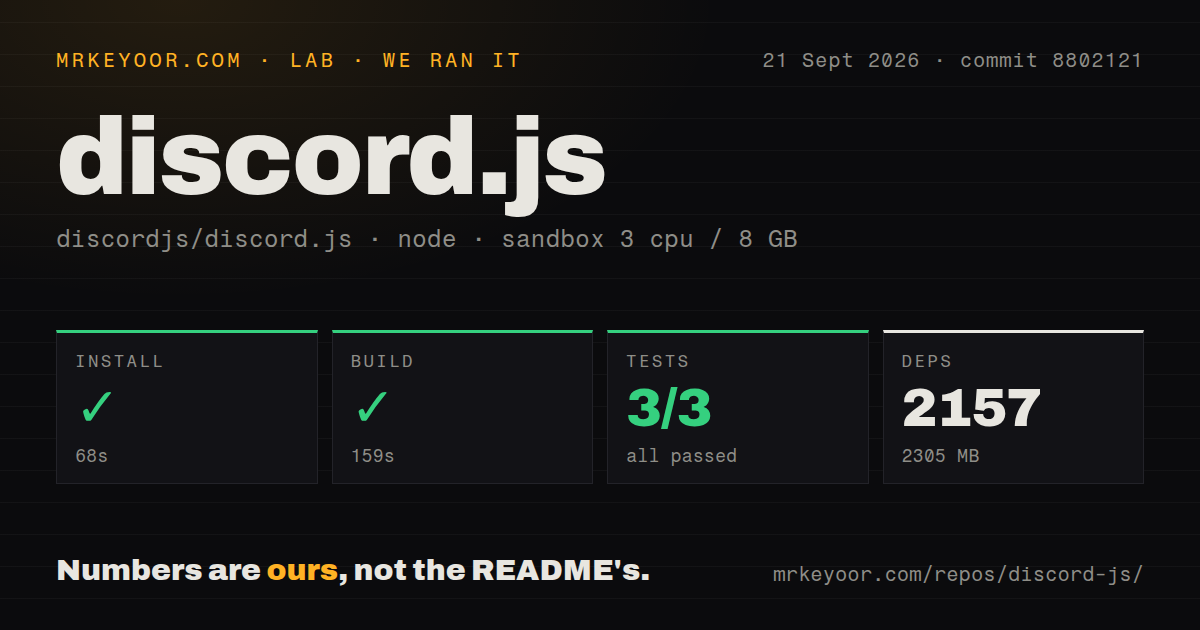
In our run, we measured a 68-second install for 2,157 pnpm packages. Dependencies occupied 2,305 MB, compared with a 14.8 MB checkout. The build completed successfully in 159 seconds, and the test command finished in 53 seconds. Vitest reported 3 passed and 0 failed out of 3. Our measurement setup used commit 8802121 in an unprivileged lab-node:22 container with 3 CPUs, 8 GB of RAM, and no secrets.
The run proves that the supplied workspace installed, built, and passed its available test target in our container. It does not measure gateway latency, reconnect behavior, cache memory, REST throughput, voice quality, or a production bot. The repository had 15 CI workflow files, no root Dockerfile, and no tests directory even though the test command ran Vitest workspaces. We found no failed step to explain, and the lab block supplied no dependency audit result.
The source workspace costs 2,305 MB before bot code
A normal user does not need the 2,305 MB contributor environment. Stable release 14.27.0 declares Node 18 or newer and installs from a package manager. By contrast, the measured main commit requests Node 24.17.0 or newer and pnpm 11.25.0. Our lab-node:22 image completed install, build, and tests, which shows pnpm did not turn that engine mismatch into a failed step in this run. It does not erase the manifest requirement.
Runtime setup also needs a Discord application and token. The client refuses to start without gateway intents, and the guide names 3 privileged groups: presences, message content, and guild members. Smaller unverified bots can enable them in the developer portal under the documented conditions; verified bots may need approval. Enable only the events the product uses, because extra traffic increases bandwidth and memory while sensitive intents expand the data your process receives.
Cache controls can save memory and break behavior
Discord.js 14.27.0 offers cache size limits and scheduled sweepers, but its guide labels this an advanced topic. Several managers, including guilds, channels, roles, and permission overwrites, cannot be customized safely. Even supported reductions need care: removing reactions or old messages can change what later event handlers find. A cache policy belongs in load tests and feature tests, not in a copied configuration block.
Open issue 11546 gives that warning a concrete edge case. The reporter found that a guild left during a sharding disconnect could remain cached after the session resumed. Issue 11626 reports a separate 14.27.0 readiness problem: isReady() stayed true during a 38-minute reconnect loop with 3,651 shard errors and 0 successful reconnects. Both reports remain open, so production health should include actual shard state and useful Discord operations instead of one boolean.
Sharding works on one machine before it becomes infrastructure
The v14 guide says Discord requires sharding at 2,500 guilds and suggests preparing around 2,000. Discord.js can launch separate processes or worker threads through ShardingManager, while internal sharding opens several connections in one process. The guide warns that internal sharding can consume too much memory for larger bots. Statistics and caches become shard-local, so even a server count must collect values across processes.
Cross-machine deployment is less packaged. The guide says you can pass shard choices to each client, but distributing processes and sharing information are the operator's job. At that size, plan a coordinator, durable state, deploy sequencing, rate-limit behavior, and shard-aware health checks. Discord.js supplies protocol clients and useful process helpers. It does not supply a cluster control plane.
Release 14.27.0 is maintained, with live operational bugs
Release 14.27.0 shipped on July 15, 2026, and added voice messages alongside API and typing fixes. The repository was pushed on September 21, while issues and pull requests were updated through that date. GitHub reported 163 open issues and pull requests. That combined number includes proposals and patches, so it is evidence of a busy queue rather than a count of confirmed defects.
For most Node teams, Discord.js remains the practical first library to try because the guide follows the same problems a bot meets as it grows. Our 68-second install and passing build make the source credible for contributors, while the 2,305 MB footprint argues for published packages in application work. Use its higher-level client when you need the state it manages. Choose REST, Discordeno, or another language library when you do not.