The directory offers breadth, not an editorial ranking
Developer Portfolios is a long alphabetical README filled with links to personal sites. Entries may include a role or specialty after the person's name, but there are no scores, screenshots, design notes, technology filters, or staff picks. That makes it useful for open-ended browsing. It is less useful for someone asking which portfolio structure works best for a backend engineer, student, designer, or consultant. The reader has to build that shortlist.
The README reported 1,949 portfolios when we reviewed commit 618a348. Its sections run from A through Z, and the entries range from personal domains to GitHub Pages, Vercel, Netlify, hosted builders, and a few repository links. The variety is the asset. It exposes restrained resumes, elaborate interactive sites, terminal themes, role-specific pages, and unfinished-looking submissions in one place, which gives a more honest view than a gallery containing only award candidates.
Live examples teach more than a stack of templates
A finished personal site reveals choices that template screenshots hide: what appears above the fold, how quickly work samples become visible, whether case studies explain decisions, and how contact details compete with animation. Browsing several entries in the same professional niche can help a developer notice common information patterns without copying one person's visual identity. It can also show which fashionable interactions become tiring after repeated use.
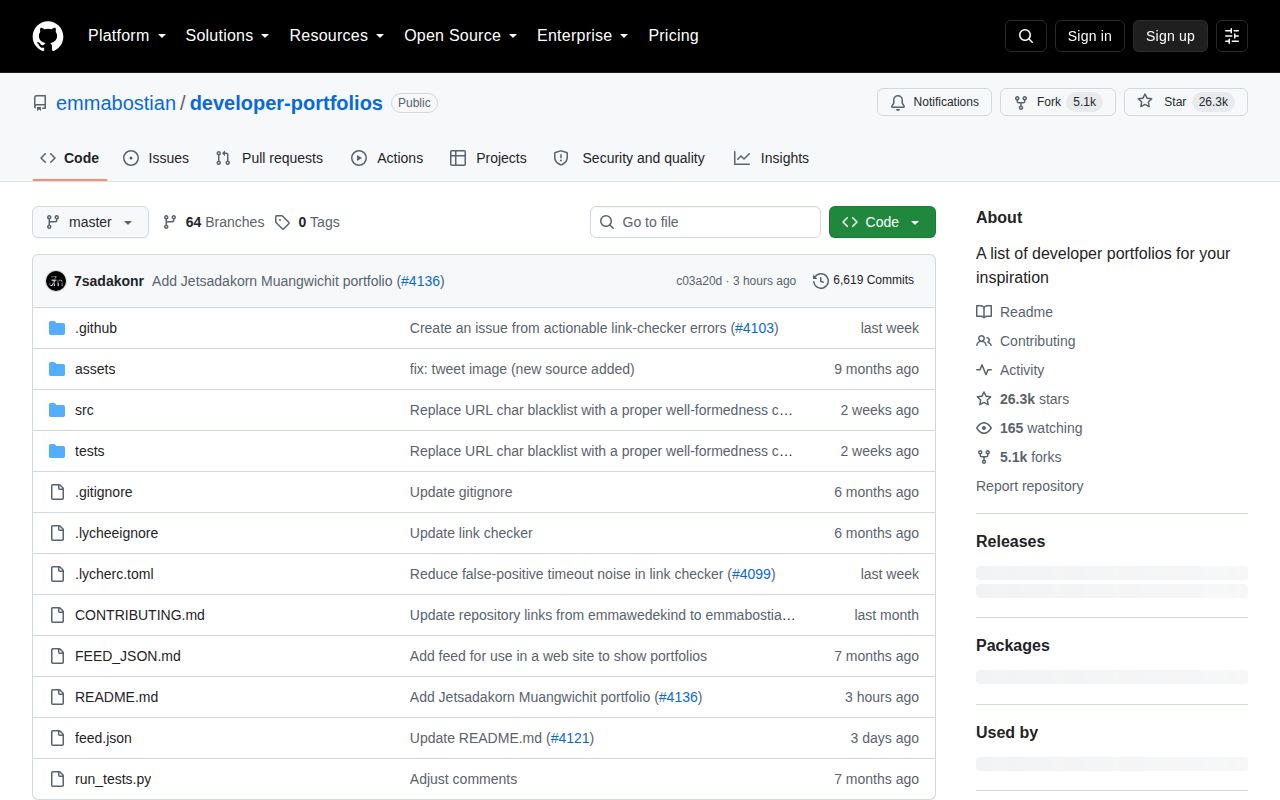
The 0.6 MB checkout holds only 25 files, so this is not a theme collection. Most entries link to deployed sites, and the directory does not promise access to their source code. A design may use copyrighted art, paid fonts, private components, or a custom CMS. Treat each portfolio as a reference, not as a licensed starter. The repository itself also had no license reported by GitHub, which limits assumptions about reusing the compiled dataset.
What happened when we ran it
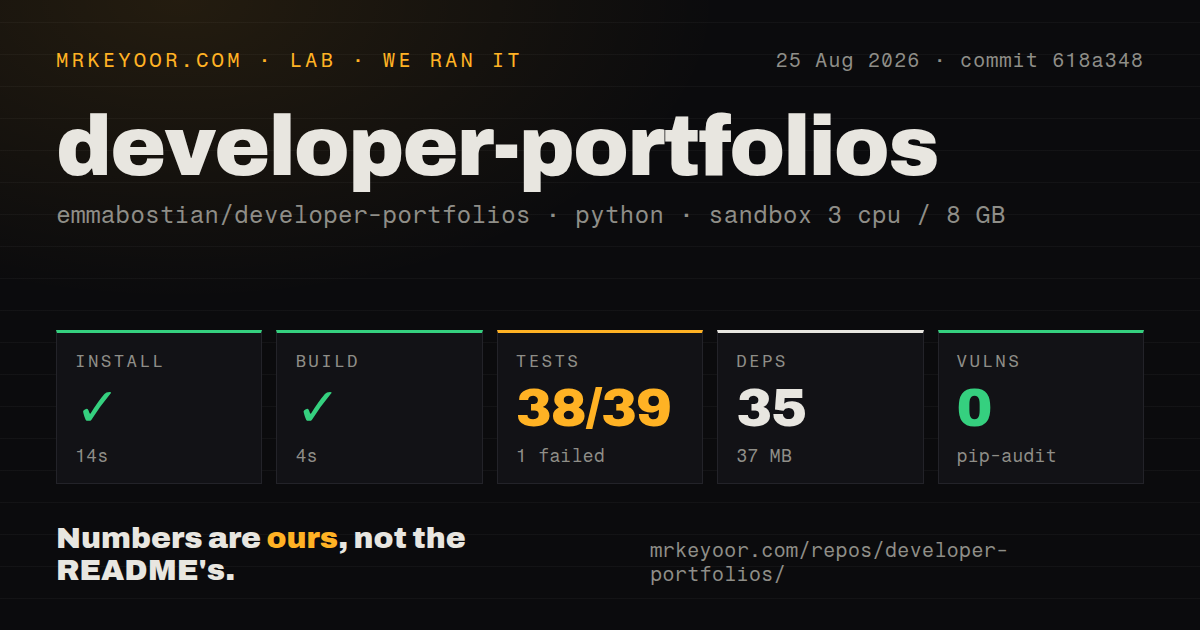
Our Python install completed in 14 seconds, installed 35 packages, and used 37 MB on disk. The build succeeded in 4 seconds inside an unprivileged Python 3.12 Bookworm container with 3 CPUs, 8 GB of RAM, and no secrets. A pip-audit scan reported 0 known vulnerabilities. These numbers fit the repository's small maintenance-script role rather than a hosted application stack.
Pytest finished in 7 seconds with 38 tests passing and 1 failing out of 39. The failed case was test_strip_aaa_prefix_token. It expected a name token to become [Aaajohn Doe], but the function returned [AaaJohn Doe]. That is a narrow, reproducible title-normalization mismatch. The output also contained 2 warnings because feed tests returned values instead of using assertions alone.
The repository had 2 CI workflow files, a tests directory, and no Dockerfile. The workflows check links and parking redirects, while local scripts cover alphabetical placement, duplicates, URL format, emoji, feed generation, and related cleanup. Our successful 4-second build does not test the availability or content of 1,949 remote websites. It only confirms that the repository's build step completed in the measured environment.
Weekly link checks cannot make a live directory timeless
The contribution checklist requires submitters to open their link and confirm that it is neither broken nor a parked domain. A scheduled workflow runs every Saturday to identify links that later fail or redirect to domain-sale pages. That is better maintenance than accepting submissions forever and never revisiting them. It still leaves a gap between a portfolio changing hands and the next successful check and removal.
With 1,949 external destinations, link decay is part of the product. A domain can expire, a hosting account can disappear, or a once-personal site can become unrelated content. Automated checks may also see bot blocks or temporary outages. Researchers using feed.json should record a retrieval date, validate URLs for their own purpose, and avoid treating absence from a weekly failure report as proof that a destination is safe or still belongs to the named person.
Contribution rules are simple, while normalization is opinionated
A contributor forks the repository, creates a branch, inserts one Markdown entry in strict alphabetical order by first name, and opens a pull request. The listed format is a name, URL, and optional title or expertise. Contributors are told not to edit feed.json because automation regenerates it. This is approachable for a first pull request and keeps the primary data readable without a database editor.
The failed 7-second test reveals the cost of automatically rewriting names. Capitalization is identity data, not ordinary prose, and AaaJohn versus Aaajohn may reflect a person's chosen spelling rather than an algorithmic correction. The scripts also handle accented characters, standalone prefixes, duplicates, and section placement. Maintainers should fix the test disagreement, then keep transformations conservative. Sorting can be automated without forcing every name through title-case rules.
Current updates matter more than a missing release tag
The repository was pushed on August 26, 2026, and GitHub showed 0 open issues and pull requests in its combined count. The latest-release endpoint returned no GitHub Release. That is reasonable for a continuously updated directory, where each accepted portfolio changes the data without needing a packaged version. Consumers who need stable snapshots should pin a commit rather than wait for semantic releases that the project does not publish.
Our build passed in 4 seconds, the audit found 0 known vulnerabilities, and only 1 of 39 tests failed. Those are good maintenance signals for the scripts, while the directory's real quality depends on outside websites and human selection. Use Developer Portfolios to gather patterns and counterexamples quickly. Use Portfolio Ideas for a smaller gallery or Awesome Portfolio Websites when the next step is adapting an actual codebase.