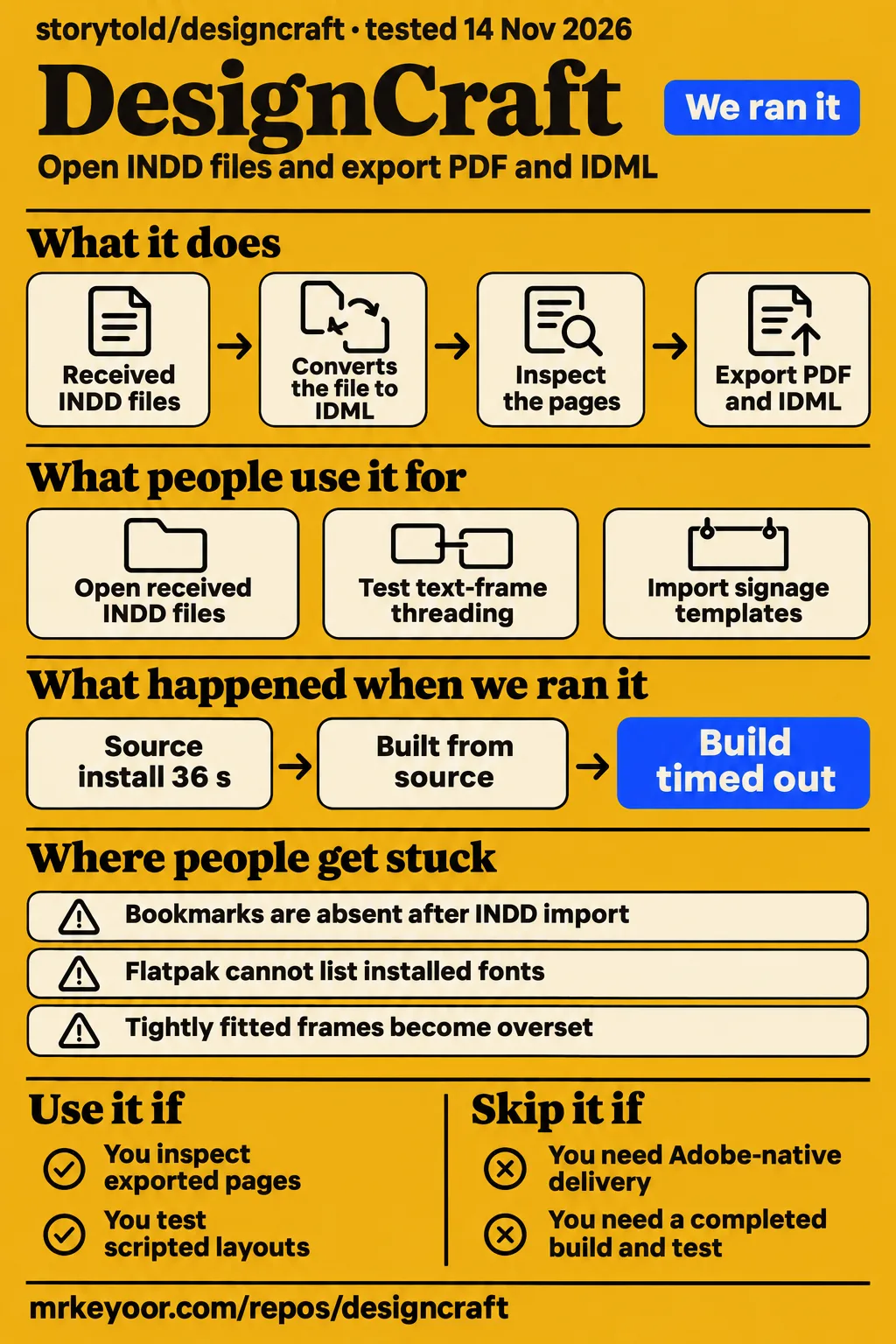
DesignCraft opened a collaborator's INDD file for one user, while an import follow-up reported missing bookmarks and hyperlinks. Opening a document and preserving everything needed for delivery are separate outcomes. Designers exploring received files and developers testing bounded scripted layouts have concrete tasks to try here. Teams requiring reliable Adobe-native delivery on a deadline should retain their required workflow. Our source run installed dependencies in 36 seconds, then build and tests reached separate 900-second limits.
DesignCraft opens layouts through an IDML conversion path
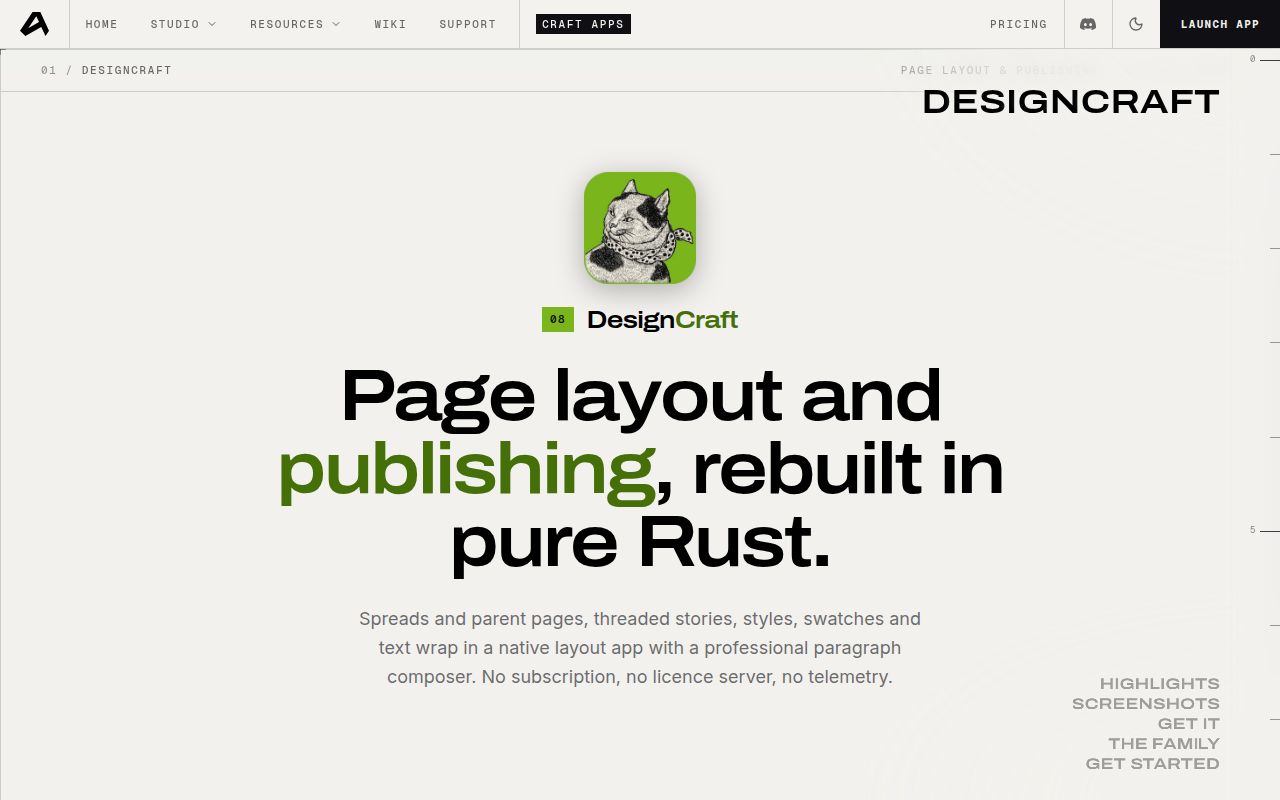
DesignCraft is ArtCraft's Rust desktop publishing application, with documented INDD import, IDML interchange and MCP control. The upstream README lists threaded text frames, paragraph and character styles, parent pages, tables and text wrap. It also describes native desktop and browser builds and labels the roadmap stage pre-alpha. Designers can begin with a received layout; developers can investigate creating and editing documents through commands.
The INDD integration converts the file to IDML in memory, then sends it through DesignCraft's existing importer. The closing comments in issue #114 identify indd-utils, include INDT templates and say converter warnings appear during import. Keep the original file and its reference PDF beside the converted document. Compare the pages, then inspect structures that a page image alone cannot show, including bookmarks and hyperlinks.
What people use designcraft for
Users have opened received INDD files, scripted text-frame threading and imported publication layouts. teszeract's successful file open is an access example; director-LAC's counted export is a text-flow example. The signage and workbook reports identify harder import tasks. Together, these examples suggest useful evaluation documents: a received file, a short threaded story and an existing template with tightly fitted text.
| Person and task | Reported outcome | Decision it helps with |
|---|---|---|
| teszeract on r/ArtCraftAI opened a collaborator's proprietary INDD file | The file opened; previously the user requested IDML for Affinity | Try a received file with its reference PDF beside it. teszeract's INDD report |
| director-LAC tested scripted frame threading | The exported PDF contained all 40 test words, and reopening the exported IDML kept the thread | Use a short, countable story to evaluate text flow. Threading checks in issue #140 |
| The reporter of issue #180 imported production signage templates | DesignCraft 0.4.0 reported 21 to 54 overset frames per template against none in InDesign | Include tightly fitted display text in an import comparison. Signage report |
| gnacef-hub imported a 166-page English/Arabic workbook | DesignCraft reported 356 overset stories against seven in InDesign | Compare labels, threaded stories and table endings. Workbook report |
The threading contributor checked the exported files as well as the canvas. Their test placed 40 numbered words in an 84 pt frame threaded to an empty 350 pt frame. The exported PDF contained all 40 words with no overset; the same file without the thread contained 10 of 40. Reopening the exported IDML preserved the relationship between frames. The issue #140 follow-up gives developers a small acceptance check with an explicit expected result.
What happened when we ran it
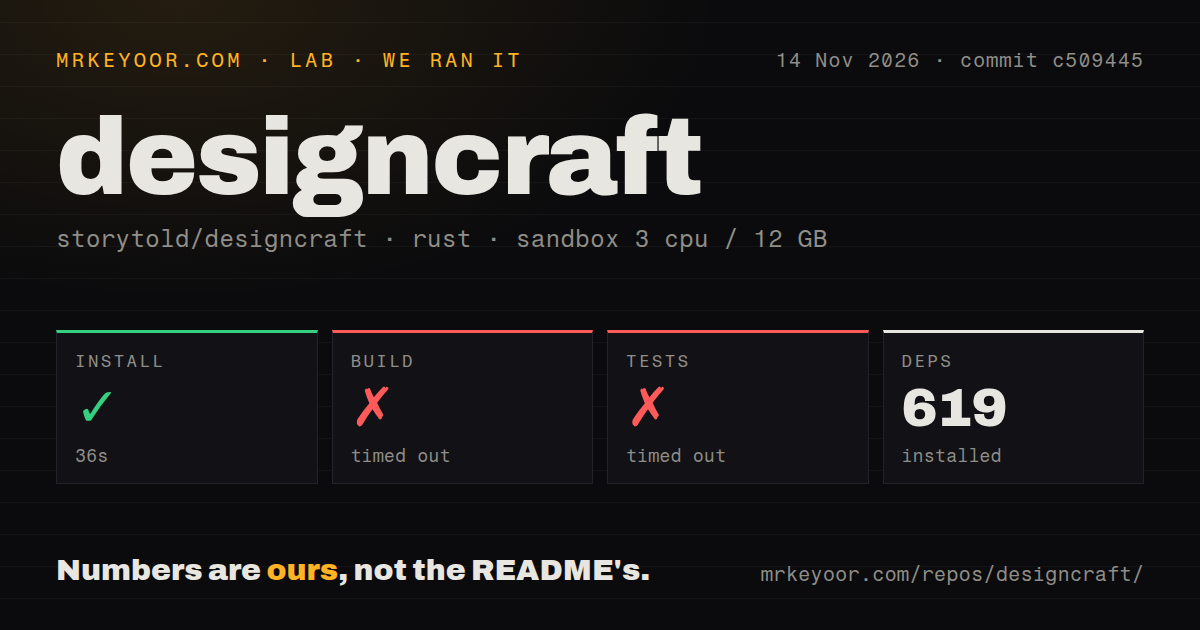
Our run installed dependencies in 36 seconds, then build and tests each timed out at 900 seconds. We cloned commit c509445 on November 14, 2026 in a sandbox configured with 3 CPUs, 12 GB RAM and image lab-rust:1. The checkout contained 870 files, approximately 337,831 source lines and 27 MB. The measurement block recorded 619 dependencies. These figures describe our source checkout and runner configuration.
| Recorded step or observation | Result | What it tells you |
|---|---|---|
| Dependency installation | Succeeded in 36 seconds; 619 dependencies recorded | Dependency setup completed in this sandbox |
| Build | Timed out at 900 seconds | The command reached its time limit |
| Tests | Timed out at 900 seconds | The command reached its time limit while the supplied tail showed compilation |
| Repository scan | Eight CI workflow files, no Dockerfile, no tests directory | These are checkout file-layout observations |
The last test-log lines show compilation of accesskit_unix, accesskit_winit, webbrowser, smithay-clipboard, arboard and winresource. They then name DesignCraft 0.20.1, egui-winit 0.37.0 and eframe 0.37.0 from the pinned egui fork, followed by the document, color and geometry crates at 0.20.1. The tail contains compilation messages rather than a failing assertion. The exact checkout identifier for this run is c509445; the log's package version is 0.20.1.
A separate hands-on attempt failed its safety step because none of compose.yaml, compose.yml, docker-compose.yaml or docker-compose.yml existed. The failed safety record identifies the missing Compose file as a runner requirement. The run header describes deployment through the project's own Compose stack, contradicting that failed step. The teardown record says cleanup was okay. The failed safety step is the concrete outcome of this attempt.
The README recommends downloading the application from the ArtCraft app page and also links to GitHub releases. Its source quick start requires Rust 1.95 or newer. Designers therefore have a documented package route, while contributors have a source route. Our dependency installation completed on the latter route before the two timeouts. The download instructions are the practical starting point for someone evaluating the editor.
Where people get stuck: match the fix to the symptom
Issue #140 confirms text-threading fixes, and issue #185 confirms object copy/paste shortcuts on Windows and Linux. Font and installer reports describe different symptoms and remedies. Start with the operation that failed and the package being used: a canvas object shortcut, a missing font in Flatpak and a Windows installer process involve different paths, even when they interrupt the same publishing task.
| Symptom | What the record says happened | Useful next action |
|---|---|---|
| Red overflow port does not continue text | Issue #140 closed after PR #84 and PDF/IDML follow-up checks | Match the installed build to the threading change. Issue #140 |
| Ctrl+C/Ctrl+V does nothing to selected objects | Issue #185 closed as fixed on main after PR #84 for Windows and Linux object shortcuts | Use the object-shortcut reproduction when comparing behavior. Issue #185 |
| macOS fonts are absent and imported text is pink | The original reporter confirmed font detection and associated IDML symptoms resolved in 0.4.0 | Compare the font menu and imported styles separately. Issue #110 |
| Flatpak cannot list installed fonts | Users confirmed a persistence and host-font-symlink workaround in 0.17.1 and 0.17.2 | Read the packaging-specific workaround. Issue #1672 |
| Launcher reports Windows errors 2503/2502 and 1603 | The reporter installed manually as administrator; a later commenter reports failure with and without elevation | Compare the failure with the Launcher report. Launcher issue #803 |
| A subsequent Windows attempt reports 1618 | The reporter describes a hung msiexec process blocking later attempts | Inspect the earlier installer process before repeating installation. Launcher issue #803 |
The Flatpak follow-up says the font cache could see fonts that DesignCraft did not list. Users reported success with --persist=.fonts and symlinks to /run/host/fonts, /run/host/local-fonts and /run/host/user-fonts. Issue #110 also contains a separate report in which bullet or numbered-list markers and their following space became magenta despite ordinary system fonts appearing correctly. Select the relevant font discussion before changing the installation.
Image-heavy layouts and tight frames deserve an export check
Issue #1411 reports severe freezes in DesignCraft 0.13.0 with a 177 MB document containing 31 pages and 27 images. schirrmacher's MCP investigation reports thumbnail rendering taking roughly five seconds, including a repeated render. Other comments describe difficulty moving or resizing images. The image-performance thread makes image manipulation and the Pages panel useful parts of an evaluation alongside the initial file open.
Issue #180 describes visible text disappearing when a tightly fitted frame becomes overset. One reported headline used 44 pt type with 53 pt leading in a 43.6 pt frame; enlarging the frame to 60 pt made it appear. A recheck on main fc36957f still reported the fixed-size case as overset after auto-size work. The same discussion reports taller table rows pushing final rows outside their frame. Compare these text-fitting examples with the exported document.
Use a copy of a familiar document and retain its reference PDF. Compare short labels, the final line of threaded stories and the last row of each table. Issue #114 describes empty graphic frames when linked source files cannot be read on the importing machine, so include a linked asset in the comparison. Reopen the exported IDML as the threading contributor did. This procedure gives each inspection an expected result.
MCP separates headless editing from desktop interaction
The MCP reference documents a headless engine and a connection to the running desktop application. Headless mode creates and edits documents without a window; connected mode works through the application's control channel. The MCP mode table assigns window tools such as screenshot, click, drag and dialog controls to connected mode. Choose the mode according to whether the task requires document operations or interaction with the desktop interface.
The documentation provides separate --automation-read-root and --automation-write-root flags for file access. Supplying only a read root grants no disk writes. Those flags apply to the in-process server, and combining them with --connect returns an error. For a headless document task, select existing project and output directories and give each the appropriate access. The file-access reference explains how the server checks paths.
Director-LAC's threading check provides a concrete export task: place known text, connect frames, export PDF and IDML, then inspect both results. ManOnTheHorse also described daily MCP use enthusiastically while reporting editing complaints in the workspace discussion. For a first scripted layout, define the required words, frames and output before running it. The counted story offers a clear starting point for that task.
The shared security analysis came from AI
New_Possibility2083 clarified that the findings after the summary were AI-generated. In the r/ClaudeCode discussion, another participant questioned changes between first-person and third-person wording, and the author acknowledged copying the summary without changing its pronoun. Attribute the findings to the AI-generated analysis when discussing them. That correction explains who produced the reassuring conclusions shared in the post.
The upstream README says there is no telemetry, and the MCP reference documents configurable file-access roots. For someone setting up automation, the roots provide an immediate configuration choice: which documents the server can read and where it can write exports. Read access and write access are separate. Give a directory both permissions only when the task calls for both, following the MCP configuration reference.
DesignCraft vs InDesign, Affinity and LibreOffice Draw
The comparisons turn on document access and handoff requirements. teszeract previously requested IDML for Affinity, then opened a proprietary INDD file in DesignCraft. The fan guide recommends retaining Adobe workflows where delivery depends on them, while issue #700 concerns old Publisher files. Choose the comparison that matches the file you receive and the output another person expects from your work.
| Alternative | Evidence behind the choice | Pick it when |
|---|---|---|
| Adobe InDesign | The fan guide advises retaining Adobe workflows when print requirements, templates or automation depend on them. Fan guide's handoff advice | Your delivery chain requires Adobe-native documents |
| Affinity | teszeract previously requested IDML for Affinity, then reported opening an INDD file in DesignCraft. User's access comparison | Affinity already serves your work and collaborators supply the interchange files you need |
| LibreOffice Draw | setzor describes Draw as unsatisfactory for old Publisher files; the importer later announced in the thread belongs to NiftyDesign. Publisher discussion | You are comparing converted copies of your legacy Publisher documents |
The Affinity workspace discussion records competing preferences. Some participants want raster, vector and layout operations inside one window; others prefer separate applications. The workspace thread helps identify which arrangement a reader wants. The upstream README lists PhotoCraft, VectorCraft and DesignCraft separately. List the operations you repeat and the files you exchange, then compare that arrangement with the workflow you already use.
Documentation earns 4/5 on the stated editorial rubric
Documentation receives 4/5 because the README and MCP reference describe download routes, operating modes and file-access controls. The rubric is: 1 for purpose only, 2 for partial instructions, 3 for a documented main route, 4 for detailed routes and operating limits, and 5 when those routes have also been independently exercised. The README and MCP reference support category 4 with specific installation and configuration instructions.
Maturity receives 2/5 on a separate rubric: 1 for a concept, 2 for an explicitly early-stage application with reported delivery defects, 3 for a completed representative workflow in our lab, 4 for repeated delivery checks and 5 for sustained production evidence. The README's pre-alpha designation and the text-fitting reports support category 2. Setup and community render as N/A, with the assessment gaps collected in the final section.
What the other reviews get wrong
The README describes multithreaded rendering and cached composition; issue #1411 reports freezes while manipulating an image-heavy document. Architecture and responsiveness during that operation are different questions. Use the performance report to choose an evaluation workload that includes moving images and rendering page thumbnails. A feature list alone gives a reader no result for those interactions with their document.
The fan guide says DesignCraft covers publications made from a user's own copy and images, but issue #180 includes a fitting failure in layouts authored directly in DesignCraft. Starting with a new document therefore does not automatically avoid that reported problem. Keep the guide's handoff advice and compare the exported pages. The fan guide and text-fitting report support a recommendation tied to the document being delivered.
The browser landing page describes IDML rather than proprietary INDD, while the desktop implementation comments explicitly describe opening INDD and INDT through indd-utils. Keep that distinction attached to the relevant interface. This review covers storytold/designcraft, the measured checkout and issue repository. Its upstream README anchors the application identity, and the desktop integration discussion describes the conversion route.
FAQ
DesignCraft's README documents INDD import, IDML interchange and MCP control, while users report both successful access and missing content. The questions below address repository identity, downloads, file handling and recurring workflow problems. Start with the task you need to complete: opening a received file, creating a scripted layout or supplying a document to another person. Then follow the matching documentation or issue discussion.
What is DesignCraft, and which similarly named product does this review cover?
This review covers storytold/designcraft, ArtCraft's Rust page-layout and publishing application. Its upstream README identifies the product and team and lists the other Crafting Apps separately. Match that repository when following installation instructions or issue reports. Search results also contain unrelated businesses and products using similar names, so the repository is the useful identity check for this application.
Where can I find the DesignCraft GitHub project and download the app?
The project is storytold/designcraft. Its README recommends the ArtCraft application page for downloads and also links to GitHub releases. Platform packages are listed separately from the Rust source quick start. Select the package for the machine on which you intend to inspect and export documents, and retain its version in any reproduction report.
Is DesignCraft a useful alternative to InDesign or Adobe's creative software?
Designers exploring received INDD files and developers testing bounded scripted layouts have concrete examples to follow: teszeract's file-open report and director-LAC's threading check. Teams requiring reliable Adobe-native delivery on a deadline should retain the required workflow, following the fan guide's handoff advice. Compare the document's required content and delivery format before changing that workflow.
Should PhotoCraft, VectorCraft and DesignCraft share one workspace like Affinity?
Participants in the workspace discussion disagree: some request an Affinity-style shared workspace, while others prefer separate applications. The upstream README presents the tools individually. For your own decision, list the raster, vector and page-layout operations you repeat, then compare the current application arrangement with the way you already move between those tasks and exchange files.
Which serious DesignCraft bugs are users encountering?
Users report image freezes, overset text, missing bookmarks and hyperlinks after INDD import, and font-related problems. Follow image issue #1411, text-fitting issue #180 or INDD issue #114 according to the symptom. The earlier troubleshooting table separates the macOS font-detection report from list-marker and Flatpak behavior. Include the application version and exact operation when comparing a reproduction.
Should DesignCraft bugs be reported on GitHub or Discord?
Issue #140 includes a reproduction relayed from Discord and says GitHub replies do not automatically reach the Discord reporter. A GitHub issue provides a linkable reproduction and follow-up discussion. Include the version, exact operation and a small shareable example, then follow the conversation in the channel where you submit it so requests for clarification reach you.
Was the shared security analysis performed by the author or by AI?
The author said the findings after the summary were the AI's work. New_Possibility2083 acknowledged copying the summary without changing its pronoun in the security discussion. That is the attribution to retain when referring to the post. For operational configuration, the separate MCP reference explains read and write roots and how to assign them to a headless document task.
Does opening an INDD file preserve its bookmarks and hyperlinks?
michaelGregoire reported that bookmarks and hyperlinks were absent from the resulting opened document in issue #114. The implementation comments describe the IDML conversion path used to open INDD and INDT. Inspect interactive structures separately from visible pages: a reference PDF helps compare appearance, while bookmarks and hyperlinks require their own checks in the resulting document.
Can DesignCraft import my old Microsoft Publisher .pub files?
The importer announced in issue #700 belongs to NiftyDesign, an independent early alpha built on DesignCraft 0.9.0. Its author describes opening Publisher 2002-and-newer files, editing them, saving .designcraft documents and exporting PDF. The announcement says Publisher 97, 98 and 2000 files are refused. Keep the fork's name attached to this capability when comparing options for a legacy archive.
How can I contribute older Publisher files for importer testing?
Issue #700 contains a request for older Publisher files and a user's offer of an archive whose exact versions they could not guarantee. Follow the Publisher discussion for that request. As general handling advice, share nonconfidential examples and describe uncertainty about the originating version; that gives an importer author clearer test material without exposing working documents unnecessarily.
Why does clicking the red overset port fail to move text into another frame?
Issue #140 closed after PR #84 and contributor confirmation of threading, including CLI use and PDF/IDML export. Compare your installed build with the change described in the threading discussion, then reproduce the interaction with a short story and known word count. A fixed-size frame hiding a line through overset belongs to the separate text-fitting report in issue #180.
Would an InDesign-generated public test corpus help validate INDD import?
A contributor proposed a public real-file test set in issue #114. Paired source documents and reference exports would give contributors concrete material for comparing missing text, graphics and interactive structures. The practical evaluation pattern is the same for an individual file: define the expected content before conversion, then inspect the opened document and exported output against that reference.
What we have not tested yet
Our source run ended at compilation timeouts, and the separate Compose attempt failed before an interactive session. We did not complete an interactive edit, open an INDD file, exercise MCP or send an exported PDF to a printer. The pack contains no screenshot records or completed hands-on question answers. Documented PDF/X export is not an independent preflight or print-production result, and no corrected example was executed for this revision.
The sandbox image label does not identify the actual Rust compiler or operating-system version. The log tail supplies no cause for the compilation delay or passing-test count. A missing tests directory says nothing about inline Rust tests, and eight workflow files do not demonstrate passing CI. Setup remains unassessed because the run ended before a usable session; community remains unassessed because the discussions provide no consistent support-response or production-adoption measurement.
The latest-release endpoint identifies v0.20.1, published November 12, 2026, and repository metadata records a November 14 push. Our checkout was c509445, whose compilation log names package version 0.20.1; this is not a test of the release package or proof of tag equivalence. Older community reproductions were not repeated on that package. The release extract contains metadata and assets rather than a release-note body. Fixes for the reported image performance, list-marker fonts, table fitting, missing interactive structures and linked-image preview fallback are unresolved in this review.
The headless MCP roots have documented exclusions and a path-check race; the desktop application has no equivalent confinement flags. This review contains no independent security audit, and the AI-generated community scan supplies no such audit. Our execution produced no measured interactive latency, decoded-image memory or installed-application footprint. The threading report covers its small export exercise rather than a completed weekly roster service; daily-use enthusiasm identifies no completed agent-produced deliverable.
The Publisher importer belongs to an independent fork whose printer output we have not assessed. Browser parity with desktop INDD handling and the relationship of designcraft-app/designcraft to the reviewed repository remain unresolved. The comparisons contain no controlled head-to-head fidelity measurement. Search demand and production adoption are unknown. No previously published DesignCraft page appears in the duplicate-check material. Rendered layout, resolved evidence links, automatic related links, recommendation modules and template behavior also remain outside this text-only correction.