One engine really does cover four working surfaces
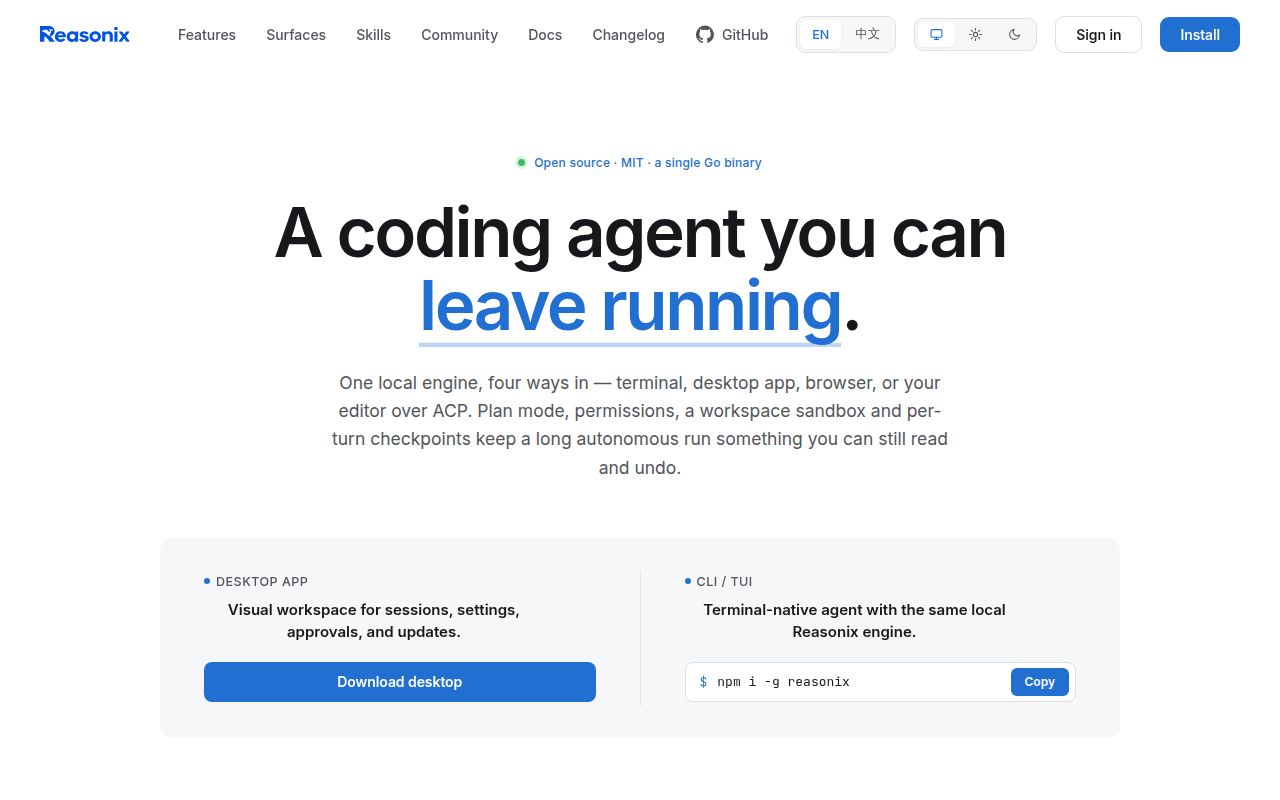
Reasonix runs the same local agent behind its terminal interface, desktop app, browser UI, and ACP editor connection. That matters if you start a task in a shell and later want the transcript and permissions in another client. The engine handles model providers, tools, sessions, plan mode, plugins, and workspace rules. DeepSeek is a preset rather than a hard dependency; the configuration guide also accepts custom OpenAI-compatible services.
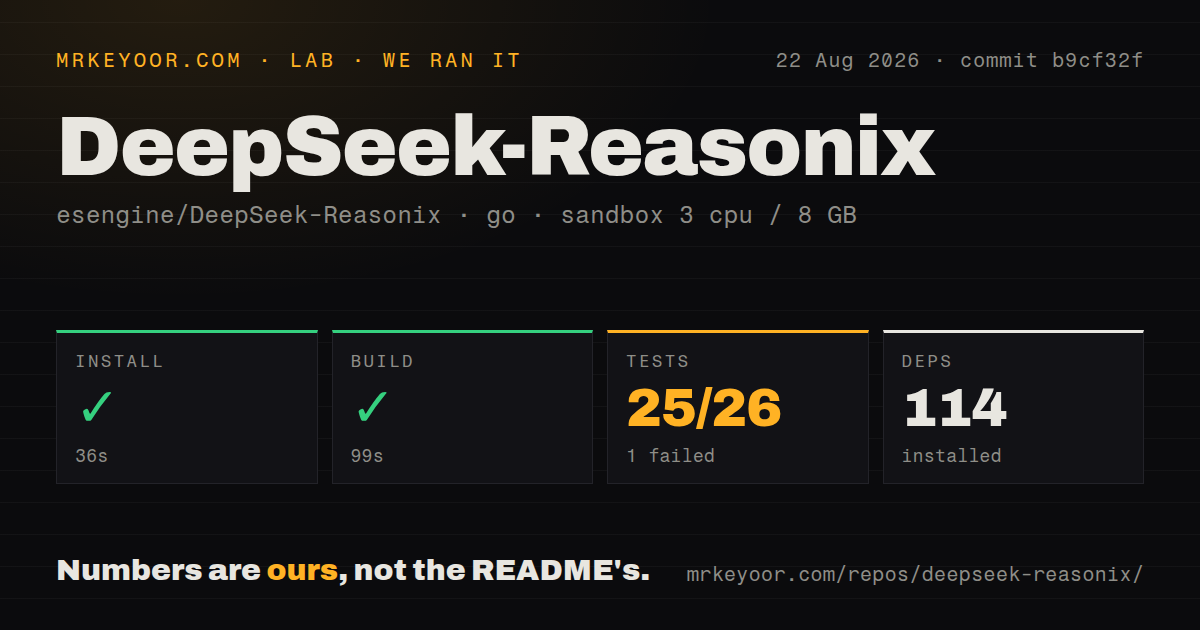
The project is much larger than the single-binary pitch suggests. At commit b9cf32f, our checkout held 5,184 files, about 982,936 lines of source, and occupied 44.1 MB. That includes the Go engine, desktop work, documentation, release tooling, and 25 CI workflow files. The breadth is useful, but it means a contributor is entering an active product with several clients, not a compact terminal utility.
Permissions reduce risk, while Bash stays outside rewind
The configuration model is unusually explicit. Rules can allow, deny, or ask before command patterns run. File writers can be confined to a workspace, extra write paths can be named, and sensitive paths can be blocked from reads. The browser server defaults to no authentication, and the guide tells operators to enable token or password mode before binding beyond localhost. That warning should be treated as an operating requirement.
Checkpoints capture the first pre-edit state of each file touched in a user turn and retain up to 100 turn directories by default. Rewind can restore code, conversation, or both without changing Git history. The boundary is important: Bash side effects are excluded, moves are not represented in previews, and each captured file has a 32 MiB limit. A command that deletes data or changes a database remains your responsibility.
ACP and plugins make it more than a terminal client
Reasonix implements ACP v1 over standard input and output. An ACP host can create, load, resume, close, and delete sessions while receiving streamed messages, tool activity, plans, permission requests, and configuration changes. When the editor exposes file or terminal capabilities, Reasonix can work against unsaved buffers instead of an older copy on disk. The VS Code extension uses this route, but it does not bundle the engine.
Plugin packages can combine skills, hooks, MCP servers, prompts, themes, and code extensions. Installation supports Git repositories and local directories, with a dry-run option before anything is copied. That is a sensible trust step because a plugin can add executable behavior. Reasonix also understands .codex-plugin/plugin.json and .claude-plugin/plugin.json, which lowers the cost of testing packages built for another agent.
What happened when we ran it
Our fresh Debian sandbox installed 114 packages in 36 seconds and completed the build in 99 seconds. This was an unprivileged container with 3 CPUs, 8 GB of RAM, no secrets, and the repository fixed at commit b9cf32f. Those results support the README's claim that the Go engine can be built without a sprawling runtime service stack.
Tests were the weak point. The Go suite ran for 749 seconds and returned exit code 1, with 25 packages passing and 1 failing out of 26. The log tail lists successful packages such as internal/tool, internal/trajectory, and tools/repolint, then ends with a bare FAIL. It does not show the failed package or an error message, so the only defensible finding is that this checkout did not produce a clean suite in our sandbox.
Source builds demand newer tools than the binary install
Users taking a release binary can install from npm or Homebrew, then run setup and select a provider. Building the CLI from source requires Go 1.25 or newer. The module can fetch its pinned toolchain when GOTOOLCHAIN=auto is left in place, which adds a network dependency to a machine without that version. Desktop contributors also need Node 24 or newer, pnpm 10, Wails, and the appropriate platform webview packages.
Provider credentials are separate from project environment files. The guide stores provider secret values in the Reasonix home .env, while reasonix.toml names the environment variable and endpoint. This separation limits accidental project-level fallback behavior, but it can surprise someone expecting their repository .env to supply the model key. MCP settings may still expand workspace-scoped variables.
Release speed is high, and desktop scrolling still draws reports
GitHub recorded a push on 2026-08-26, one day after desktop v1.31.4 was published. The repository reported 1,593 open issues and pull requests, so that number should be read as activity and backlog together. The latest release addressed damaged session metadata, background task notices, model-service deletion, scrolling, and database read cost. This is active maintenance by any reasonable reading.
The caution is that several current Windows reports still describe transcript jumping, flicker, or forced scrolling. Issue 9365 says scrolling upward after an answer returns the view to the bottom, while issue 9391 reports content moving when the chat text is clicked. A busy release train can fix problems quickly, but it can also change behavior quickly. Pin the exact version you qualify, especially for unattended work.
Choose it for cross-client continuity, not brand loyalty
Reasonix earns a trial when one local agent must span terminal, desktop, web, and an ACP editor while keeping permissions visible. Its two-model option, plugin packaging, and checkpoint picker go beyond a basic chat wrapper. The best audience is an engineer willing to read configuration and test the chosen model, plugins, and release against a disposable repository first.
If you mainly want a Git-first terminal conversation, Aider is easier to reason about. Codex CLI or Claude Code makes more sense for teams already committed to those providers, while OpenCode is the closest broad-provider comparison. Reasonix's distinct advantage is the shared engine and its explicit recovery model. The failed 26-package run and current desktop reports are enough reason to pilot it before using it on valuable work.