Short answer: use the archived matcher only if you can own the repairs
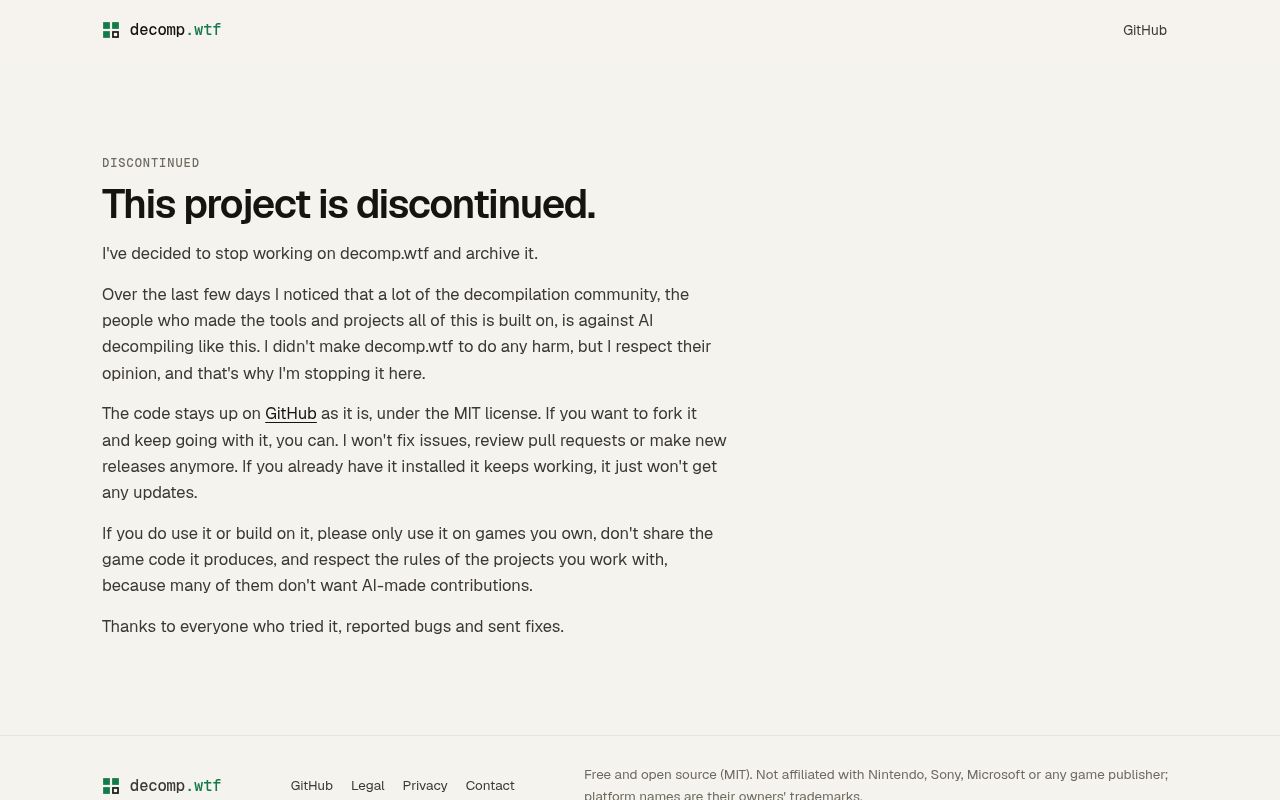
decomp.wtf is discontinued, and the author says version 0.10.6 will receive no further fixes or releases. Use it if you understand console decompilation and want to inspect or extend its function-by-function matching workflow. Skip it if you need supported software, an Android importer, or a dependable route from a disc image to a finished PC game. The final README makes the maintenance boundary unusually clear: installed copies remain usable, while future maintenance belongs to whoever forks the code. Discontinuation notice
Our sandbox installed the source successfully in 16 seconds and built it in 1 second, but the test command failed. A separate service run reached health, then our task harness stopped because it lacked a runnable adapter. That leaves a narrower recommendation than the animated website suggests: this is worth studying as a matching workbench, with substantial responsibility for the person running it.
What people use decomp.wtf for
The strongest reported outcomes are individual function matches and importer workarounds, with results varying by target. The following accounts distinguish the author's demonstrations from users trying their own games. A successful import gives an agent a project to work on. It says nothing by itself about how much original source that agent will recover.
| Who used it | Task | Reported outcome |
|---|---|---|
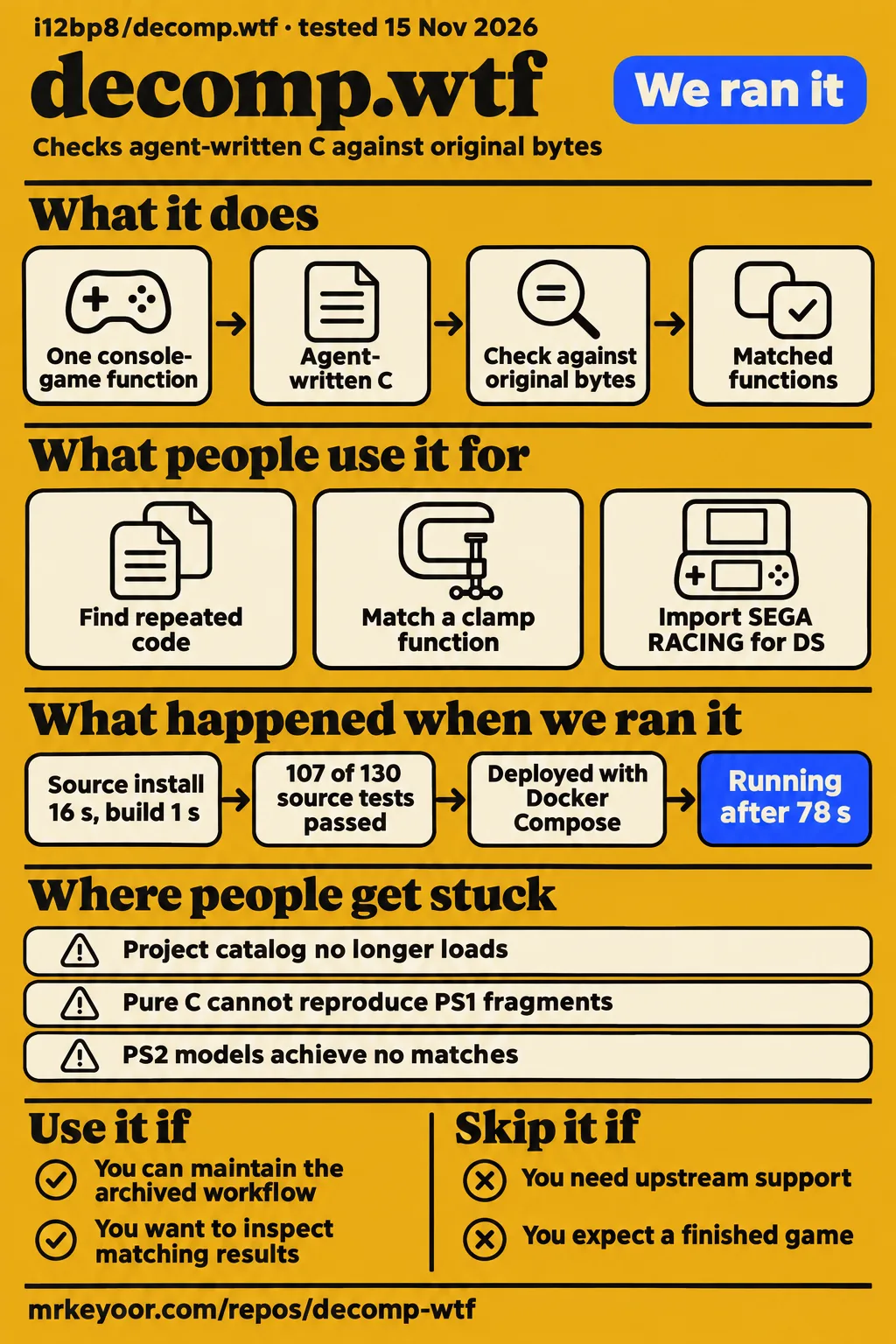
| Project author | Find repeated code in Mario Party 6 before agents spend tokens | The author reports 762 functions matched in 12 minutes and 678 copies of handwritten assembly set aside. This is an author benchmark. README run |
| Project author | Match a clamp function in the bundled N64 example | The README shows C that compiles to the original bytes with KMC GCC 2.7.2 at -O2. The landing page says its agent activity and timing are simulated. Code example, simulation disclosure |
| RaySollium99 | Import the US and EU versions of SEGA RACING for DS | Analysis stopped at calls without identified functions. After the author supplied the 0.10.1 workaround, the user confirmed success. Issue #17 |
| Tgo1014 | Recover PS1 functions containing handwritten assembly and fallthrough fragments | The author changed 0.10.6 to exclude these from agent assignments. Exclusion prevents repeated futile attempts; it does not recover the fragments as C. Issue #22 |
| ensapra | Run models on the PS2 project slus-20565 | The user reported no matches, tool-call errors and a missing EE-GCC toolchain. The author declined further fixes after discontinuation. Issue #25 |
| pizzapista | Import Sonic Adventure DX from RVZ through WSL | The author described a 0.10.5 workaround that leaves out unreadable modules and their dependants, allowing partial import. Issue #20 |
RaySollium99's thread is the most useful success story for someone stuck during import. The error named a call that led to no function. The author explained the retry option, explicitly said they lacked the game to test, and asked for another log. The reporting user then returned to say it worked. That exchange supports the particular workaround far better than a general promise that DS games work.
What happened when we ran it
Our November 15, 2026 service run deployed commit 575b4a30ed48 with its own Docker Compose configuration, with every port bound to 127.0.0.1. Deployment took 78 seconds. These service observations are separate from the source-install and test harness below.
| Service step | Recorded result | What it means |
|---|---|---|
| Deploy | OK in 78 seconds | The deployment step completed. |
| Connect Ollama | OK | The connection step completed. |
| Model pull | The recorded output shows SHA256 digest verification and a 4.7 GB layer at 100% | The extract repeats progress and reports 0s; it is unsuitable as a download-duration benchmark. |
| Health check | OK in 0.1 seconds | A health check passed. |
| Task recipe | FAILED: no runnable adapter yet for recipe generic | Our task harness could not execute its recipe. |
| Idle memory | decomp-wtf 97 MiB, total 97 MiB | This is the recorded application footprint. |
| Later memory sample | decomp-wtf 97 MiB, total 97 MiB | The record labels this “after the questions,” although the recipe failed. |
| Teardown | OK | The teardown step completed. |
The failed recipe matters more than the healthy endpoint. The harness reached the stage where it should drive a task, then reported that its generic recipe had no runnable adapter. That is a limitation of this lab workflow. It supplies no game, candidate C function, compiler comparison or accepted match to judge. Calling the run a successful decompilation would turn service readiness into a result the record never contains.
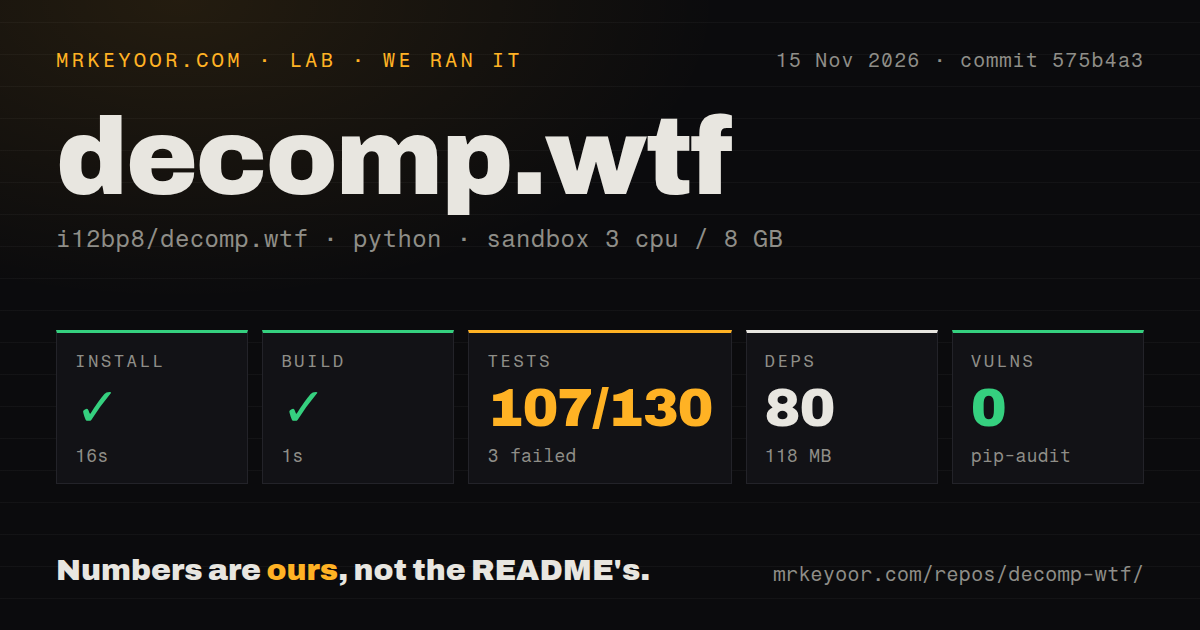
The source harness used commit 575b4a3 on November 15, 2026, with 3 CPUs, 8 GB RAM and image label ghcr.io/astral-sh/uv:python3.12-bookworm. The label records the chosen image; actual runtime and operating-system versions require the raw toolchain logs.
| Source-harness step | Measured result |
|---|---|
| Install | Succeeded in 16 seconds; 80 dependencies recorded, 118 MB on disk |
| Build | Succeeded in 1 second |
| Tests | Failed with exit 1 in 21 seconds; pytest reported 107 passed, 3 failed, 139 skipped and 20 collection/setup errors |
| Dependency audit | pip-audit reported 0 known vulnerabilities |
| Repository scan | Python; 273 files, approximately 42,016 source lines, 8.3 MB checked out |
| Automation and packaging signals | 0 CI workflow files detected, no Dockerfile detected, a Compose file and tests directory present |
The failing tail contains GCC subprocess errors in network and phase23 tests. It also names test_the_api_agent_stays_within_a_small_local_context, which failed with TypeError: 'NoneType' object is not subscriptable. The other named failures concern expired claims and hash-only project storage. The excerpt ends with pytest's own 17.56-second summary; the harness records 21 seconds for the test step. Those are different observations, so the table preserves the harness duration.
The supplied parser adds “of 130” to its error summary, but that denominator does not reconcile with the displayed outcomes. We use the explicit pass, fail, skip and error counts without calculating a pass rate. The truncated GCC calls give no compiler diagnostic explaining why compilation failed. Installing a guessed package would be a diagnosis unsupported by this log. Likewise, the scan's failure to detect a Dockerfile does not outweigh the separate recorded Compose deployment.
Where people get stuck: the version and the target change the answer
Versions 0.10.1, 0.10.3, 0.10.5 and 0.10.6 addressed different failure modes; a closed issue can still describe unfinished work. Start with the version in the error panel and the exact import or compiler message. The table separates a confirmed user retest from an author's reported change and from an abandoned bug.
| Symptom and reporter | Change or next check | Status in the record |
|---|---|---|
| RaySollium99: SEGA RACING DS analysis leads to no function | 0.10.1 retries ds-decomp analysis with --allow-unknown-function-calls | Workaround confirmed by the reporting user. #17 |
| Shadow of the Colossus import: duplicate symbols after reimport | The author says 0.10.3 removes symbols with their project and clears older orphaned symbols | Database fix reported; separate ARM restriction remains. #18 |
| pizzapista: Sonic Adventure DX cannot locate module 1 | The author says 0.10.5 excludes compressed modules and all modules depending on missing ones together | Partial-import workaround; the extract contains no user retest. #20 |
| Project catalog no longer loads | 0.10.5 stops fetching decomp.dev; paste a repository URL instead | Retired directory replaced by direct repository entry; old cached lists remain dated. #21 |
| Tgo1014: pure C cannot reproduce PS1 fragments | 0.10.6 sets qualifying handwritten MIPS assembly aside when agents start | Assignment fix, with the excluded code still unrecovered as C. #22 |
| ensapra: PS2 models achieve no matches | Inspect the recorded malformed function arguments and missing EE-GCC toolchain | No resolution supplied; author declines fixes. #25 |
| opencode exits with code 1 despite an added key | fatalis suggests checking provider-console logs for rejected inference | Suggested diagnostic only, with no confirmed cause or retest. #3 |
The Sonic Adventure DX report is particularly easy to misread. Its title blames an RVZ file, and the user wonders about Windows. The author's explanation instead identifies SaCompGC-compressed REL modules and event modules importing from missing module 1. Leaving those modules out together makes the supported portion importable. It does not decode the compressed content, and the author says the same failure happens on Linux. Replacing Windows would miss the documented cause.
A green function does not mean the whole game is recovered
The README distinguishes a matched function from a linked file: linking also requires the file's data to match and the game checksum to pass. That is the useful distinction behind the live map. Read a progress claim alongside what it counts, which code was already present and which functions or modules were excluded. Matching and linking
The Mario Party 6 result counts repeated functions matched from existing twins, alongside assembly set aside. The PS1 workaround removes impossible C assignments. The Sonic Adventure DX workaround removes unreadable modules and their dependants. Each can improve the working queue without recovering all of the original program. Ask for matched functions, linked files and excluded code separately before treating a percentage as a preservation milestone.
In the video “Why decomp.dev is Shutting Down,” the creator discusses the project directory's closure. It is commentary about the decompilation community, rather than a recorded matching result for this tool. That distinction matters when game-port videos appear beside decomp.wtf search results: a creator discussing or showing a port is not evidence that this matcher produced it. Shutdown video
Local execution still needs an agent and trusted project builds
The README says agents receive decomp.wtf tools without shell access, while continuing a public decomp runs that project's build scripts on your computer. Those are different permission boundaries. Review the installer and choose projects you trust before letting a local agent work through them. The final README also asks users to respect projects that reject AI contributions and says changes stay on a local branch until a person submits them. Permissions and contribution guidance
The code is MIT licensed, but that license does not grant rights to the games you feed it. The author asks users to bring games they own, avoid distributing generated game code and review each community project's contribution rules. Starting with the bundled Demo Quest 64 avoids making a commercial game's import the first thing you need to diagnose. The README describes the demo as public-domain code plus zlib.
Our pip-audit result covers known dependency advisories in the recorded environment. It does not audit installer behavior, agent permissions or arbitrary project builds. A local application can also use a remote model provider. Pick the model connection with its actual data handling in mind rather than treating the word “local” as a privacy guarantee for every agent configuration.
decomp.wtf vs decomp.anything, decompdecomp and a general agent
The forks offer continued development or broader scope according to their maintainers; the original offers a frozen upstream reference. Choose between them by the target you need to process and the repair work you can own. No star-count comparison settles whether a particular compiler, importer and model combination will produce matches.
| Choice | Evidence-backed distinction | Pick it when |
|---|---|---|
| decomp.wtf | Final 0.10.6 remains available under MIT after upstream discontinuation | You want to inspect or reproduce the original workflow and can maintain it yourself. Final README |
| giveen/decomp.anything | Its README describes matching Windows and Linux binaries | You need the fork's documented broader inspection scope and are prepared to evaluate those claims on your own target. Fork README |
| n-delic/decompdecomp | naxx99's Reddit announcement reports rebuilding console support and trying DS decompilation with free agents | You want to help test a console-focused continuation. Maintainer announcement |
| General coding agent | Upstream describes decomp.wtf as the splitter, original compiler, byte-comparison judge and agent coordination around an agent | You already maintain those pieces yourself, or want direct control of an existing decomp project's workflow. Official comparison |
The decompdecomp thread includes Slight-Plant-213 saying they are waiting for reviews before trying it. That is interest, not a successful deployment. Similarly, decomp.anything's larger target list is its maintainer's description. Neither record supplies a controlled matching comparison against upstream, so choosing a fork should begin with one target whose output you can inspect rather than an assumption that continued commits guarantee better results.
SkillsLLM also compares decomp.wtf with hermes-agent using popularity and skill metadata. That comparison supplies no game-matching experiment. Hermes is therefore not presented here as a substitute for period compilers and binary comparison. SkillsLLM comparison
What the other reviews get wrong
The final installer explicitly excludes macOS, contradicting platform advice in Allves Games and Domain Arrivals. Allves Games says Windows, Linux and macOS work; Domain Arrivals describes macOS/Linux installation commands. For the final release, use the upstream Linux and Windows instructions instead. Allves Games, Domain Arrivals, final installer
SkillsLLM's comparison says neither project includes a SKILL.md file, yet its own decomp.wtf scan names plugins/decomp-wtf/skills/decompile/SKILL.md. The README also documents the Claude Code decompile skill. The scan and the comparison contradict each other. Comparison, scan
The landing page's invitation to browse 245 projects is stale: issue #21 says decomp.dev retired its directory and 0.10.5 stopped requesting it. The retained README update instructions need the same chronological reading. Automatic-update machinery cannot supply releases the author has explicitly said they will no longer make. Use repository URLs for discovery and read the discontinuation notice before the older feature list.
AI Release describes roughly 90 minutes for a first run on a small C target. That duration is not our measurement or a general completion promise. ensapra's zero-match run and the author's warning about large functions are reasons to reject a universal deadline. The original description specifies a small target; broadening it into a guaranteed completed game adds a claim the evidence cannot carry. AI Release guide, reported PS2 run
BareStack's November X post places provider refusals and an account ban beside decomp.wtf's shutdown. The author's discontinuation notice gives community opposition as the reason for stopping. Those records support separate events, not a causal claim that a model provider shut this project down. BareStack post, author's explanation
Questions people ask
decomp.wtf has public MIT-licensed source, but public source and a clean dependency audit do not certify a safe installer. The useful answers depend on whether you are choosing a host, connecting a model or diagnosing a particular game.
Is decomp.wtf legitimate and safe to install?
It is a publicly inspectable, discontinued MIT project. A Reddit user asked whether it was legitimate, but the supplied thread has no comments answering them. Read the source and installer rather than treating that unanswered post as either a scam finding or an endorsement. Our dependency audit result is narrower than a security audit of the application. README, Reddit question
How do I install decomp.wtf and connect my existing agent?
The README provides a Linux shell installer and a Windows PowerShell installer, followed by decomp connect for an existing agent. It also documents decomp mcp and the Claude Code plugin. Inspect the script first, follow the instructions for your host, and sign in through your chosen agent or configure the API provider you intend to use. The app's license does not include model-provider credits. Connection instructions
Does decomp.wtf run on Windows, Linux, macOS or ARM hardware?
The supported path is a 64-bit Intel or AMD PC running Linux, or Windows through WSL 2; Windows is marked unstable and macOS is unsupported. In issue #18, the author explains that the PS2 EE-GCC compiler and assembler are x86 programs without ARM builds. A comment claims experimental success on ARM but supplies no implemented supported path. Platform instructions, ARM discussion
Why do opencode workers exit with code 1 even after I add a key?
Issue #3 contains no confirmed diagnosis. A commenter named fatalis suggests checking opencode's provider-console logs for inference rejection on free models. Treat that as a place to look for evidence, rather than assuming every code-1 exit means a bad key or insufficient credit. The thread supplies no successful retest. opencode report
Why does SEGA RACING for DS fail during game analysis?
The reported 0.10.0 analysis stopped at calls to code without identified functions. The author says 0.10.1 retries using ds-decomp's --allow-unknown-function-calls option, and RaySollium99 confirmed it worked. This is a specific importer workaround for the reported error, not evidence that every subsequent function matched. SEGA RACING report
Is Sonic Adventure DX failing because I used an RVZ file or Windows?
The author attributes the reported failure to compressed REL modules and dependent event modules, and explicitly says Windows is not the cause. Version 0.10.5 leaves the missing modules and their dependants out together. That makes the result a partial import of readable content, rather than recovery of everything inside the game. Sonic Adventure DX report
What can I do when a PS1 function cannot be compiled from pure C?
Version 0.10.6 excludes qualifying handwritten MIPS assembly from assignments when agents start. In Tgo1014's report, the examples include a fallthrough fragment and PS1 GTE instructions that ordinary C cannot emit. Setting them aside saves attempts; the issue's resolution concerns assignment behavior rather than C recovery. PS1 report
Why have my models run without achieving a single match?
ensapra's PS2 report shows malformed tool arguments alongside a missing EE-GCC toolchain, and the author declined to fix the report after discontinuation. Preserve the compiler and tool-call logs before concluding that model strength is the sole problem. That thread documents several obstacles in one run without proving a universal cause for zero matches. No-progress report
Why does decomp.wtf fill more than 200K context so quickly?
Issue #5 reports rapid context consumption on a PSX project, and the author acknowledges efficiency work. Later README guidance describes compact context and recommends at least 16K context for local models. That configuration advice and the earlier reported consumption concern different observations; the record contains no controlled before-and-after result for the reported game. Context report, local-model guidance
Can decomp.wtf support Android APKs, Unity IL2CPP and standalone Meta Quest games?
The requested Android and Quest workflows were declined as outside the project's scope. Issue #7 describes a proposed APK and IL2CPP reconstruction workflow, not a delivered feature, and issue #14 explicitly says Android is not planned. Do not read their closed status as implementation. Quest request, Android request
Why use decomp.wtf instead of asking a general AI agent to decompile a game?
The official FAQ positions it as the compiler, splitting, byte-comparison and coordination layer around an agent. You still supply the model and the game. The value is having an attempted function judged against its target bytes, with feedback sent back into the agent's loop. That is the author's workflow comparison, not an independently measured speed advantage. Official FAQ
Does decomp.wtf recover C, C++, or both?
The documentation supports C++ for GameCube, Wii and DS, including C++ drafts and .cpp files for code with C++ symbol names. N64, PlayStation, PS2 and GBA functions started from scratch use C in the documented final workflow. Public decompilation projects use their own language. The retained promise of future C++ expansion must be read under the discontinuation notice. Language support
What we have not tested yet
Our service run stopped before a runnable game-decompilation task, so it establishes no accepted match, whole-game recovery rate or model-quality result. The pack contains no question-and-answer exercise or screenshots for this run. We have not tested the desktop installers, Windows WSL path, ARM experiments, proprietary toolchain downloads, a commercial game's rebuilt checksum or a playable PC port. The actual sandbox runtime versions require complete toolchain logs.
The supplied records also leave several comparisons unresolved: installer and agent-permission security, provider request contents and retention, sustained memory under compilation, cost per recovered function, and independent reliability of either continuation fork. The later 97 MiB sample is not a compilation peak, and the model-pull output does not identify a defensible elapsed download time. Our failed recipe cannot answer those questions.
For reported progress, the missing evidence is a denominator that includes excluded assembly and unreadable modules, plus a breakdown of work inherited from community projects. Neither a green function nor a checksum-preserving partial project tells you how much new C this tool produced. If you take over this archived code, record one owned target, the exact compiler, the functions accepted and the code excluded. That is the result worth bringing back.