The free edition is a broad JDBC workbench
DBeaver Community puts schema browsing, SQL editing, data editing, execution plans, diagrams, transfers, dashboards, and connection tools in one desktop application. Its README lists more than 100 database drivers and says any database with a JDBC or ODBC driver can be connected, though the Community and commercial connector lists differ. This breadth is the reason to choose it: one interface can follow a developer across PostgreSQL, MySQL, SQLite, Oracle, SQL Server, and less common systems without learning a new client each time.
The boundary around free features deserves a careful read. Community covers a long list of JDBC databases, while the README assigns non-JDBC sources such as MongoDB, Cassandra, Redis, DynamoDB, and several cloud services to commercial editions. ODBC is also listed under the paid products. A team choosing DBeaver because it appears universal should check its exact data sources before standardizing on the free build. The Apache 2.0 repository does not mean every connector named on the product page ships in Community.
More than 130 plugins explain the project's weight
This is an Eclipse RCP and OSGi application, not a small Swing client with a few drivers. The Community version consists of more than 130 plugins, with model plugins separated from desktop UI plugins so some backend pieces can also be used by CloudBeaver. SQL parsing uses JSQLParser and Antlr4, while networking, spreadsheets, charts, geometry, and expression support bring additional libraries. Native OS components handle parts of the interface, networking, and database-driver work. That design buys reach, but contributors inherit an ecosystem with its own packaging habits.
Our checkout made that scale visible: 9,902 files, about 932,096 lines of source, and 50.1 MB checked out. Those numbers do not measure application speed or quality. They do explain why understanding a change may require following plugin boundaries, Eclipse services, platform fragments, and P2 dependencies rather than editing one Maven module. Teams considering a private fork should budget for specialist Java desktop knowledge and release work across operating systems.
What happened when we ran it
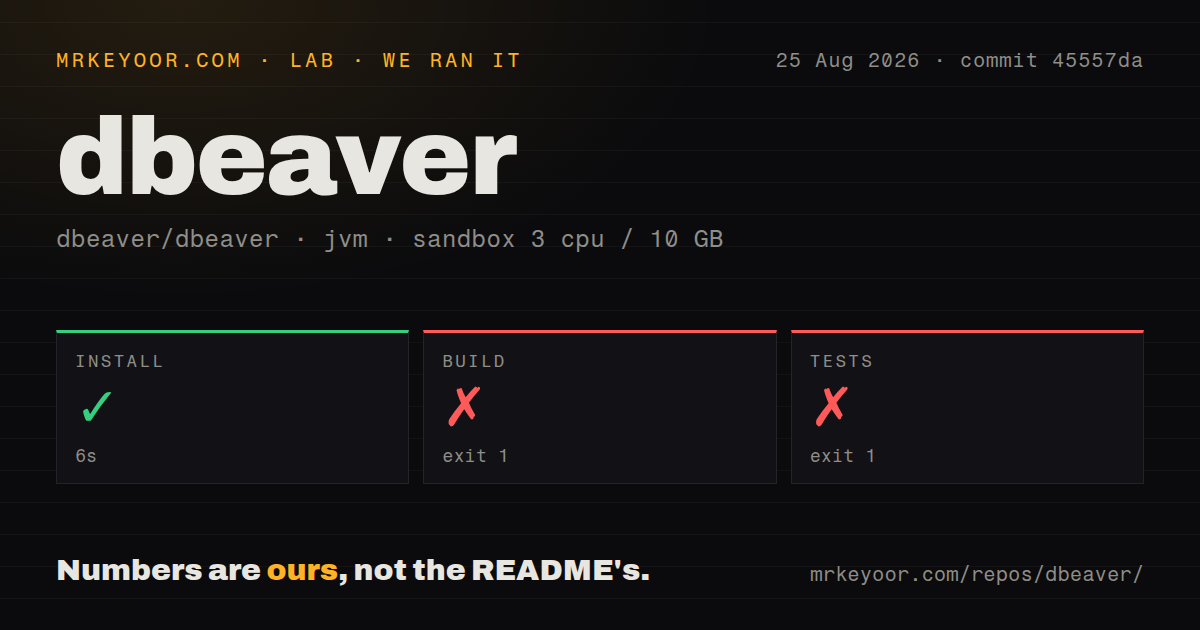
Our commit 45557da run installed in 6 seconds inside an unprivileged Java 21 container with 3 CPUs and 10 GB of RAM. The build failed with exit code 1 after 4 seconds. Maven reported that com.dbeaver.common:com.dbeaver.common.main:2.8.0-SNAPSHOT, the project's parent POM, was absent and could not be resolved. That message is all the log establishes; we did not reach Java compilation.
The test command failed with exit code 1 after 3 seconds for the same unresolved parent POM. Maven never got far enough to run tests, so this result says nothing about test pass rates. The repository did contain a tests directory and 2 CI workflow files, but no Dockerfile. A fresh Debian container plus a standard Maven path was therefore insufficient to reproduce the source build at that commit. The separate build-from-source guide and dependency repository are required reading before another attempt.
Prebuilt releases avoid the source-build problem
For ordinary users, the repository directs people to installers or archives and says OpenJDK 25 is bundled with every distribution. That route removes the need to assemble the Eclipse, OSGi, and P2 build environment. Running the application is only the first layer, though. Each connection still needs a reachable database, suitable credentials, and the correct driver. Proxy and SSH tunnelling have more settings, while AI features need a configured provider such as OpenAI or Copilot in Community.
Release 26.1.5 was published on August 16, 2026. Its notes include fixes across data editing, transfers, Linux authentication, navigation, and several database drivers, plus a GreptimeDB driver entry. The repository was pushed again on August 26, and GitHub reported 3,354 open issues and pull requests. That combination points to active maintenance and a very large support surface. The queue should set expectations: a client covering this many databases will always carry vendor-specific defects and requests.
CloudBeaver is the better answer for shared browser access
DBeaver itself is built around a local desktop. A developer who wants saved connections, a mature SQL editor, data transfer, and visual inspection on their own machine gets the intended experience. A platform team trying to give many users centrally managed browser access is solving a different problem. The README explicitly names CloudBeaver as the related server product with a web interface. Choosing between them early avoids turning desktop packaging into an improvised collaboration system.
The practical recommendation is simple. Install the released Community application first and confirm that its edition supports every required database. Buy a commercial edition only after mapping the paid connectors or support features to a real need. Clone this repository when you intend to contribute to a large Eclipse application and are willing to follow its dedicated build documentation. Our 4-second Maven failure makes a plain source checkout a poor trial path, while the packaged application is the path DBeaver presents to regular users.