DataEase makes self-hosted BI approachable, especially in Chinese
DataEase is a full business intelligence application for turning operational data into shareable charts and dashboards. Its pitch is accessibility: point-and-click analysis, drag-and-drop chart creation, sharing, and deployment across multiple platforms. It is a destination for analysts and business users, not a Java charting component. The project is Chinese-first, with English and other translated documentation available.
Its 24,403 GitHub stars accompany a suitably broad source list. Transactional connections include MySQL, Oracle, SQL Server, PostgreSQL, MariaDB, Db2, TiDB, and MongoDB-BI. ClickHouse, Apache Doris, Apache Impala, StarRocks, and Amazon Redshift address analytical workloads. Excel, CSV, and API inputs cover everyday gaps, making DataEase plausible as a shared reporting layer rather than a dashboard tied to one database.
The visual workflow is the reason to choose it
The main attraction is putting common BI jobs in one interface. The README shows data sources, a workbench, dashboards, and a template center. AntV supplies charting, while Vue.js and Element underpin the frontend. For organizations whose analysts understand the questions but do not want to hand-code every query and visualization page, that workflow is DataEase's clearest value.
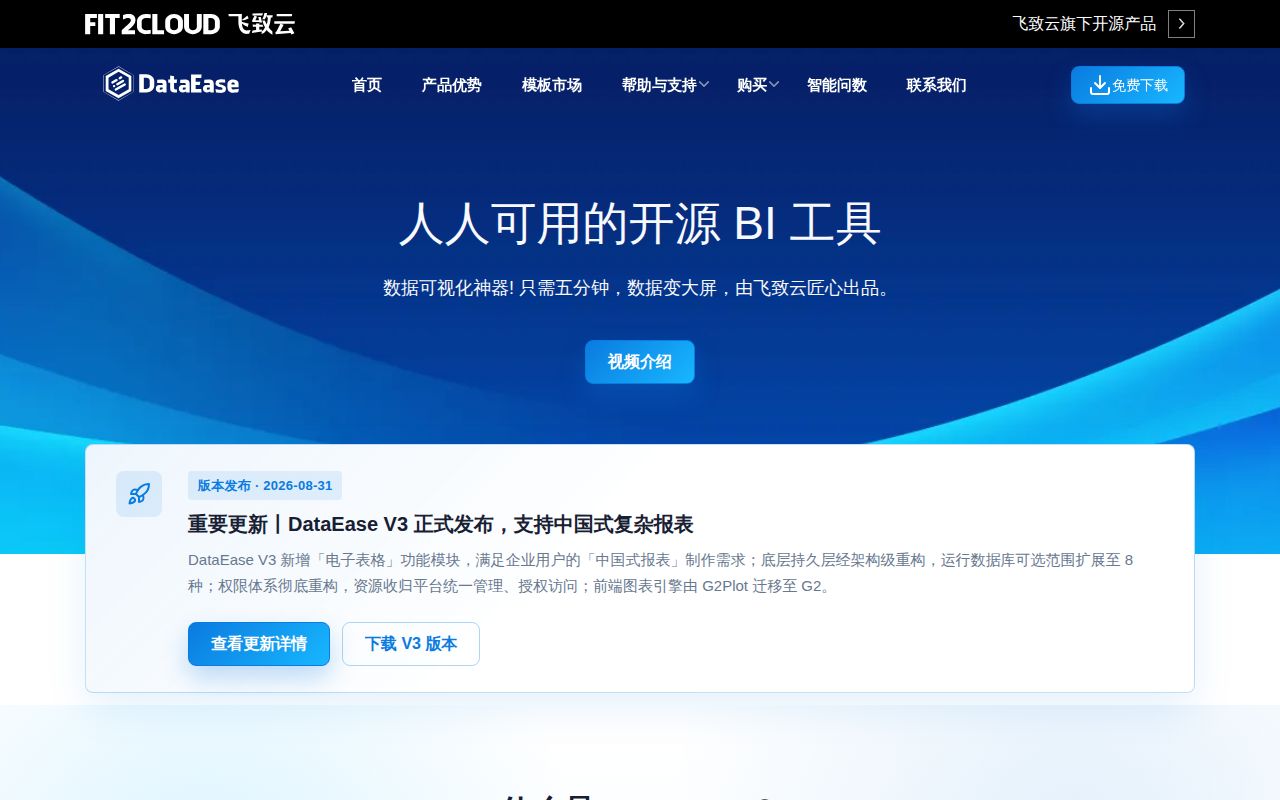
The backend uses familiar components: Spring Boot, MySQL, Apache Calcite, Apache SeaTunnel, and Docker are named. DataEase also advertises SQLBot integration for conversational questions over data. The current v3.0.0 release arrived on August 31, 2026, so teams should treat it as a fresh major version and verify connectors, permissions, and dashboard behavior against their own workloads.
Secure sharing and multiple embedding modes are stated strengths, but the truncated README does not provide enough detail to judge their controls. Buyers should verify authentication, tenant isolation, data restrictions, exports, and auditing in the full documentation. GPL-3.0 also matters: legal review is sensible for organizations planning to modify, redistribute, or tightly integrate the application.
What happened when we ran it
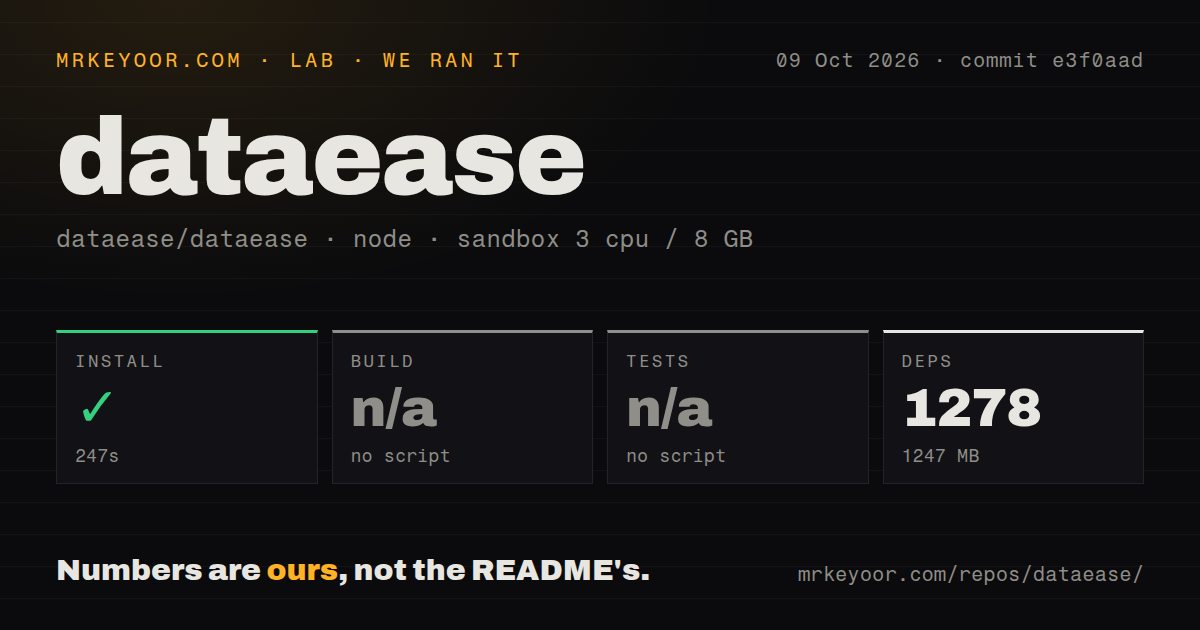
We cloned commit f195cf4 and examined ./core/core-frontend/ in an unprivileged Debian container with 3 CPUs and 8 GB of RAM. Installation succeeded in 226 seconds, bringing in 1,057 packages and consuming 942 MB. The checkout itself contained 6,396 files, about 313,766 source lines, and occupied 160 MB, so this is substantial software rather than a lightweight dashboard starter.
We did not obtain a build result. Our runner found no build script or target, so it skipped that stage rather than declaring success or failure. Tests were also skipped because there was no test script or target, and the scan found no tests directory. We found 4 CI workflow files, but our run exposed no contributor-facing local validation command.
The README's easiest path differs from our source run. It asks for a Linux server with at least 2 CPU cores and 4 GB of memory, then provides a root-run shell installer. An offline package is recommended for production. That may be smoother, but a remote script piped into a root shell warrants inspection and change control. The measured checkout contained no Dockerfile despite Docker appearing in the stated infrastructure.
Documentation is broad, but source contributors need a clearer path
The quick start is direct, and documentation links cover Simplified and Traditional Chinese, English, Japanese, Portuguese, Arabic, German, Spanish, French, Korean, Indonesian, and Turkish. A forum, WeChat group, introduction video, and 2026 presentation provide more entry points. Packaged-release operators have useful guidance, but frontend contributors face the rough edge we measured: no discoverable build or test target.
The listed default login is admin with DataEase@123456. A convenient installer still needs immediate credential rotation, network controls, TLS, backups, and tested upgrade recovery. The excerpt does not prove these are missing; it simply provides insufficient evidence to credit them. Production evaluators should verify each control instead of inferring it from the project's secure-sharing claim.
Activity looks healthy, with normal major-release caution
Development looks current. The latest push occurred on September 4, 2026, the day of this review, and v3.0.0 was published 4 days earlier. There are 47 open issues, a modest-looking count beside the project's adoption, although the number alone cannot reveal response quality. The README claims monthly iteration, while the fresh release and same-day push supply firmer evidence of active maintenance.
Version 3.0.0 is nevertheless a major boundary. Existing v2 users should study upgrade notes and rehearse migrations on copied data. One quick-start documentation URL still contains /docs/v2/, which may be intentional or transitional. Confirm the correct production installation and upgrade guide before rollout, particularly when dashboards, permissions, and connectors support important business decisions.
It fits as a reporting layer, not an observability default
DataEase belongs behind governed databases, warehouses, files, and APIs as a self-hosted analysis layer. It is most convincing for organizations that value Chinese-first materials, want business users to construct views visually, and can operate Spring Boot, MySQL, and Docker-era infrastructure. It is less suitable for teams seeking a tiny library, permissive licensing, or an immediately obvious source-validation workflow.
Choose Apache Superset for a Python-centered analytics ecosystem, Metabase for an English-first querying experience, or Grafana when operational telemetry is the main job. DataEase merits a pilot because its 24,403-star community, broad connector list, and current development show substance. Use packaged deployment, representative permissions, and actual data sources; source adopters should require a reproducible build and test path before production approval.