The Python example needs an exchange runtime beyond Python
Open the Python momentum tutorial and its source calls _C, Sleep, and an exchanges object that the file does not define. Those FMZ-style runtime dependencies matter more than the filename's Python label. You can read the trading rules, but a normal interpreter has no supplied definitions for those objects. The momentum example is a starting point for inspection and porting.
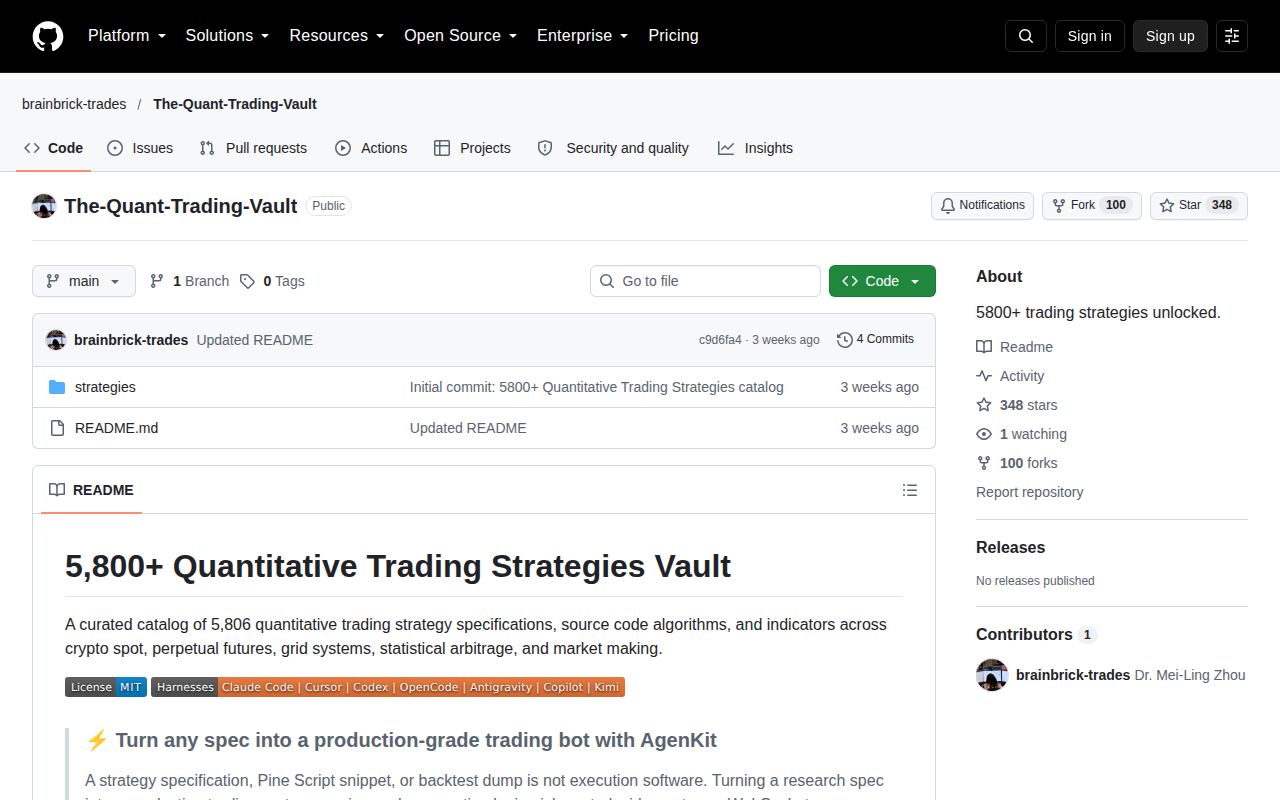
The README advertises 5,806 strategy specifications covering crypto spot, futures, grids, and market making. Its language table puts roughly 5,286 entries under Pine Script and 132 under Python. Those are the publisher's catalog figures, not our count of working programs. They also explain the collection's practical center: chart scripts and source references, with a smaller set of examples for other environments.
What happened when we ran it
Our lab did not run commit c9d6fa4 on October 15, 2026, because the harness detected no supported ecosystem, reported language as null, and found no Dockerfile. That result supplies no installation timing, successful build, test outcome, or dependency audit. It describes the limit of our sandbox's coverage, without establishing that every embedded example is unusable in its intended environment.
The README's source-language table does not contradict the language-null result. A Markdown file can contain a Python or Pine Script block without giving the repository a supported executable project. The harness did not turn these documents into a common runtime. Reading an individual file remains useful, but the next step is to identify its platform assumptions before deciding whether to port it or use its original environment.
The source links are more useful than the catalog's size
The strategy index groups entries by source language and links to FMZ pages. Individual files can preserve an author, parameter table, code block, and detail URL. The momentum tutorial retains a backtest configuration spanning 2019 to 2020 and a January 2020 modification date. That provenance lets you ask which exchange interface and market assumptions the example originally expected, rather than treating a recent repository push as a recent strategy revision.
A collection advertised as 5,806 entries needs that kind of filtering. The index includes indicators and exchange utilities alongside strategies, so a listing is not automatically a complete trading rule. Start with a file whose mechanism you can explain, then compare its description with the actual source. The useful outcome is a smaller set of research candidates with known assumptions, rather than a large pile of generated bots.
The market-making prompt names a model the source does not implement
The README presents its Dynamic Spread Market Making example under an Avellaneda-Stoikov build command. The linked source instead contains a Pine Script v5 example based on a simple moving average, a configured spread percentage, and a price offset. Its inventory counter restricts entries, but it does not feed an inventory-dependent reservation-price formula into those quote calculations.
That mismatch matters if you ask a coding assistant to preserve the file as mathematical ground truth. The generated system could reproduce the simple spread rule while carrying the name of another model. The example's own optimization section proposes adding volatility-based spread adjustment and more advanced inventory handling. Those suggestions describe further work. They are not implemented features established by the accompanying source.
The grid example gives conflicting starting-capital values
The adaptive grid file declares Pine Script v4 and sets initial capital to 100 in its strategy declaration. Later, the source assigns 50,000 to strategy.initial_capital. Its prose describes the smaller simulation value. That is a concrete inconsistency to resolve before interpreting any result. We did not compile the script, so this observation does not establish a particular compiler error.
The README itself labels published logic and backtests as unvalidated research dumps. Its AgenKit examples ask an external tool to supply execution machinery and risk controls. Those prompts do not prove the resulting system exists in this checkout. If you need an executable framework now, Freqtrade or LEAN offers a more relevant starting point. This archive's contribution is the source material you might evaluate inside such a framework.
The MIT link returns 404, and recent PRs concern documentation
The README claims MIT licensing, but the linked LICENSE file returns 404. The root contents response lists only README.md and the strategies directory, and GitHub reports no detected license. Outside authors and FMZ detail links appear in the sampled files. That leaves a reuse question the badge does not answer. We would ask the maintainer to supply the missing license and clarify the collected material's permissions before incorporating it into a distributed product.
The last push was September 27, 2026. GitHub listed 348 stars and 0 open issues and PRs combined on October 15, with no latest release. Recent PR history includes a spelling correction closed without merging on October 13. That shows some recent attention, without evidence of strategy validation or a maintained execution engine. Keep the original detail URL beside any candidate you select, and resolve its runtime and source inconsistencies before writing the port.